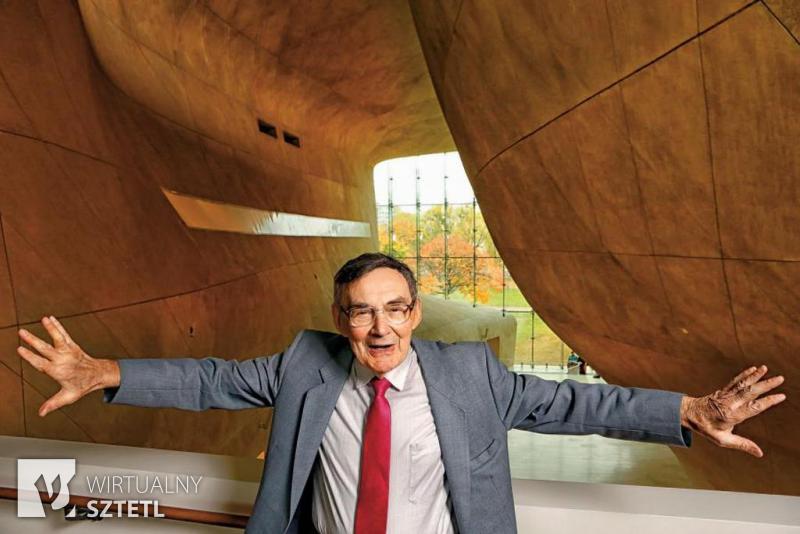
Marian Turski (26 June 1926, Porzecze - 18 February 2025 Warsaw) – historian, journalist, social activist, Holocaust Survivor, prisoner of Nazi German concentration camps in Auschwitz and Buchenwald.
Family, childhood, early youth in Łódź
He was born on 26 June 1926 in Porzecze, Grodno District (according to some documents, in Druskieniki)[1.1] as Moshe Turbowicz, son of Eliasz Turbowicz (4 September 1894, Kleck – 1944, KL Auschwitz) and Estera Rachela née Worobiejczyk (10 October 1901, Porzecze – 1988, Warsaw).
Eliasz Turbowicz came from a well-known family of rabbis from Kleck (his parents were Wolf Zeew Turbowicz – Talmud scholar and author of religious works,[1.2] and Basza Jenta née Lichterman). During World War I, he served in the in the 125th Kursk Infantry Regiment of the Russian Army. On 16 August 1916, he was injured in combat, sustaining serious wounds to the lungs. After the war, he was a member of a kvutza – a group of pioneers from Kleck preparing to leave for Palestine to set up the Degania Bet kibbutz. However, the lung disease he had developed due to his wartime experiences flared up right before Eliasz’s planned departure. Because of that, he remained in Łodź. Estera’s parents (Szmuel Worobiejczyk and Rebeka née Joz) ran a shop at 2 Jeziorska Street in Porzecze. It specialised in the sale of cotton goods.
Marian had a brother six years his junior – Wolf Turbowicz (3 July 1932 – 1944, KL Auschwitz).
He thus recalled his parents:
“My father was an educated man, very educated even – especially in matters relating to Jews, Jewish culture, Jewish heritage, Jewish history, and Jewish teachings. That is how he was brought up, and this he tried to pass on to me […]. My mother was fluent in French, Russian, and also Polish. And she was progressive. We didn’t speak Yiddish at all at home. Although my parents spoke Yiddish between themselves, they also spoke Polish. But this Yiddish was Lithuanian Yiddish.”[1.3]
Marian only learned Yiddish in the ghetto. He spent his childhood and adolescence in Łódź. The Turbowicz family lived at 11 Szkolna Street (now 11 Mielczarska Street). In the early 1930s, they moved to Sterlinga Street. Marian’s father was struggling with his health (his lungs permanently damaged after serving in the 125th Kursk Infantry Regiment during World War I), so the elder son had to contribute to the family budget. He made some money by tutoring his classmates. His mother worked as a clerk in the office of Pinkus Herszowski.
Marian graduated from the “Tarbut” Primary School at 11 Piotrkowska Street which had Hebrew as the language of instruction. He then enrolled in the Polish-Hebrew Secondary School run by the Society of Jewish Secondary Schools at 21 Magistracka Street (today’s A. Kamińskiego Street). He managed to graduate second grade prior to the outbreak of World War II. He continued his education in the ghetto. In 1941, he passed the so-called “small leaving exam” after attending secret classes.
Ghetto in Łódź, shaping of left-wing views, camps, and death marches
In 1940, following the establishment of the ghetto in Łódź, the Turbowicz family was resettled to the district and rented a room at 7 Kościelna Street. Marian’s father became the manager of a coal store in the ghetto, on Łagiewnicka Street. (He had been involved in coal trade prior to the war.) Marian once again started tutoring (teaching Hebrew, Latin, and Polish). He also worked in the so-called Fleischabteilung (meat smokehouse), cutting horse meat, and later in the Holzabteilung (“timber department”) in the district of Marysin, all of which allowed his family to avoid starvation.
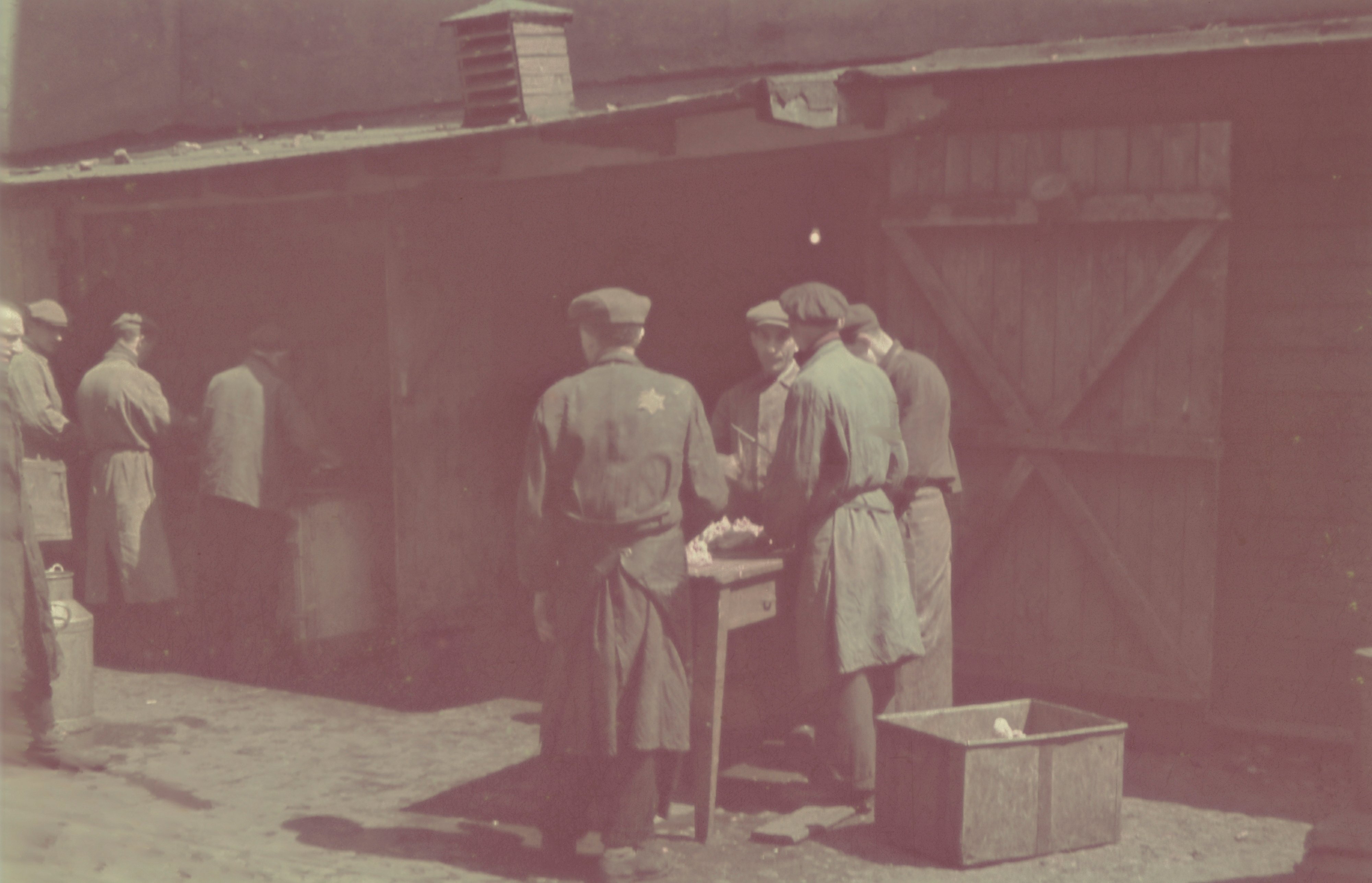
In 1942, Marian joined the ranks of the Left-Wing Anti-Fascist Organisation in the ghetto (Polish: Lewicowa Organizacja Antyfaszystowska; after the war, it was commonly known as the “Union Left” [Lewica Związkowa]), founded by former activists of the banned Communist Party of Poland. He was very active within its structures, for example organising sabotage operations in factories (the “Work Slowly” campaign), self-help (donating two tablespoons of soup and a piece of bread to the needy in the ghetto), and self-education (he hand-copied Lenin’s State and Revolution).
In 1944, Marian’s parents and brother were deported to the Nazi German camp in Auschwitz. Two weeks later, Marian was sent to the same site in one of the last transports from the ghetto. He joined it voluntarily along with other members of the Union Left shortly before the liquidation of the Jewish district. (The leaders of the organisation believed that they stood a better chance of survival in Auschwitz than during the liquidation of the ghetto.)
His father and brother perished in the gas chambers, most likely sent there immediately after arriving in the camp. His mother was sent to work in the Bergen Belsen camp in northern Germany. Marian, registered as prisoner no. B-9408, joined a labour commando performing roadworks on the premises of the Auschwitz-Birkenau complex. After a few weeks, he was transferred to the sub-camp in Czechowice, where he remained until January 1945.
He survived two death marches – the first from Auschwitz to Wodzisław Śląski, from where he was sent to the Nazi concentration camp in Buchenwald (in January 1945), and the second from Buchenwald to Terezin. He lived to see liberation, though he was on the brink of death due to exhaustion and contracting typhus.
In September 1945, he returned to Poland as self-proclaimed ideological socialist and staunch communist, having previously refused the opportunity to migrate West offered to him by the American-Jewish Aid Committee (the “Joint”). His dream was to live in Poland under a new system.[1.4]
At that time, he considered himself a revolutionary – “[…] today, I would call it a kind of proselytism, […] urging others to recognise the new Poland, the People’s Poland, the socialist, proletarian Poland, often against the will of those to whom I proselytised.”[1.1.4]
Post-war period, political involvement in communist Poland, "Sztandar Młodych" magazine
Initially, he settled in Lower Silesia. Already during his convalescence in the hospital in Fyrląd Wałbrzyski (now Mieroszów near Wałbrzych), he began galvanising young people, opening the first local cell of the Union of Youth Struggle (Polish: Związek Walki Młodych, ZWM).
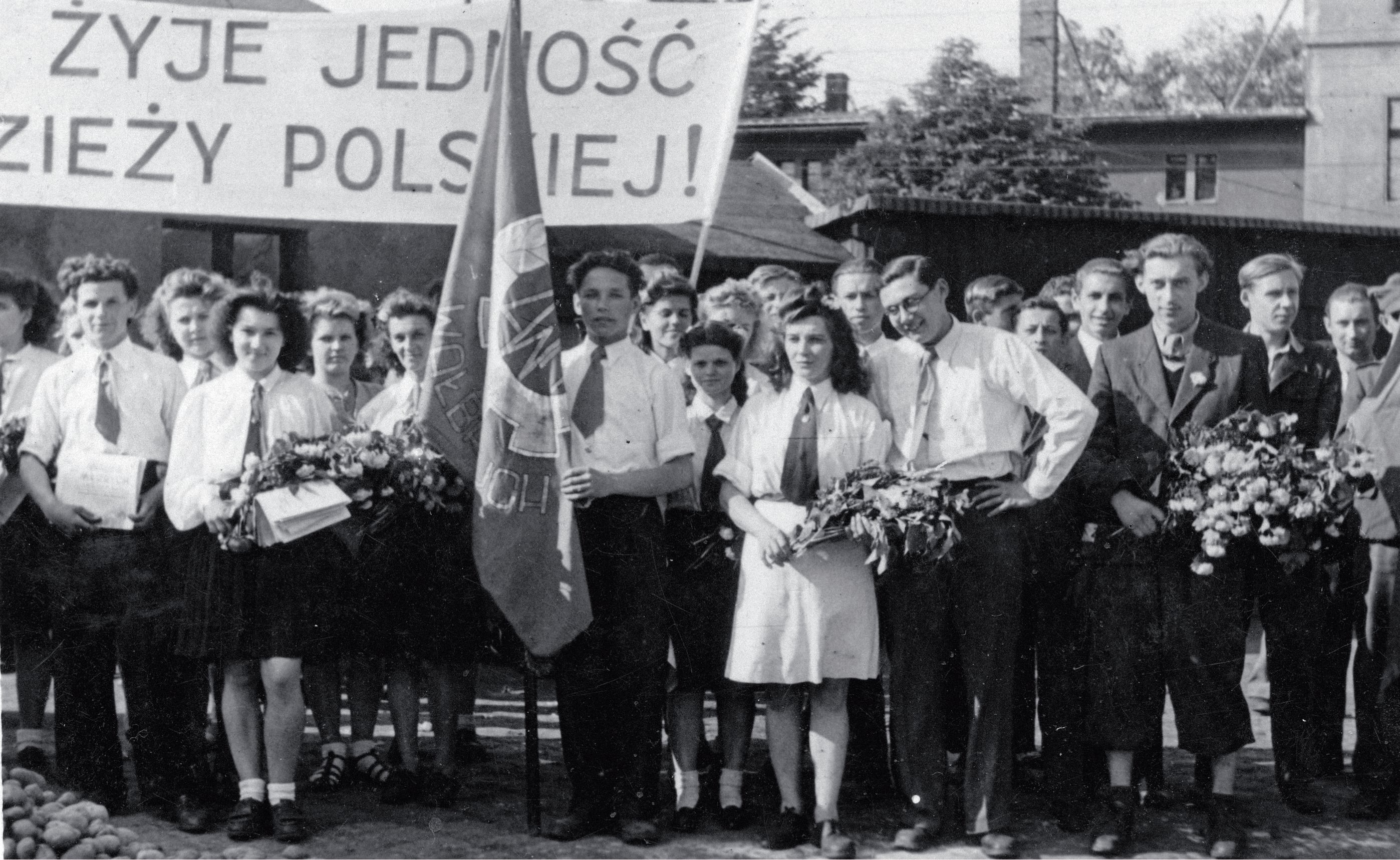
At the end of 1945, he joined the Polish Workers’ Party. The Personnel Department of the party’s Central Committee advised him to change his name to a non-Jewish sounding one – Marian Turski. “They urged me to change my name for security reasons when working in a ‘dangerous area.’”[1.1.4]
In 1946, he was transferred to Wałbrzych as chairman of the District Board of the ZWM.
During the People’s Referendum held in June 1946, Marian Turski was an election commissioner. Years later, he openly admitted that he was complicit in rigging the results. As he explained, “because it seemed to us that it was in the Polish national interest that there should be absolute unanimity as to the settlement of the ‘Recovered Territories.’ It was the way of thinking at the time – to get rid of the Germans as soon as possible.”[1.5] He also took part in the campaign of enforcing obligatory deliveries of agricultural products – so-called quotas – from farmers.
In October 1946, he began studying history at the University of Wrocław and took up journalism. In 1945, he became a correspondent for the Trybuna Dolnośląska and, from December 1948 to July 1949, he ran the “Budujemy” youth column in Gazeta Robotnicza – the press organ of the Provincial Committee of the Polish United Workers’ Party in Wrocław. In 1946–1949, he was an advisor in the Provincial Office of Control of the Press, Publications, and Performances in Wrocław.
In July 1948, he joined the District Board of the Academic Union of Polish Youth (Polish: Związek Akademicki Młodzieży Polskiej, ZAMP) and was appointed secretary of the Coordinating Committee of Polish Student Organisations in Wrocław. He was also a member of the thirty-person Polish delegation (chaired by Zofia Nałkowska) to the World Congress in Defence of Peace, which took place in Prague on 19 April 1949.
In 1949, he moved to Warsaw. From 15 October 1949 until 14 August 1951, he attended the full-time two-year course of the Party School of the Central Committee of the Polish United Workers’ Party (KC PZPR) in Warsaw. He concomitantly continued his studies in history at the College of Social Sciences, also operating under the auspices of the KC PZPR.
On 15 August 1951, he was assigned to work in the Office for the Press and Publishing of the KC PZPR as an instructor. In 1954, he became a senior instructor in the Department of Propaganda and Agitation (Publishing Section). In the years 1956–1957, he was a member of the Press Commission of the Central Committee. During the events of Polish October of 1956, he was removed from party structures and appointed deputy editor-in-chief of the Sztandar Młodych magazine. In the conflict between two informal factions competing for influence in the KC PZPR, Turski supported the “Puławianie” group.
On 31 December 1957, he was dismissed from the position of editor-in-chief of Sztandar Młodych. This was for several reasons. Turski opposed subordinating the magazine to the newly established Union of Socialist Youth, which replaced the ZMP. He also refused to publish an article condemning the editors of Po Prostu. In addition, he was accused of making “anti-Soviet comments” in the wake of the Soviet intervention in Hungary.[1.6] The Press Office of the KC PZPR claimed that “most of the editing staff [of Sztandar Młodych] displayed a reconciliatory attitude towards revisionism.”[1.7]
Together with other journalists of Sztandar Młodych (including Dariusz Fikus, Zygmunt Szeliga, Daniel Passent), he moved to the newly created founded Polityka weekly. (Its first issue was published in February 1957.) He was invited to join the magazine’s staff by his former colleague from the KC PZPR, Mieczysław Rakowski. In 1958, he became head of the “History” section.
Editor in "Polityka"
As head of the “History” section, Turski made recent history of Poland one of the leading issues discussed in Polityka. The results of the 1960 reader survey indicated that the articles devoted to modern Polish history were among the most popular.[1.8]
Daniel Passent, Turski’s editorial colleague, recalled[1.9]:
“He gathered great historians around himself – Juliusz Bardach, Janusz Tazbir, Stefan Kieniewicz, Tadeusz Manteuffel. It would be hard to find a historian who did not write for Polityka or who was not a judge for Polityka’s history award or its recipient.”
It was at Marian Turski’s initiative that Polityka (since July 1958) started to present annual awards for the best academic and popular books on the contemporary history of Poland.
Mieczysław Rakowski, former editor-in-chief of Polityka, thus recalled Marian Turski’s early days as a journalist and member of the weekly’s staff in his memoir Dzienniki polityczne of 1958–1962:
“A team of very ambitious journalists is slowly being formed. Marian Turski puts forward the most ideas.” [...] “The linchpin of the editorial staff is, without a doubt, ZWM member Marian Turski, my colleague from the Central Committee apparatus. We worked in the same department. Our ways parted partially in October 1956. At the time, Marian had already been working for Sztandar Młodych. He took the side of the outraged, but as far as possible, he maintained good relations with the centrists. Some claimed that his attitude was due to the fact that he wanted to rid himself of the stigma of the apparatus. I believe that this is an accurate diagnosis.” […] “Despite being thirty-three, he often acts like an eighteen-year-old boy. He’s not reliable, he seems disorganised, his mind is constantly drifting to this or that, he doesn’t meet deadlines, but he is a first-class friend. Whenever someone close to him needs help, he can be counted upon.”[1.10]
In July 1962, Turski (together with T. Drewnowski, M. Rutkiewicz, and T. Lisowski) conducted an extensive interview with Jean-Paul Sartre in the editorial offices of Polityka, later published in the weekly in excerpts. Also in 1962, a year after the murder of Patrice Lumumba, he wrote a book about him titled Lubumba i jego kraj [Lumumba and His Country]. He put the proceeds from the publication towards scholarships for African students.
In 1964, he left on an eight-month State Department scholarship to the United States, during which he held meetings and delivered lectures at many universities (e.g. at the University of Denver at the invitation of Prof. Joseph Korbel). In 1965, he took part in the anti-segregation march from Selma to Montgomery organised by Martin Luther King. When decades later he was asked about his motives by President Barack Obama, he replied, “It was simply out of solidarity with all those who were fighting for civil rights and against racial divisions.”[1.11]
March ‘68, decision to stay in Poland, attitude towards the KOR (Workers’ Defence Committee) and “Solidarity”
The anti-Semitic campaign of March 1968 incited by the Polish authorities and the invasion of Czechoslovakia by Warsaw Pact troops five months later constituted a breakthrough in Turski’s attitude towards the communist system. In Michał Bukojemski’s film Mój najszczęśliwszy dzień [My Happiest Day], he recalled:
“That year, I felt absolutely freed from any loyalty towards these factions […] it was the end of my loyalty towards the official line (of the Communist Party), as well as a change in thinking about my Polish-Jewish identity. […] The year 1968 accelerated my transition from being a Pole with Jewish origins to an awareness of being a Pole and a Jew simultaneously.”[1.12]
However, many decades needed to pass before he eventually put a checkmark next to “Jew” in the nationality section in one of the latest censuses.[1.13]
Following the events of March ‘68, Turski remained in Poland. Repeatedly asked about the reasons for that decision, he gave various replies:
“Why? What I’ll say may seem trivial, but it’s true. It was solidarity! Because if in 1968 twenty people from the Polityka team, except for one person, were able to stand firm with the nine of ‘bad origin,’ then I had no right, either earlier or in 1968, to leave such friends who, if the hour came, would not be able to leave.”[1.14]]
As argued by Michał Przeperski, historian dealing with the press in the Polish People’s Republic, “It was impossible to pit journalists of Polityka against one another.”[1.15]
In March 1968, the editorial staff of Polityka refused to publish – despite receiving an instruction to do so from Gomułka himself – the 1924 pamphlet O drażliwości Żydów [On the Irritability of Jews] by Antoni Słonimski. As opposed to many other popular press titles, Polityka did not publish any articles with anti-Semitic overtones during the smear campaign of 1968.[1.16]
Marian Turski thus recalled the period of March ’68 in Polityka’s headquarters:
“Yes, they were beautiful days of great human solidarity. We worked eighteen hours a day. We wrote several versions of articles in anticipation of possible censorship interference. But it was worth it! This was one of the most beautiful times of my life.”[1.1.14]]
In 1975, Turski and his editorial colleague Henryk Zdanowski co-wrote a book titled Ruch pokoju: ludzie, fakty. Z historii polskiego ruchu obrońców pokoju [The Peace Movement – People, Facts. From the History of the Polish Peace Movement]. It was translated into English, French, and Russian. The same year, he put forward the idea to publish Byli wówczas dziećmi [They Were Children Then] – a collection of Survivor accounts submitted for a competition announced by Polityka and the Council for the Protection of Monuments to Struggle and Martyrdom, addressed to people who were children during World War II.
In the 1970s and early 1980s, the editorial team of Polityka was growing more and more polarised on important current events – starting with the June 1976 protest in Radom, through the establishment of the Workers’ Defence Committee, “Solidarity,” and ending with the introduction of martial law in 1981. The latter eventually led to an open conflict in the editorial office and the departure of many journalists from the weekly. Marian Turski remained at Polityka throughout that period. He described his decision as an expression of his “Conradian loyalty” towards his long-time collaborators with whom he had gone through various turns in difficult times, but also as a result of a large dose of optimism.[1.1.14]]
When asked how he would have acted if he had had his current knowledge on the development of anti-communist opposition in the Polish People’s Republic, he replied:
“Definitely differently, especially since I was close to the KOR and, at some point, I had a chance of becoming its member, but in the end decided not to join. I would probably have had to leave Polityka and broken with Rakowski, if only to protect him… Another thing is that when I read Karol Modzelewski’s memoirs today and see the scale of his disappointment, I hesitate in my assessments. Although it is better to be disappointed from a more decent position than a less decent one.”[1.1.14]]
At another time, he said, “I never believed that I should join Solidarity and I never saw any reason to, although many of my personal friends were members.”[1.1.12]
Returning to the subject of the Holocaust, social activism for the commemoration of the Holocaust and preserving the history of Polish Jews
In 1985, Marian Turski visited Israel at the invitation of Szmuel Stefan Krakowski (future director of the archives of the Yad Vashem Institute in Jerusalem) to participate in a conference of former members of the Union Left, Holocaust Survivors. A few years later, in 1989, Turski joined Arnold Mostowicz (also a survivor of the Łódź ghetto) and Tomasz Miedziński on the Founding Committee of the reactivated Association of Jewish Combatants and Victims of World War II.[1.17] He was mainly active in the History Commission established in 1994 with the aim of, among others, collecting accounts from living members of the Association and publishing them in book form.
For many years, Marian Turski did not speak of his experiences in Nazi camps. He went to Oświęcim for the first time since the war in the 1970s. In interviews, he described the repression of his camp memories as twenty-year-long amnesia. However, he devoted many years to collecting accounts from other Holocaust Survivors. His work was crowned by the three-volume publication Losy Żydowskie. Świadectwo żywych [Jewish Fates – a Testimony of the Living], issued over the years 1996–2001 and containing the stories of over 120 people. Turski prepared the accounts for print and wrote the introduction. The work was published by the Association of Jewish Combatants. Marian Turski is currently a member of the association’s General Board.
In the 1990s, Marian Turski was involved in the activities of numerous associations, organisations, and initiatives focusing on research and education on the history of Polish Jews and commemorating the Holocaust – including the project of establishing POLIN Museum of the History of Polish Jews. Since 1991, he has worked with the Association of the Jewish Historical Institute in Poland, which was the initiator and co-founder of the Museum. In the years 2000–2011, he was the chairman of the Association and until 2023 served as its deputy chairman. Since 2009 until his death he was the chairman of the Council of POLIN Museum of the History of Polish Jews.
Marian Turski served many important social functions, including deputy chairman of the International Auschwitz Committee (chairman since 14 June 2021) and deputy chairman of the International Auschwitz Council (three terms over 2000–2018). He was also a member of the Presidential Council for Polish-Jewish Relations under President Lech Wałęsa and a member of the Wannsee Conference Memorial Council (Beirat Wannsee-Konferenz-Gedenkstaette) in Berlin.
His tireless efforts to preserve Jewish heritage and warn against racial and religious crimes, against the exclusion of minorities, as well as pointing out hate speech and hateful acts, have brought Marian Turski many awards and distinctions both at home and abroad. These include:
- Silver Cross of Merit (1946),
- Commander’s Cross with Star of the Order of Polonia Restituta (1997),
- Cross of Merit First Class of the Federal Republic of Germany for contributions towards Polish-German relations (2007),
- Officer’s Cross of the Order of the Legion of Honour (2012),
- Commander’s Cross of the Order of Merit of the Federal Republic of Germany (2013),
- Insignia of Honorary Civil Rights Spokesman “For Contributions towards the Protection of Human Rights” (2015),
- Gold Medal of Merit for Culture – Gloria Artis “for protection of heritage” (2015),
- Honorary Citizenship of the Capital City of Warsaw (2018),
- Amicis Universitatis Mariae Curie-Skłodowska Medal and City of Lublin 700th Anniversary Medal (2019),
- 2020 Father Stanisław Musiał Award “for contributions towards Christian-Jewish and Polish-Jewish dialogue,”
- Officer’s Cross of the Order of Merit of the Grand Duchy of Luxembourg (2020),
- “Superbrands” Honorary Prize awarded to “outstanding personalities who are positively influencing the image of Poland abroad” (2020),
- Honorary Prize of Sérgio Vieira de Mello, UN High Commissioner for Human Rights (2020),
- Officer’s Cross of the Order of Merits for Lithuania (2020),
- Honorary Freedom of Speech Medal (2021).
-
Golden Honorary Badge for Services to the Republic of Austria (2021)
-
Man of the Word Award (2022)
-
Award from the socio-cultural monthly "Kraków i Świat" – for "Civic Wisdom" (2023)
-
The Andrzej Wajda Award for "Outstanding Activity in the Spirit of Social Solidarity" (2023)
In November 2023, Marian Turski had bestowed upon him Honorary Citizenship of the City of Łódź. In June 2024, by a decision of the Jerzy Turowicz Foundation, Marian Turski received Honorary Citizenship of the World of Turowicz.
“Auschwitz didn’t suddenly fall from the sky – do not be indifferent.”
In January 2020, during the commemorations of the 75th anniversary of the liberation of the Nazi German camp in Auschwitz, Marian Turski delivered a speech which received worldwide coverage. He said,
“Do not be indifferent, because if you are, you will not even notice when you or your descendants suddenly see another Auschwitz fall from the sky.” These words have become a popular slogan in the media. He made an appeal: “Do not be indifferent towards discrimination against minorities, harm and violation of human rights, violation against social contracts,” which he defined as the “Eleventh Commandment” to be added to the Tablets of the Law.
This and other speeches by Marian Turski were included in a collection titled XI Do Not Be Indifferent published by Wydawnictwo Czarne in 2021 to mark the author’s ninety-fifth birthday.
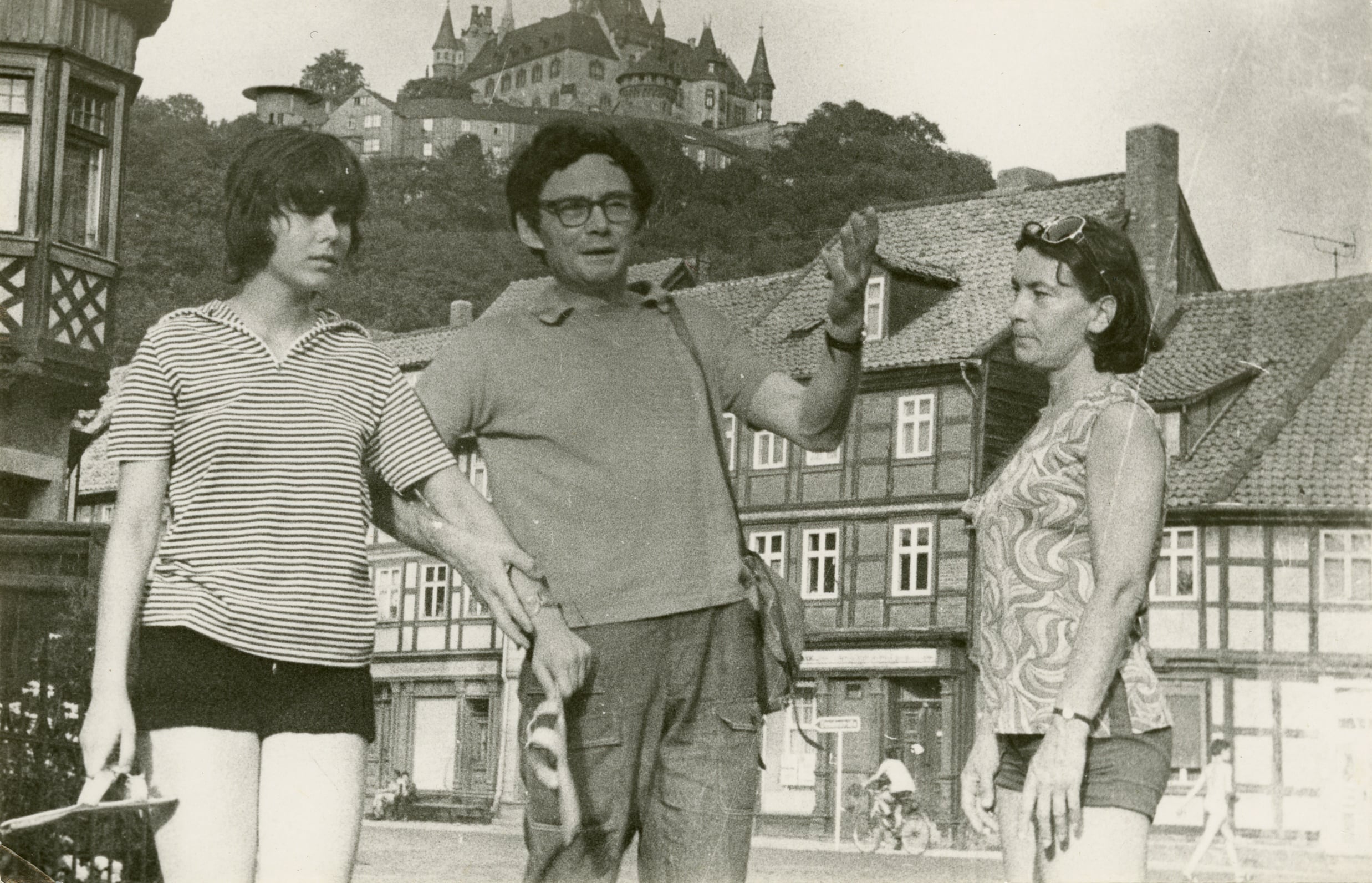
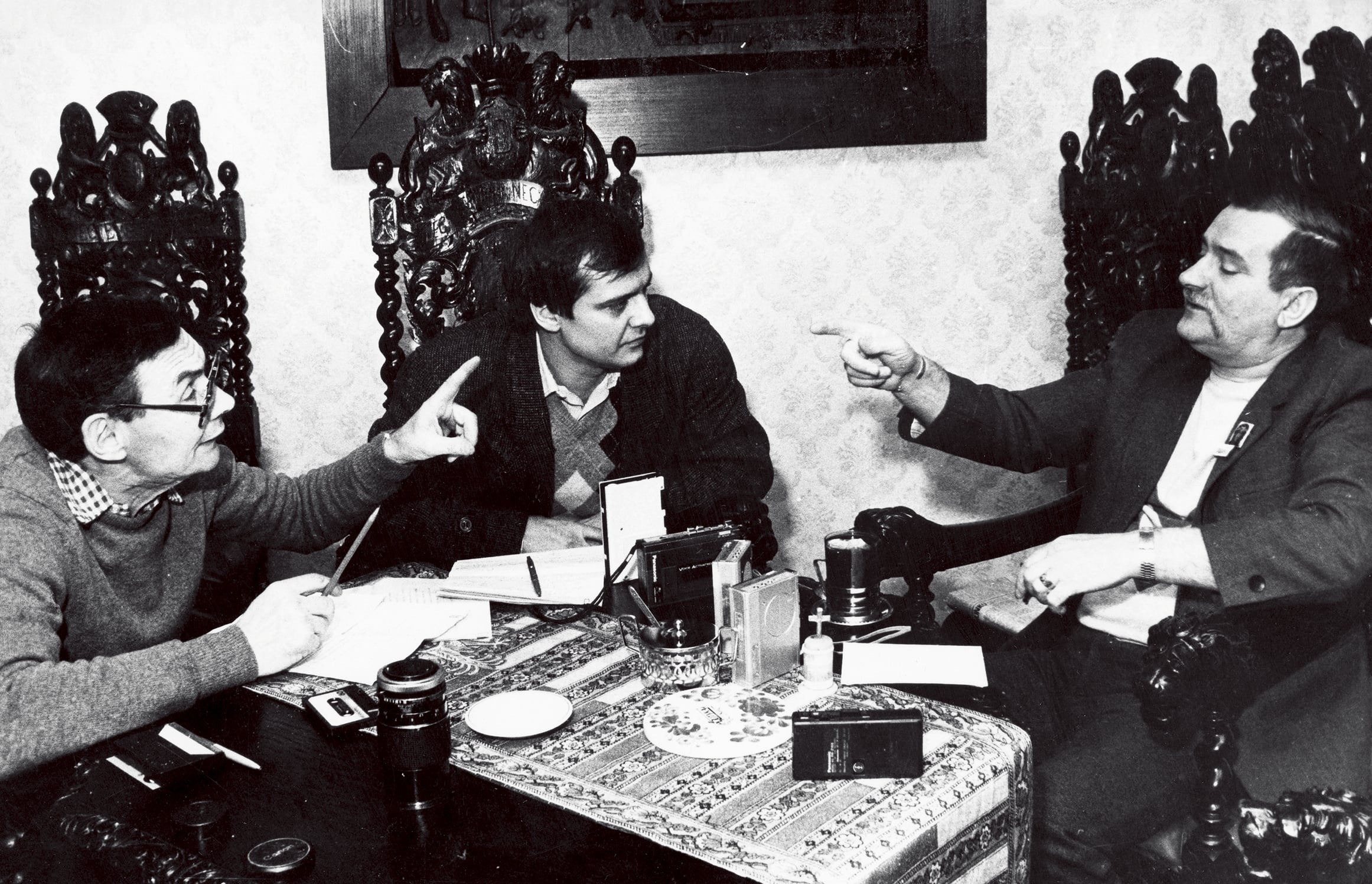
Marian Turski’s wife was Halina Paszkowska (10 June 1927 – 26 March 2017), a Holocaust Survivor, liaison messenger in the Warsaw Uprising (nom de guerre “Lusia”), and an esteemed sound operator. She worked on sound production for the Polish Film Chronicle and on over 200 documentaries and twenty feature films. Thanks to her contacts as a member of Solidarity, in 1990 Marian Turski was able to conduct two interviews with Lech Wałęsa (one together with Jerzy Baczyński).[1.18]. Marian Turski and Halina Paszkowska’s daughter Joanna is a renowned flautist.
Marian Turski died on 18 February 2025 in Warsaw. He was buried in the Jewish cemetery on Okopowa Street in Warsaw.
Author: Olga Mielnikiewicz, Editor: Joanna Król-Komła, Academic consultant: dr Krzysztof Persak
Further reading:
- 'Marian Turski: This is what matters in life': https://sztetl.org.pl/en/towns/w/18-warsaw/120-news/192361-marian-turski-this-is-what-matters-in-life
- Watch the interview with Marian Turski on POLIN Museum’s Oral History YouTube channel: The Last Transport Leaving the Ghetto – the Story of Marian Turski - YouTube
- Wartime experiences of Marian Turski: https://sztetl.org.pl/en/towns/l/497-lodz/104-texts-and-materials/193062-i-left-last-transport-ghetto-wartime-experiences-marian-turski
- Listen to Marian Turski’s speech – “Do Not Be Indifferent” https://youtu.be/NU0FqE2GvmY?t=4089
Bibliography:
-
Dylewski A., Wzorek M., Rodowód Mosze Turbowicza, research, interview, and text written for the Virtual Shtetl portal (available at the courtesy of the authors)
-
Marian Turski. Mój najszczęśliwszy dzień, documentary film, dir. Michał Bukojemski, 2015.
-
Mielnikiewicz O., archival research in issues of Polityka from the years 1957–2021.
-
Na początku było marzenie 1993-2014. Jak powstawało Muzeum Historii Żydów Polskich POLIN, Warszawa 2014.
-
Passent D., Passa, Warszawa 2012
-
Przeperski M., Mieczysław F. Rakowski. Biografia polityczna, Warszawa 2021.
-
Rakowski F.M., Dzienniki polityczne z lat 1959-1962, 1963-65, 1967-68, 1972-75, Warszawa 1998-1999, 2002.
-
“Trzech na jednego z Marianem Turskim,” in: Zdanie, 2014 [online] http://old.mbc.malopolska.pl/Content/89819/zdanie-2014-3-4-162-163.pdf [Accessed: 17 Nov 2024]
-
“Turski Marian,” in: BIP IPN [online] https://katalog.bip.ipn.gov.pl/informacje/654290 [Accessed: 20 Aprll 2022]
-
Interview with Marian Turski, 7 October 2019, Digital Collection of POLIN Museum of Polish Jews, researcher: J. Markiewicz [online] The Last Transport Leaving the Ghetto – the Story of Marian Turski - YouTube [dostęp:12.02.2025]
-
- [1.1] The family home of Marian Turski’s mother, Estera Turbowicz, stood at 2 Jeziorska Street in Porzecze, next to a railway station which was called “Druskieniki” until the mid-1930s.
- [1.2] Rosz Pina (Wilno 1878/1879), Korona Zeewa (Warszawa 1889/1890), Chwała Zeewa (Warszawa 1896/1897), Miszna Zeewa (1903/1904).
- [1.3] Interview with Marian Turski conducted by J. Markiewicz, POLIN Museum Digital Collection, 7 Oct 2019.
- [1.4] Marian Turski. Mój najszczęśliwszy dzień, dir. Michał Bukojemski, 2015.
- [1.1.4] [a] [b] Marian Turski. Mój najszczęśliwszy dzień, dir. Michał Bukojemski, 2015.
- [1.5] The third question of the referendum read: “Do you want to consolidate the Polish state border on the Baltic, the Odra, and the Nysa Łużycka?” Marian Turski. Mój najszczęśliwszy dzień, dir. Michał Bukojemski, 2015.
- [1.6] “Trzech na jednego z Marianem Turskim,” in: Zdanie, 2014 [online] http://mbc.malopolska.pl/Content/89819/zdanie-2014-3-4-162-163.pdf [Accessed: 17 Nov 2021].
- [1.7] Cited from Przeperski M., Mieczysław F. Rakowski. Biografia polityczna, Warszawa 2021, p. 72.
- [1.8] Rakowski F.M., Dzienniki polityczne 1958–62, Warszawa 1998, p. 189.
- [1.9] Passent D., Passa, Warszawa 2021, p. 121.
- [1.10] Rakowski F.M., Dzienniki polityczne 1959-1962, Warszawa 1998, pp. 47, 107.
- [1.11] “Obama: Ja tu jeszcze wrócę,” Polityka [online] https://www.polityka.pl/archiwumpolityki/1516444,1,obama-ja-tu-jeszcze-wroce.read [Accessed: 16 Nov 2021].
- [1.12] Marian Turski. Mój najszczęśliwszy dzień, dir. Michał Bukojemski, 2015.
- [1.13] “Marian Turski o getcie, czułości i swojej żonie,” Polityka, 9 February 2020 [online] Marian Turski o getcie, czułości i swojej żonie | Złote słowa Mariana Turskiego - Polityka.pl [Accessed: 20 Oct 2021].
- [1.14] “Trzech na jednego z Marianem Turskim,” in: Zdanie, 2014 [online] http://mbc.malopolska.pl/Content/89819/zdanie-2014-3-4-162-163.pdf [Accessed: 17 Nov 2021
- [1.15] Przeperski M., Mieczysław F. Rakowski…, p. 131.
- [1.16] See Przeperski M., Mieczysław F. Rakowski…, pp. 130–132.
- [1.1.14] [a] [b] [c] “Trzech na jednego z Marianem Turskim,” in: Zdanie, 2014 [online] http://mbc.malopolska.pl/Content/89819/zdanie-2014-3-4-162-163.pdf [Accessed: 17 Nov 2021
- [1.1.12] Marian Turski. Mój najszczęśliwszy dzień, dir. Michał Bukojemski, 2015.
- [1.17] 25 lat Stowarzyszenia Żydów Kombatantów i Poszkodowanych w II Wojnie Światowej, Warszawa 2016.
- [1.18] “Czekam na ruch partii,” in: Polityka, 27 January 1990; “Nie boję się demokracji, nie boje się tłumów,” in: Polityka, 17 November 1990.