
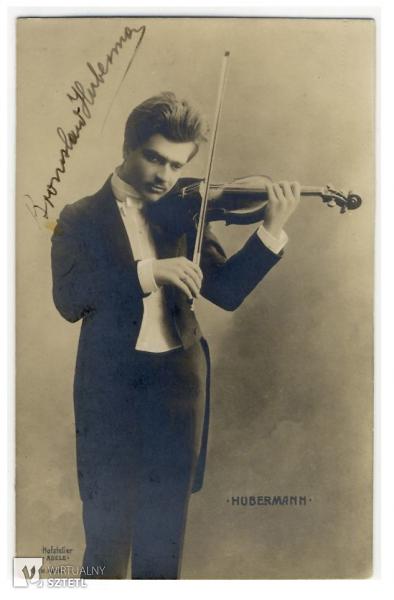
Bronisław Huberman was born on 19 December 1882 in Częstochowa, died 16 June 1947 in Corsier-sur-Vevey, in Switzerland.
His father Jakub [Jankiel] was a clerk and a lawyer’s assistant. As a music lover and a self-taught musician he quickly noticed his son’s talent and his ear for music. He started to give him violin lessons at home.
The five-year-old Bronisław drew attention to his extraordinary musical talent for the first time during a concert in the Szokalskich living room, when he repeated from memory a piece of music played by an invited violinist, then fifteen-year-old Mieczysław Michałowicz, who was delighted with the child's talent and became his first professional teacher.
Bronisław Huberman made his debut at the age of seven, performing works by Beethoven, Wieniawski and Tchaikovsky. In 1892, thanks to the Ludwig Ginsberg scholarship, the Huberman family moved to Berlin, where Bronisław amazed the greatest educator at that time, Józef Joachim, with his talent, and he agreed to take care of him. In 1893, eleven-year-old Bronisław Huberman went on tour, giving a series of concerts in Germany, Belgium, Holland, France and England. In the same year, he received a Stradivarius violin from 1773 from his patron, Count Jan Zamoyski.
In 1896 Huberman performed in Berlin, where, in the presence of Johannes Brahms, he played his Concerto in D major, which was greatly admired by the composer. After the European tour, which lasted for a few years, in 1897 he went on tour around the United States.
In 1903, the fame of the twenty-one-year old violinist was already well established and he had the honour to play the violin belonging to Niccolo Paganini.
The interwar period was for Huberman a time of the most intense work.
He performed in Italy, Germany, Austria, France, Scandinavia, the Czech Republic and Poland. In 1927, together with pianist Ignacy Friedman (1882-1948) and cello virtuoso, Pablo Casals (1876-1973), he founded the world-famous trio.
In addition to artistic activity, Huberman was also engaged in political activity, associated with the idea of Richard Coudenhove-Kalergi (1894-1972), which assumed the creation of a Pan-Europe, a union of European states "from Poland to Portugal", united by common economy and economics.
According to this idea, Pan-Europe was to be a response to the pressure from Soviet Russia on Europe, as well as a protection against economic crisis. Huberman described the pan-European ideas in his publication Vaterland Europa, published in Berlin in 1932.
As a result of growing anti-Semitism in Germany, in 1932 Huberman left Berlin and settled in Switzerland, at the same time continuing his political activities. His opposition to Nazism resulted in an open letter to "German intellectuals" published in the Manchester Guardian in 1936, in his refusal to tour in Germany and, indirectly, in his effort to create the Palestinian Symphony Orchestra in Tel Aviv, where he engaged Jewish instrumentalists persecuted in Germany. His efforts were crowned with the inaugural performance of the Orchestra, on 26 December 1936, with a concert conducted by maestro Arturo Toscanini. Currently, the Israel Philharmonic Orchestra is named after him.
From the outbreak of World War II, Huberman was involved in the activities aimed at helping Polish refugees. The war prevented him from returning to Switzerland from his tour and he decided to settle in the United States, continuing his artistic work. He performed in the USA, performing, i.a., Karol Szymanowski's 1st Violin Concert, conducted by Grzegorz Fitelberg.
After the war he returned to Switzerland, where he spent the rest of his life, performing in Europe and the Middle East.
As a result of severe complications following an accident, Bronisław Huberman died on 16 June 1947 in Corsier-sur-Vevey.
Katarzyna Wieczorek