
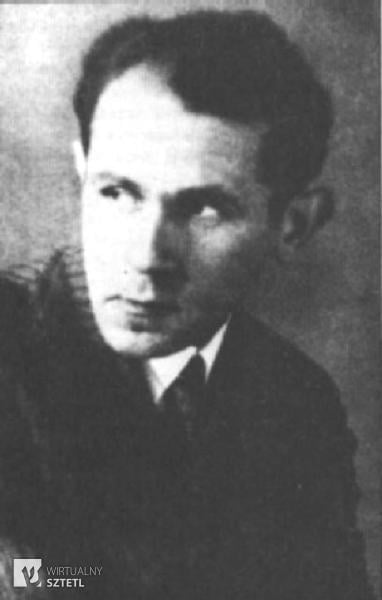
Schulz Bruno (12 July 1892, Drohobych – 19 November 1942, Drohobych) – prose writer, essayist, painter, graphic artist, illustrator.
He was born in an assimilated Jewish family of a textile merchant. In the years 1910–1911 and 1913–1914, he studied architecture at the Lwów University of Technology. During World War I, he took fine arts classes in Vienna.
He started to earn his first money as a portrait painter, and in 1924 he began working as a teacher of drawing and handicrafts at the state secondary school in Drohobych. He spent his whole life in this city, only occasionally leaving for Lviv, Warsaw, Zakopane, or Paris. In the 1930s, he gained renown in the Polish literary milieu as one of the most outstanding writers of the debuting generation. In 1941, after the invasion of the German army to Poland, Schulz found himself in the Drohobych Ghetto. For some time, his relative safety was assured by Gestapo officer Felix Landau, for whom Schulz produced numerous works of art (including the wall paintings in the so-called Villa Landau, discovered in 2001 and illegally transported to the Yad Vashem Museum in Jerusalem). On 19 November 1942, Schulz was shot in the street by Gestapo officers under unclear circumstances.
Schulz made his debut as a writer in 1933. His first book saw the light of day thanks to Zofia Nałkowska, who, having received the manuscript of Cinnamon Shops, undertook to publish it. In the following years, Schulz’s short stories, essays, and reviews were published in the press, including Wiadomości Literackie, Sygnały, and Skamander. In 1938, he published a volume of short stories titled Sanatorium Under the Sign of the Hourglass. Some of his letters and unprinted texts, probably including the unfinished novel The Messiah, were lost during World War II.
Several hundred drawings by Schulz have survived to the present day: portraits, erotic and genre scenes, illustrations for books (including Ferdydurke by Witold Gombrowicz), bookplates, and an oil painting. He also produced a series of prints called Xięga bałwochwalcza (made using the cliché verre technique and preceded by numerous drawings similar in style and subject matter). Most works from Xiega feature grotesque scenes of women dominating men, who in turn accept their submissive role of inferior beings, adore women in every possible way, and erect altars to deify them. Upon seeing these works, Stanisław Ignacy Witkiewicz classified Schulz as a representative of “demonologists.”
Schulz’s prose is an attempt to mythologise the everyday life of the author, his family, and his city. The narrative uses them as a model of human existence and the entire cosmos and inscribes them into a mythical time cycle divided into the seasons of the day, the year, the epochs of human life and history. A similar mythical character is given to the space of the city, the mercantile activities of the protagonist’s father, and the activities of common people – both everyday routines and festive, extraordinary events. Schulz’s world is torn apart by polar opposites: masculinity and femininity, reality and dream, tradition and modernity, loyalty and rebellion against authority. They all express the hidden dynamics of reality, triggering cyclical events of in the mythical dimension and leading to irreversible historical transformations. Schulz’s stories are an ode to poetry, eroticism, the creative potential inherent in matter and man on the one hand, and an expression of fear of the destructive forces undermining the old world on the other. The writer tries to overcome this fear by inscribing all events in a mythical cycle which overthrows the irreversibility of death. In creating his own literary myth, Schulz makes use of themes drawn from Jewish mysticism, the Old and New Testament, the mythology of various peoples, German Romanticism, the philosophy of Friedrich Wilhelm Nietzsche and Arthur Schopenhauer, psychoanalysis, surrealism, the avant-garde, as well as the latest discoveries of science and technology. His strongly metaphorical, poetic language combines vocabulary and concepts drawn from various disciplines to discover in them a primordial unity, alluding to the divine causative power of the word.
The protagonist of Schulz’s stories is Joseph, the author surrogate. There is also the character of old Jacob – the protagonist’s father and the personification of the writer’s real father. Jacob is a very colourful character – a storyteller, demiurge, creator of the world dominated by matter, he has the miraculous power of transforming himself into various beings. Sometimes he seems to be a demiurge, but it is enough for a young woman to appear by his side to make him forget his miracle-working power and succumb to her charms. Thus a man – the personification of mental powers – succumbs to the charms of a woman, associated with matter, something which is material and practical and not poetic or artistic. This is also how an erotic bond is formed between the representatives of different sexes. Ultimately, the women in Schulz’s works usually become a metaphor for the apocalyptic vision of the world, dominated by pragmatism and not by art. This is only one possible interpretative angle and it does not take into account other readings of Schulz’s prose (e.g. in the spirit of psychoanalysis, Kabbalah, postmodernism or, more recently, feminism).
Schulz’s prose bred extreme reactions before the war and was officially suppressed during the Stalinist period. It was rediscovered after 1956 and has since been interpreted ever more profoundly, mainly thanks to the long-term efforts of Jerzy Ficowski and several generations of younger scholars. Schulz’s career abroad began in the 1960s. Since then, his works have been translated into over 20 languages, and the writer has gained the repute of a 20th-century literature classic. The worldwide fascination with Schulz’s literary output is reflected in the growing number of translations, commentaries and literary studies, as well as works of fiction in which the author of Cinnamon Shops himself appears as a character (see, for example, The Messiah of Stockholm, a short novel by American writer Cynthia Ozick). Schultz’s prose has been highly praised by such prominent writers as Bohumil Hrabal, Danilo Kiš, and John Updike. UNESCO announced that 1992 would be the Year of Bruno Schulz, with his artistic output promoted in numerous exhibitions held throughout Europe. His writing was also successful as source material for acclaimed films: Sanatorium Under the Sign of the Hourglass (1973) by Wojciech Jerzy Has and The Street of Crocodiles by brothers Stephen and Timothy Quay (1986). The largest collection of Schulz’s works is held by the Adam Mickiewicz Museum of Literature in Warsaw.
Schulz’s paintings have rarely been featured in the news, mainly in the memories of his family and friends or in the few preserved photographs. In 1992, an original composition was put up at an art auction. The work is now known under the title assigned to it during commercial appraisal (the author did not give titles to most of his works, with Xięga bałwochwalcza being an exception): The Meeting. A Jewish Youth and Two Women in a City Alley (1920). It is a variation on a motif frequently tackled by the artist: the meeting of two worlds, two conflicting spheres of reality, personified by a woman and a man. This opposition is emphasised in the painting by spatial divisions and costumes. The young Hasid (payot, bekishe, wide-brimmed hat) is captured in a humble bow, a theme often appearing in Schulz’s work, before two young ladies wearing Art Deco attire. The scene is set against the background of small town buildings. The painting showcases Schulz’s skilful hand and considerable artistic experience. His expert modelling of shapes, handling of space, and colour selection place him among the ranks of the most interesting painters of the interwar period. Worth emphasising is also the inspiration drawn from recent or new trends in art (German expressionism, formism, surrealism), which found their way to The Meeting after passing through the prism of the artist’s own sensibility. The unexpected discovery of the painting kindles hopes for more fortunate discoveries of Schulz’s paintings. The work was displayed for the general public for the first time at the Museum of Literature in Warsaw, at the exhibition called Ad memoriam. Bruno Schulz 1892–1942, arranged in 1992 to mark the 100th anniversary of Schulz’s birth and the 50th anniversary of his death. The two-part exhibition catalogue is the most comprehensive overview of the author’s creative output.
The year 2001 brought the solution to another mystery: the wall paintings adorning Villa Landau in Drohobych, which Schulz had painted shortly before his tragic death, were discovered (and photographed) by German filmmaker Benjamin Geissler, although for almost fifty years they had been considered destroyed. In a cruel twist of fate, they were actually destroyed after their discovery, when representatives of the Yad Vashem Israeli Remembrance Centre transported a large part of the paintings out of Ukraine. Whatever remained at the site was transferred to the Museum of Drohobych. They were displayed in Poland for the first time in 2003, at the exhibition titled The Republic of Dreams, held in Warsaw, Wrocław, and Gdańsk and produced by the Gdańsk Kontakt Agency and the Warsaw Literature Museum. The international uproar raging in the wake of the scandal helped remind the general public of Schulz’s close ties with Drohobych. As a result, the city has been included in the list of “magical sites” immortalised in masterpieces of world literature alongside Dublin, Prague, and Trieste. Further surges in the international interest in Schulz were aroused by subsequent anniversaries commemorated in 2002: the 110th anniversary of his birth and the 60th anniversary of his death. The occasion was accompanied by the publication of new editions of the books Letters and Drawings of Bruno Schulz and Regions of the Great Heresy by Jerzy Ficowski as well as the first edition of the comprehensive Dictionary of Knowledge about Bruno Schulz.
Jerzy Jarzębski, Renata Piątkowska, Małgorzata Kitowska-Łysiak