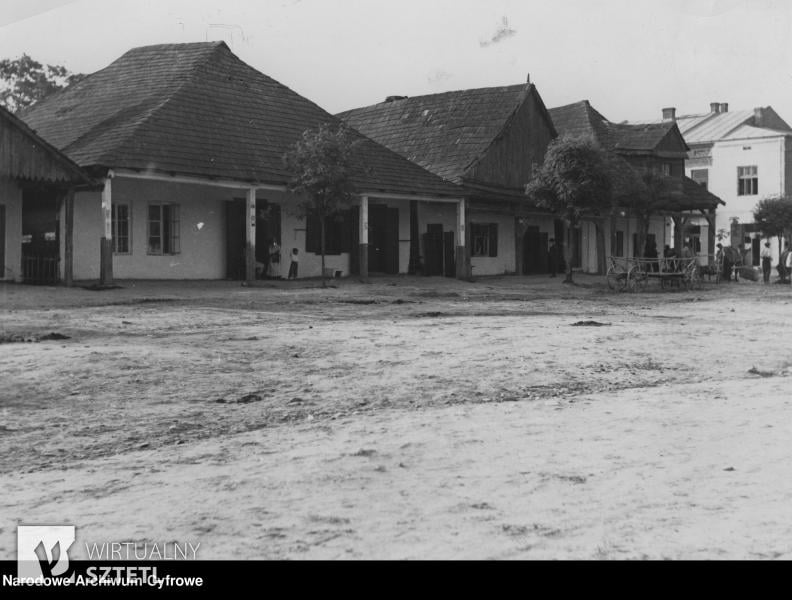
The first mention of Dubiecko as a royal settlement located on the right-bank the Sun River, dates back to 1358. At that time, the Polish king Casimir the Great awarded the land bordering Dubiecko to Jacek, known as The Sun (Słoneczko). Dubiecko itself, however, was awarded by King Wladyslaw Jagiello to Peter Kmita, the castellan of Lublin, in a document dated to June 22nd, 1389.
Since Dubiecko was located on the so-called ‘Hungarian’ trade route, the Kmits wanted it to be granted city rights. This family, using the Szreniawa (Srzeniawa or Śreniawa) coat of arms originally came from Wiśnicz, in what was then the Cracow province.The Kmits also owned Dynów in the Sanok area, and a castle in Sobień, near Załuże. The son of the aforementioned Piotr Kmita, Mikołaj, who later became a castellan of Przemyśl, received the permission from the king Wladyslaw Jagiełło to convert Dubiecko into a city. The privilege was issued on August 24th, 1407 in Wiślica.
Granting the city rights to Dubiecko was connected with the move of the settlement from the right bank of the San river to the left bank. On the right bank of the river a village was created. It was named Ruskie Dubiecko, and from the end of the 15th century Rusia Wieś. Since 1407 Dubiecko was a city of the former Sanok district, and the home to many families - the Kmits, the Stadniccy, the Krasiccy and the Konarscy.
In the 15th century, Dubiecko was inhabited by a Polish population. Proof of this are the names and surnames of the townsmen which are preserved in documents: Goworek, Dąbiec, Laszko, Szafranek, Stanisław, Stodola, Wawrzek, Marcin Masz, Jakub, Stachna.
At the beginning of 16th century Dubiecko was given to Piotr Kmita, the Great Marshal of the Crown, Starosta of Przemyśl, Koło and Spisz. He was the most famous member of his family.
In 1530, Dubiecko became the property of Stanisław Stadnicki. He arranged the second annual fair taking place in the city during the Feast of the Cross.
Since 1530, Stanisław Stadnicki, as the first owner of Dubiecko, has had a seat in the Senate as a castellan of Sanok. In 1533, he received the Starostwo of Nowy Korczyn from the king Sigismund I the Old. It was one of the most profitable properties, and was the object of desire of many magnates. In 1542 he died and his son, Stanisław Mateusz, inherited the Dubiecko properties. Stanisław Mateusz Stadnicki owned two cities and thirty six villages in years 1558-1559.
Stanisław Mateusz Stadnicki gained the reputation of a passionate infidel, and was even regarded as one of the most important supporters of the Reformation in Poland. In his public activities in the sejmiks and the Sejm in years 1558-1559 he focused mainly on minimizing the influence and role of the Catholic Church in Poland.
Already around 1550, he started propagating Lutheranism and decided to turn Dubiecko into a centre of the Reformation movement in the Diocese of Przemyśl.. According to historical sources, he converted to Lutheranism one year later .
The bishop of Przemyśl - Jan Dziaduski - wanted to convert Stadnicki to the Catholic faith and he personally went to Dubiecko to achieve this aim. His mission, however, ended in failure.
In 1551, Stadnicki brought to Dubiecko the priest Wojciech from Iłża. Wojciech baptized in the Lutheran rite Stadnicki's son, Stanisław, later called "the Łańcut Devil" ("Diabeł Łańcucki").
Around 1557, Stadnicki, for unknown reason, dismissed Wojciech from Iłża. In the following year, he himself converted from Lutheranism to Calvinism. In 1580, as a result of family division, Andrzej Stadnicki received Dubiecko. "The Łańcut Devil" received: Nienadowa, Iskań, Piątkowa, Żochatyn, Wola Piątkowska, Tarnowa Wola and other villages. In 1586, after another another family division, he exchanged his properties with Anna Pilecka for Łańcut and 14 villages.
Dubiecko changed owners in 1588. Andrzej Stadnicki sold the city, along with the castle, to Stanisław Krasicki, castellan of Przemyśl and Grand Crown Camp Commander.
Jerzy Krasicki, Stanisław's son, who inherited Dubiecko from his father, was an exceptional figure. He studied in Ingolstadt and Rome and them he served in the army of Archduke Charles. In 1610, he was nominated for the post of Chorąży of Halice by Sigmund III Vasa.
Kazimierz Jerzy Krasicki died between 1688 and 1690. He left his properties (including Dubiecko) to Karol Krasicki. From the mid-seventeenth century to the mid-eighteenth century Dubiecko experienced a period of stagnation. The cause of the economic decline were the destructions that occurred during the Swedish Deluge, especially in 1656, when the army of Rakoczy entered Poland. The Hungarians and Cossacks burnt down Sanok, Dynów, Dubiecko and Babice. Dubiecko was once again destroyed during the Tatar invasion in 1672. The destruction was completed by the fire of 1717, during the Northern Seven Years' War. Due to those events, Dubiecko lost 88% of its population.
Due to the the serious demographic decline, in 1731 the owner of Dubiecko, Anna from Starzechowscy Krasicka (wife of Jan Krasicki), forbade the townsmen to leave the city. They were also forbidden to sell houses and squares in the city without permission. Despite difficulties, craftsmanship was still developing in Dubiecko in the second half of the 18th century. There were 4 guilds in the city: shoemaker's, carpenter’s, blacksmith's and cooper's. In addition to the guilds, sources mention also individual craftsmen: a saddler, carpenters, blacksmiths, metalworkers, coppersmiths, a painter, potters and barber surgeons.
The most famous son of Jan and Anna Krasiccy, Ignacy Franciszek Błażej, was born in Dubiecko probably on February 3rd, 1735. Ignacy Krasicki spent his childhood in Dubiecko and in the following years, when he studied at the Jesuit School in Lviv, and then in the seminary, he was coming to his beloved hometown for holidays.
Since 1762, Antoni Krasicki has been the owner of Dubiecko. It was him who rebuilt the castle in years 1770-1790, giving it a similar look to today's. A park using the existing, old trees was also established.
Aleksander Krasicki, the next owner of the property, was a poet and heraldry expert. He was maintaining contact with Wincenty Pol. A frequent visitor to the the Dubiecko palace was Ignacy Kraszewski, who was also enchanted by the beauty of the area. The subsequent heir of Krasicki's properties - Aleksandra from Krasiccy Konarska - also "inherited" literary talent, and the contacts with people from the world of culture, with Teofil Lenartowicz and Zygmunt Kaczkowski, increased the prestige of Dubiecko. In 1830 the first Voluntary Fire Brigade in on Polish lands was created here.
The town was severely damaged during the First World War. Furthermore, the Russian army plundered Dubiecko, including Jewish property. Many soldiers did not return after the war; they remained in Austria and Germany or emigrated to America.
In November 1918, local peasants plundered shops owned by Jews. Dubiecko has had city rights for 527 years. It lost lost them in August 1934, as a result of the creation of the so-called collective communities in former Austrian partition.
After the outbreak of World War II Dubiecko was under German occupation.
In the years1975-1998 the town administratively belonged to Przemyśl Voivodeship. Currently, the town is the seat of the rural commune, which includes the following villages: Bachórzec, Drohobyczka, Hucisko Nienadowskie, Iskań, Kosztowa, Łączki, Nienadowa, Piątkowa, Przedmieście Dubieckie, Sielnica, Słonne, Śliwnica, Tarnawka, Winne-Podbukowina, Wybrzeże, Załazek Piątkowski.
At present, Dubiecko is inhabited by 1150 people. Most of the inhabitants live on incomes from agriculture, there are no big factory units on this territory. There is a secondary school in Dubiecko, as well as middle school and primary school.
Bibliography
- Chłapowski Krzysztof, Dzieje Dubiecka, Rzeszów 1983, p. 47-48.
- Fastnacht A., Słownik historyczno-geograficzny ziemi sanockiej w średniowieczu, Brzozów 1991, p. 98.
- Horwat J., Zarys genealogii rodu Krasickich do 1717 r., part III, Przemyśl 1989–1990, p. 165-166.
- Kaniewska I., Małopolska reprezentacja sejmowa za czasów Zygmunta Augusta 1548–1572, [w:] „Zeszyty Naukowe Uniwersytetu Jagiellońskiego”, Prace Historyczne, Z. 48, Warszawa–Kraków 1974, p.15.
- Lisowicz K., Dzieje parafii Dubiecko, Dubiecko 1966, maszynopis w Archiwum Archidiecezjalnym w Przemyślu, p. 13-14.
- Motylewicz Jerzy, Miasta ziemi przemyskiej i sanockiej w drugiej połowie XVII i XVIII wieku, Przemyśl–Rzeszów 1993, pp. 62-63.
- Niesiecki Kacper, Herbarz polski, Warszawa 1988, s. 475.
- Przyboś K., Urzędnicy województwa ruskiego XIV–XVIII, Wrocław 1987, p. 222.
- Śliwa T., Rozwój protestanckiej reformacji w diecezji przemyskiej w połowie XVI wieku, Przemyśl 1975–1977, p. 17.
- Stęczyński Maciej Bogusz, Okolice Galicyi, Lwów 1847, p. 149.
- Wierzbowski Tomasz, Matricularum Regni Poloniae Summaria, vol. 1-5, Warszawa 1905–1914.