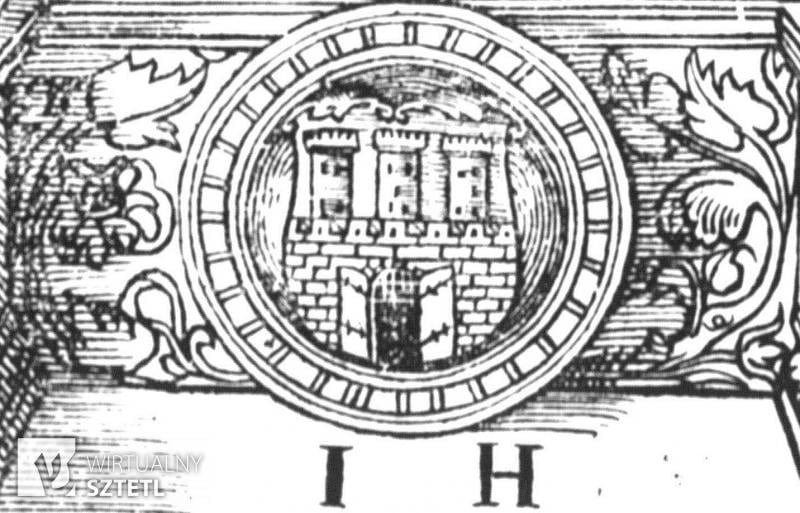
The first Jewish printing house in the Polish territories was established in Kraków in 1534 by the Halicz (Helicz) brothers: Szmuel (Samuel), Aszer and Eljakim. In the same year, they printed two books, Shaarei Dura and Mirkevet ha-Mishne, followed by another two prints a year later. In 1537 the brothers were baptised under unknown circumstances and assumed the names of Andrzej, Paweł and Jan. The conversion to Catholicism secured them the special protection of King Zygmunt I Stary and Archbishop Piotr Gamrat but simultaneously led to the Jewish boycott of their printing house. Under a privilege issued by the king, Jews were forbidden to export books and were required to buy them from the Halicz brothers. When they refused to observe the ordinance, King Zygmunt forced Jews from Kraków, Poznań and, later also Lviv, to buy prints collected in the printing house held by the Halicz brothers (3,350 volumes according to the oldest register of this kind) under a decree of 31 December 1539. The books were purchased but must have been destroyed by Jews because only few of them have been preserved to our time.
The printing house in Kraków operated another several years until 1541. In the last years of its existence, sequels to the previously published works were printed. Paweł Halicz himself focused on religious writings. He published, for instance, Dos Naye Testament (the New Testament; the only full copy is held by the Jagiellonian Library) in German translation, but in Hebrew fonts. He then moved to Lower Silesia and started to publish Protestant works. Jan Halicz commenced work for another printing house, while Andrzej (Samuel) Halicz converted back to Judaism and pursued activity as a printer in Constantinople from about 1552. We are familiar with 14 prints published by that first Jewish printing house in Poland.
There was no Jewish printing house in Kraków from 1541.
It was only in 1568 that Icchak ben Aaron from Prościejów (called Prostitz, Prostic) came to Kraków. He opened a printing house on 15 October 1568. He was granted a privilege to print the Talmud and other Hebrew books by King Zygmunt II August. The permit was revoked for a short period of time but later restored, except for the right to print the Talmud. Prostic's printing house operated until 1628 with short breaks here and there. Under the reign of Stephen Batory, Prostic started to violate the prohibition to print the Talmud. He printed Avoda Zara, a treatise to the Basel edition of the Babylon Talmud (1578–1581), without any interventions of censorship. In 1592, following the outbreak of the plague in Kraków, the printing house moved for several months to the village of Nowy Dwór near Kraków, where only one work was published. It is estimated that the printing house had printed about 200 works by 1600, including biblical books, prayer books, halakhic and cabbalistic works in Hebrew, sometimes also in Yiddish. Starting from about 1600, the printing house in Kraków was run by his sons Aaron ben Icchak and Mosze Jozue, and grandson Isachar (Ber) ben Aaron, who took on Icchak's younger sons, Simcha and Mordechaj, as apprentices. In the years 1600–1612, they published about 60 works, including the 1602–1605 Babylon Talmud (12 volumes in a folio edition) and the 1609 Jerusalem Talmud (these works could not be printed in other countries until the mid-17th century due to the restrictions of church censorship). After Icchak's death (1612), his heirs ran the printing house for another 16 years. In the years 1612–1628, they printed more than 80 works, including the second edition of the Babylon Talmud (1616–1621), in which they invested all their property and ran into debt. With fierce competition from other Jewish printing houses in Kraków, a general crisis in Europe triggered off by the Thirty Years' War (1618–1648) and the plague, the printing house kept by the Prostic family went into bankruptcy. During the sixty years of its operation, about 340 works were printed, 15% of the output of Hebrew printing houses all over the world.
In 1627 two sons of Meir Gan, Izrael Zalman and Chaim, attempted to set up a new printing house in Kraków. It published only one book and was closed in 1629. At a time when Jewish schooling flourished and religious (Talmudic) education was gaining importance, the demand for biblical, exegetic, ascetic, devotional, and, most importantly, halachic literature grew among the increasingly large community of Kazimierz near Kraków.
In 1630 a new printing house was established by Menachem Majzels ben Mosze Szimszon, a relative of Mojżesz Isserles, in his house in Kazimierz. It operated in intervals for almost 40 years. Majzels financed his publishing activity by taking out loans, pledging his house, land and sheets of the printed works. It is possible that the creditors became the co-owners of his printing house that way. In 1649, in order to pay his debts, Majzels was forced to sell his house. Majzels's financial situation did not improve even in view of the fact that his printing house was the only one in the Polish territories starting from 1650. During the war between Poland and Sweden in the years 1655–1660, the printing house was demolished and Majzels reopened it only in 1659.
He ceded his royal and municipal privileges to his son-in-law Jehuda Lejba Majzels, who ran the printing house from 1670. Nonetheless, it never regained its former glory. In the years 1630–1655, more than 90 works were published under the direction of Majzels, 14% of the global production of books in Jewish languages. The works published by printing houses operating in Kraków from the 16th to the 17th century (mainly halachic literature) had a considerable impact on the intellectual development of not only Polish Jews but also German and Italian Talmudic scholars. From the mid-17th century, the method used by rabbis in Polish yeshivot became common among Jewish circles in the West. It became recognised in particular through printed books and thanks to Jewish scholars from the Polish territories who were appointed rabbis, mainly in Moravia, Germany and the Netherlands. In the 19th and 20th centuries (until 1939), Jewish printing houses in Kraków no longer enjoyed the same prestige as from the 16th to 17th century. At that time, only the printing house of Józef Fisher, operating in the years 1880–1914, made a name for itself.
© The entry was written on the basis of information found on the PWN Publishing House website; see: The PWN Encyclopedia|http://encyklopedia.pwn.pl]], [[urle:Polish landuage dictionaries|http://sjp.pwn.pl]] i [[urle:Foreign language dictionaries.