Wysock (Ukrainian: Vysotsk) was one of the most isolated, and in many respects also least developed Jewish centres – reading the book of remembrance, one can come to the conclusion that for a long time, it constituted almost a model provincial “shtetl” in a remote part on the border of Polesie and Volhynia. For decades, there were no public institutions there, only a few social institutions; no local newspaper was ever published; no writer was born to immortalize the life of the town. Therefore, we can reconstruct its past only thanks to scanty statistics and very few accounts.
The beginning of the Jewish settlement in Wysock took place probably in the 17th century. The local community was subordinate to the Jewish community in Pińsk (Belarusian: Pinsk). It is possible that the settlement of Jews in Wysock actually constituted a part of a conscious effort by that particular community. In the book of remembrance, Arie Fialkov writes: “Pińsk’s influence resulted from the fact that it established settlements (colonies) in Polesie, which were linked to the metropolis of Pińsk in the field of law and taxes.”
Around 1764, Wysock became independent as a community. At the time, there were approximately 85 “Jewish souls” there. The 1774 vetting report mentions seven Jewish landlords who paid the castle rent, which amounted to 16.23 zlotys per year.
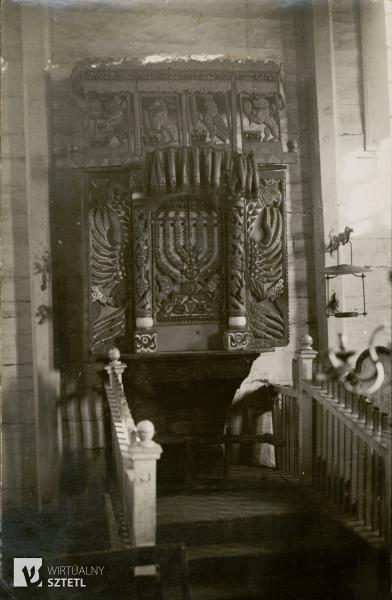
Słownik Geograficzny Królestwa Polskiego i innych krajów słowiańskich describes Wysock in the late 19th century as a town with a noticeable Jewish presence: “It includes 217 houses, 1,702 Orthodox residents, up to 100 Evangelicals, not counting the Jews, of whom there are many”. From the same source, we learn that a synagogue stood there in 1877. “Local Jews are engaged in the trade of berries, blackberries, and cranberries, as well as mushrooms growing in the forests, on a large scale. Each year, they send several bajdaks filled with these products to Kyiv and Odesa”.
According to the 1897 census, there were 912 people living in the town, including 880 Jews (96.5%!). Later, these proportions changed quickly, perhaps as a result of including areas previously considered rural in Wysock. In 1906, the population was already reported to be 2,668, living in 180 houses.
In 1901, from an article by B. Abelson in Ha-Cefira, we learn about the dire economic situation of the local community, of – according to the author – approximately 250 Jews. Most of them were craftsmen (tailors and shoemakers, who also performed construction work during winter), and there were also a few merchants travelling through the neighbouring villages. Their incomes were low; many were affected by unemployment; there was even a shortage of water as the Horyn River was too far from the town. The only social institution was an almshouse, founded back in the 19th century by a rabbi (most probably Rabinowicz) at the turn of the century, which was in a very poor condition. The pre-existing self-help society did not survive until 1901. The only doctor commuted twice a week from Dąbrowica (Ukrainian: Dubrovytsia), but soon, there were no funds to pay him. Wysock was clearly inferior even to the neighbouring shtetls: Stolin to the north and Dąbrownica to the south. In this situation, emigration was a frequent choice, both to Sarny and Równe (Ukrainian: Rivne) as well as much further abroad (e.g. France).
Spiritually, the Hasidic Jews – followers of the Karlin-Stolin dynasty and the Tzadik of Bereźne (Ukrainian: Berezne) were the dominating groups. We know the last three rabbis of the town from the 19th and 20th centuries: Mojżesz Rabinowicz, known as reb Mushke (1880s); Jehuda Abelson of Pietryków (Ukrainian: Petrykiv) (who was famous, among other things, for reconciling the followers of the two dominant Hasidic groups); and his son Jehoszua Abelson, who held the ministry until the Holocaust.
It was not until the Second Polish Republic that significant changes were introduced to Wysock. In 1921, there were approximately 2,978 people in the town, living in 471 houses; there were 893 Jews – almost exactly 30%. The first institutions have emerged. The activation of Zionists resulted in the establishment of a Hebrew school and a library with a Hebrew and Yiddish book collection. Organizations of a political nature have emerged: Poale Zion, Tze’irei Zion, HeHalutz Hatzair. Funds were raised for Keren Kajemet le-Israel and Keren Hayesod. There were also people from non-Zionist groups: Orthodox, Bund, and even communists. However, economic life continued to be local. Its most prominent representatives included a cattle trader from Zamorocze (Ukrainian: Zamorochennya) J. [Jehuda?] Fiszman and the miller J. Feldman.
The community in Wysock probably included the neighbouring village of Lutyńsk (Ukrainian: Lyutyns’k). In 1930, Jews from two families ran mills (F. Perelsztajn, N. Perelsztajn) and grocery shops here (N. Fiszman [probably Nachman Fiszman, 1910–1942?], W. Fiszman, N. Perelsztajn).
In 1939, Wysock came under the Soviet occupation. It was replaced by German occupation in June 1941. The Germans created a ghetto for the Jewish population, where they imprisoned approximately 1,500 people. On 9 September 1942, a unit of the Sicherheitsdienst (SD) from Pińsk, assisted by the German gendarmerie and Ukrainian police, murdered the people in the ghetto; approximately 100 people managed to escape and avoid execution.
Bibliography
- Abelson, “Wisotsk”, Ha-Cefira 1901, no. 174.
- Fialkov (ed.), Ajaratenu Wisotsk; sefer zikaron, Haifa 1963.
- Rulikowski, “Wysock”, in: Słownik Geograficzny Królestwa Polskiego i innych krajów słowiańskich, vol. 14, Warszawa 1895, pp. 111–119.
- “Wysock”, in: I. A. Altman (ed.), Holokost na tieritorii SSSR, Moscow 2009, pp. 190–191.