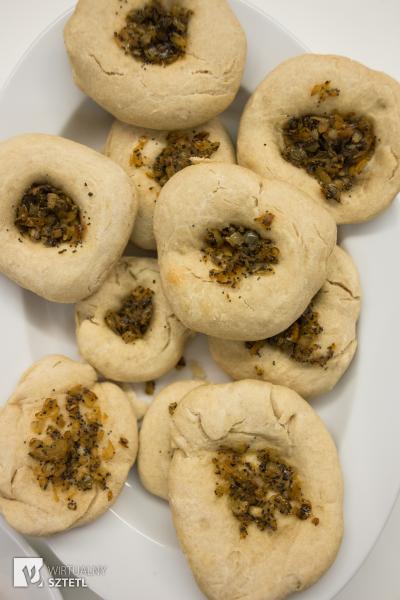
In their everyday life, Krynki Jews mostly ate poultry, potatoes, herring, soups, fish, and dairy products. Food was purchased in numerous Jewish shops, with Krynki boasting over 30 of such establishments. They were located mainly in the hall at the market square, in the market frontages and along the busiest streets. They sold various types of bread, small baked goods: rolls, crescent rolls, and bagels as well as milk, butter, cream, and eggs. There were also several Jewish bakeries, e.g. Szymon Buk’s or Klebańska’s bakeries, where in addition to the most popular items one could buy rolls with onion filling. A handful of local shochtim sold beef, veal and mutton, poultry, and goat meat from goats that grazed on the hills surrounding Krynki (hence the name of the nearby Góry Kozie [Goat Mountains]). The officially imposed kosher meat prices were on average 40% higher than the prices of meat bought by Christians.
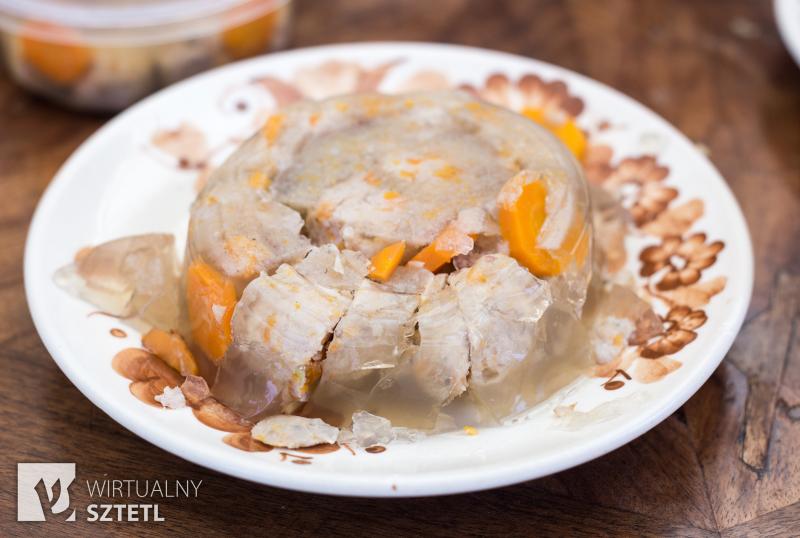
All these products were used by Jewish housewives to prepare various dishes, which would always come with large amounts of onions and garlic, fragrant herbs and spices – almonds, cinnamon, cloves, nutmeg, and ginger. It was rather fatty food, because according to the kosher principle it was made with goose, duck or chicken lard. Traditional Jewish dishes, also popular in Krynki, included white cabbage borscht and krupnik (barley soup); small dumplings stuffed with beef cooked in broth; fried and chopped chicken livers with onion; stewed goose gizzards with a lot of garlic and onion; strongly seasoned ground beef wrapped in cabbage leaves, nowadays known as gołąbki. Balls of chicken meat in aspic, lamb cutlets or fish balls cooked in broth were also popular. Herring was served in several ways – cut into slices with onion and spices or as a salad ingredient. In Krynki, such dishes were only eaten by Jews who could afford them. The poor people, which constituted the largest part of town’s population and lived mainly in the Kaukaz district, had to settle for boiled potatoes garnished with goose fat, lean broth, grated potato or flour pancakes fried on chicken lard, a slice of bread with onion. Sometimes it was a scrambled egg or radish with some chicken fat.
Once a week, during the Thursday market, Jewish housewives would buy more groceries in preparation for the Sabbath. Browsing through the goods laid out on peasant carts, which would come to Krynki in great numbers on market days, the women looked for chickens, ducks, and geese, sometimes turkeys. Choosing the birds for the feast, they palpated their bodies and blew on their feathers, making sure that they were suitably fatty. From rural women, they bought fresh eggs and chunks of butter wrapped in linen cloth or horseradish leaves. Straight from villagers’ wooden boxes and hemp sacks, they bought potatoes, cabbage, carrots and onions, apples, and legume seeds – beans, peas, and lentils. From wicker baskets, Jewish women would pick out well-baked loaves of country bread – dark rye or white, made from sifted wheat flour. The housewives, laden with all those goods, would then return from the market to start preparations for the Sabbath feast.
Already on Thursday evening, Jewish women kneaded dough for challah – a specially woven roll eaten on the Sabbath. It was made from finely ground flour with a small amount of sugar, sometimes with the addition of raisins or honey. On Friday morning, the air was permeated with various scents of holiday dishes from Jewish homes around the town: baked challot and geese stuffed with apples, boiled fish, fried herring, and other Sabbath staples. Cholent was prepared on Friday – a traditional stew eaten hot on Saturday at noon. It consisted of chopped beef or mutton, beans, sometimes potatoes and pearl barley from the local cereals store run by Mordchelewicz, onions and garlic, enriched with aromas of herbs and spices. In the afternoon, a vessel with all ingredients was taken to the baker, who put the dish in a warm oven for the whole night. Poorer people kept the dish in their own ovens, in a special chamber called “szabasówka” (shabbather). On Sabbath, as well as on other holidays, Krynki Jews would eat kugel. It was a kind of casserole made from raw potatoes with eggs, onions, and some groats. Nowadays, many Krynki housewives bake this dish under the name “potato babka” (“potato cake”). Kugel was also served sweet as a dessert, baked from noodles or rice with the addition of fruits and raisins. The festive table was enriched with other dishes: stuffed fish, carp in aspic still popular in Krynki, turkey roulades stuffed with onion and breadcrumbs, goose neck cooked in broth, beetroot borscht and various salads – with potatoes or with herring. Cymes was an exceptional Jewish dish. It could be made with or without meat, but it always had to be sweet. It consisted of boiled carrots with the addition of potatoes, stewed beef, cinnamon, and sugar. Various cakes and raisin wine were also served with Sabbath meals.
On Friday after sunset, all members of the Jewish community of Krynki, regardless of their financial and social status, sat down to the Sabbath supper. The poor were helped by richer neighbours or charities. On those feast days, even the most destitute had a little bit of cholent, some white bread, and a piece of meat or fish.
Cecylia Bach-Szczawińska
Krynki – historia, miejsca, ludzie
Czytaj więcej o historii społeczności żydowskiej w Krynkach >>