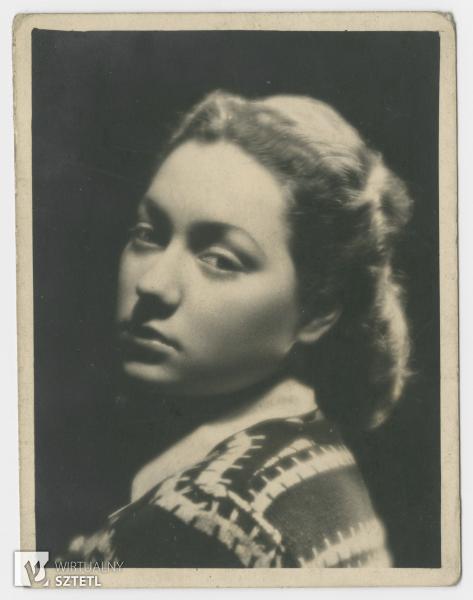
Berg Mary, born Miriam Wattenberg, married name Mary Pentin (10 October 1924, Łódź – April 2013, York, Pennsylvania) – author of a diary from the Warsaw Ghetto covering the period from 10 October 1939 to 5 March 1944.
She was the daughter of Szaja (Srul, later Stanley) Wattenberg, an antiquarian and art dealer from Łódź, and Lena (née Zol), a clothing designer. She had a sister, Anna. The Wattenberg family probably lived at 117 Piotrkowska Street.[1.1]
The original maiden name of Miriam’s mother was Zołotarewski. Her parents lived in Long Branch, New Jersey, and she was a United States citizen; her daughters were also entitled to American citizenship. This circumstance later proved crucial to the survival of the author of the diary and the preservation of her work.
When Germany invaded Poland, the Wattenbergs initially fled to Warsaw. On 15 October 1939, they returned to Łódź, only to discover that their possessions had been looted or confiscated (including the painting collection of Mary’s father, including works by Poussin, Delacroix, and Matejko). In late December 1939, the mother and the two daughters once again moved to Warsaw after receiving a letter from the American Consulate; the father stayed in Soviet-controlled Białystok until 1940. The women were hoping that the US consulate would grant them protection, which turned out to be only partially true – though the Wattenbergs eventually ended up in the ghetto, they were treated better than other prisoners in the closed district. They also had a real chance of leaving occupied Poland, as they were awaiting the issuance of American passports.
Miriam’s unique predicament was thus described by Samuel L. Shneiderman: “Mary Berg had the advantage of being an outsider (and a young woman at that) who could move around the ghetto much more freely than others thanks to an American flag pinned to her clothes [she did not have to wear an armband – editor's note]. Her circle of friends included rebellious children of Judenrat officials or members of the notorious ‘Group Thirteen’ who collaborated with the Gestapo. One of these friends committed suicide, ashamed of his father who had been executed by the underground movement. Mary also had close friends who had joined the Jewish police with the help of their well-connected parents, doing so with the intention of neutralising destructive elements in the so-called Jüdischer Ordnungsdienst. Several of them later joined the underground Jewish Combat Organisation. Feeling an overwhelming desire to discover every facet of the ghetto life, Mary also visited the Catholic neophytes, among them famous writers and actors, who gathered at the only church operating in the ghetto. To put it shortly: she had the opportunity and the will to be everywhere, to hear, see, and record everything.”[1.2]
While living in the closed quarter, she took part in the illegal activities of the Jewish community, worked in self-help organisations, attended courses in graphic design and architecture, and was even a member of a theatre group called the Łódź Artistic Assembly (Polish: “Łódzki Zespół Artystyczny” or ŁZA).
Just before the Grossaktion in July 1942, the entire Wattenberg family was detained at the Pawiak Prison along with other ghetto residents holding American or British citizenship. During the six months of their internment, Miriam witnessed many tragedies taking place just outside the prison walls and wrote down the accounts of other prisoners. One of the events she recorded was the liquidation of Janusz Korczak’s orphanage – it was located at Dzielna Street, opposite the Pawiak Prison.
In January 1943, the Wattenbergs were taken to the internment camp in Vittel in western France. In March 1944, they were included in a group of detainees exchanged for German citizens interned by the Allies. The Wattenbergs thus travelled from occupied France to neutral Lisbon, from where they sailed to America on board the Swedish liner MS Gripsholm. They reached New York on 14 June 1944. It should be pointed out that many other prisoners from Vittel did not live to see a similar happy ending. The Germans later started to send groups of detainees to other internment camps or to the Auschwitz death camp; this was the fate which met the outstanding poet Yitzhak Katzenelson, who held a Honduran passport.
“On 14 June 1944, the Wattenberg family arrived in New York on the Swedish ship MS Gripsholm. I was one of the many reporters awaiting the first transport of American citizens exchanged for German prisoners of war, arriving at the port from Nazi-occupied Europe. During my meeting with the Wattenbergs, nineteen-year-old Mary told me that she had managed to smuggle twelve small notebooks with notes in Polish that she had made while in the Warsaw Ghetto. So these notes were the first authentic source of information about the German occupation of Poland in general and the Warsaw Ghetto in particular. I was looking at the pages filled with letters scribbled in small print and reading them with true terror. For fear that the notes might fall into Nazi hands, Mary wrote them in abbreviated form, using only the initials of the people she mentioned. She never used the word ‘Nazis.’ Instead, she wrote ‘they.’”[1.3]
Samuel L. Shneiderman, the reporter quoted above, translated the diary from Polish into Yiddish in 1944 and published it in instalments in the New York-based Der Morgen Zshurnal newspaper. All abbreviation were deciphered with the help of the author. The English edition was published in April 1945 by L.B. Fischer in New York. Although the original English print run did not sell out until the 1950s, Mary Berg’s diary was widely popularised by newspaper reviewers and became one of the first famous accounts of the tragedy of the Warsaw Ghetto. Julian Tuwim is known to have been one of its first readers. With time, the text was translated into many languages. Its authenticity was confirmed by the discovery of the underground ghetto archive assembled by Emanuel Ringelblum and his collaborators.
During her first years in the United States, Mary Berg was actively involved in commemorating the fate of Polish Jews. On 19 April 1944, she marched at the head of a demonstration organised in New York to commemorate the first anniversary of the Ghetto Uprising, attended by a total of 35,000 Jews. In 1945, she continued to make public appearances and recounted the tragic story of the ghetto in radio broadcasts. However, she soon announced that she had no intention of returning to Poland, describing the United States as her home and expressing a wish to become a “real American”. She subsequently removed herself from the public eye, not even taking part in events commemorating the Holocaust. It was only possible to publish subsequent editions of the diary because the copyright was held by the aforementioned editor of the text, Samuel L. Shneiderman (1906–1996) – also a native of Poland, he was a journalist and graduate of the University of Warsaw who moved to the United States in 1940 and became the president of the Yiddish PEN Club.
Mary Berg herself settled in York, Pennsylvania, where she married William Pentin; from then on, she was known as Mary Pentin. She was involved in the antiques trade. Over the years, she seems to have distanced herself more and more from her past and her identity; she never established contact with the local Jewish community. In the early 1990s, Prof. Susan Pentlin of the University of Central Missouri contacted Mary through S. L. Shneiderman, trying to persuade her to approve a new edition of her diary. Mary Berg did not just refuse; she also wrote a bitter response to Pentlin: “Instead of continuing to milk the Jewish Holocaust to its limits, do go and make a difference in all those Holocausts taking place right now in Bosnia or Chechin. Don’t tell me this is different.”[1.4]
Her neighbours did not know her true identity and she planned to keep it a secret forever. The story of Mary Pentin was discovered by chance after her death, during a sale of her remaining antiques. Among them was an album of clippings from the 1940s, documenting Mary Berg’s activities at the time. In accordance with the wishes of the author of the diary from the Warsaw Ghetto, her family did not publish an obituary or disclose any other information to the public, so even the date of her death remains unspecified.
Editions of Mary Berg’s diary
- Original Polish manuscript.
First English edition:
- Warsaw ghetto: A Diary by Mary Berg, transl. [from Polish] N. Guterman, S. Glass, ed. S. L. Shneiderman, New York 1945. [some bibliographies cite it with the tile: The Diary of Mary Berg: Growing up in the Warsaw Ghetto].
First Polish edition:
- Berg M., Dziennik z getta warszawskiego, transl. [from English] M. Salapska, Warszawa 1983.
Second Polish edition – extended:
- Berg M., Pamiętnik Mary Berg: relacja o dorastaniu w warszawskim getcie, transl. [from English] A. Tuz, Warszawa 2016.
Bibliography
- Argento M., “Holocaust diary author lived in York County for years,” The Washington Times [online:] 27 Dec 2014, https://www.washingtontimes.com/news/2014/dec/27/holocaust-diary-author-lived-in-york-county-for-ye/ [accessed: 26 Feb 2021].
- Shneiderman S.L., “Wstęp,” [in:] Berg M., Dziennik z getta warszawskiego, Warszawa 1983, pp. 5–11.
- [1.1] Księga Adresowa Miasta Łodzi i Województwa Łódzkiego: z informatorami m. stoł. Warszawy, wojew. krakowskiego, wojew. kieleckiego, wojew. lwowskiego, wojew. poznańskiego, wojew. pomorskiego z m. Gdynią i wojew. Śląskiego, Łódź 1937–1939, p. 109.
- [1.2] Shneiderman S.L., “Wstęp,” [in:] Berg M., Dziennik z getta warszawskiego, Warszawa 1983, pp. 9–10.
- [1.3] Shneiderman S.L., “Wstęp,” [in:] Berg M., Dziennik z getta warszawskiego, Warszawa 1983, pp. 7–8.
- [1.4] Cited from: Argento M., “Holocaust diary author lived in York County for years,” The Washington Times [online:] 27 Dec 2014, https://www.washingtontimes.com/news/2014/dec/27/holocaust-diary-author-lived-in-york-county-for-ye/ [accessed: 26 Feb 2021].