
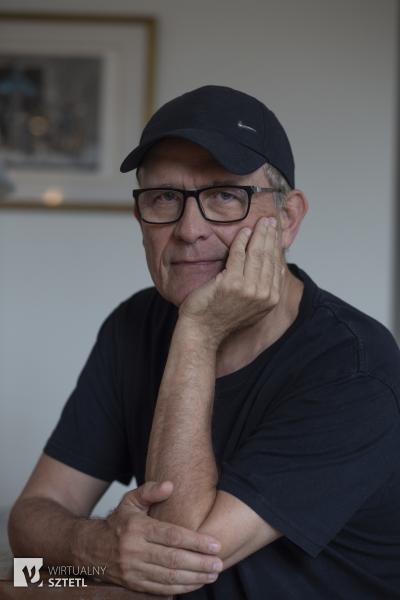
Weitzner Jacob (Kobi) (24.03.1951, Tel Aviv - 20.09.2018, Warsaw) - Israeli-Polish literary scholar, theatre scholar, lecturer, journalist, translator, writer.
His parents were Samuel Weitzner and Chana née Neuman. Born in Skole, Samuel Weitzner came from a family with ties to Chernivtsi, but grew up in Lviv. He left Poland for Palestine in 1934 as an ideological emigrant – he was a committed Zionist, a member of Ha‘Shomer ha‘Tzair. Chana Neuman came from Skałat in the Tarnopol Province. She was persuaded to emigrate to Palestine in 1936 by friends. Kobi's parents, therefore, only met in Israel. In his family home, he acquired abilities in Hebrew, Yiddish and Polish.
He graduated from primary school in Tel Aviv and then from the French-language Collège des Frères in Jaffa. From 1970 to 1976, he studied Hebrew literature and theatre studies in the Faculty of Humanities of the Hebrew University of Jerusalem. He subsequently worked as a lecturer there (1978-1983).
In 1981, he came to Poland for the first time. During this visit, he interviewed Julian Stryjkowski (recording preserved in the digital collection of the POLIN Museum of the History of Polish Jews) regarding the production of Jerzy Kawalerowicz's movie Austeria (1982).
In 1982, he received his doctoral degree, based on his work Shalom Aleichem be-teatron ha-jehudi olem, published in 1994 by Symposium Press in London (Sholem Aleichem in the Theatre). From 1988 to 1989, he served as cultural director at the World Yiddish Congress in New York. In addition to his academic work at, for example, Tel Aviv University, Emory University, Columbia University and Hunter College, he has been involved in a number of Jewish heritage projects. He participated in the Diaspora Museum's expedition dedicated to the documentation of cemeteries and synagogues of the former Galicia (ca. 1984).
He has collaborated (as a translator) on films, including Partisans of Vilna (USA, 1986, dir. Joshua Waletzky). At the turn of the 20th century, he became involved in the running of the magazines 'Yiddisher Kemfer' (in Yiddish, 1998- 2005) and 'Response: A Contemporary Jewish Review' (in English, 2001-2005). He was also associated with the well-known New York weekly 'Forverts', where he held the positions of assistant editor and radio host (2001-2004) and, after arriving in Poland, that of a correspondent (until 2018).
He moved to Poland in 2005. In Warsaw, he worked as literary manager of the E.R. Kamińska Jewish State Theatre in Warsaw (2005-2018), editor of the Yiddish section of the bi-weekly 'Słowo Żydowskie / Dos Jidisze Wort' (2005-2018), Yiddish teacher at the Mordechaj Anielewicz Centre at the Institute of History of the University of Warsaw (2006-2010), Yiddish and Hebrew language teacher at the Yiddish Culture Centre and the University of the Third Age at the Jewish Theatre (2006-2018), news editor and cultural service editor at the Hebrew Section of Polish Radio Abroad (2007-2012) and the director of the Kinder Theatrr (children's theatre) operating as part of the Social and Cultural Association of Jews in Poland (2011-2015).
On many occasions, he has been active as an actor, both in theatre and film. For example, he appeared as a tourist from Israel in one of the final scenes of Władysław Pasikowski's Pokłosie (Aftermath) (2012). Extremely versatile, he was an active man of letters through and through. He left behind a number of publications, which we list below - the last one so far, waspublished in 2023 in e-book form.
Kobi Weitzner is buried in the Jewish cemetery on ul. Okopowa in Warsaw.
Publications
- Sholem Aleichem's The Jackpot, New York 1989 - a translation and commentary on Sholem Aleichem's classic work Dos grojse gewins [eng. 'The Jackpot'].
- The film version of I.B. Singer's 'Enemies, a Love Story', 'Ha-Doar', 09.02.1990.
- From Tevye the Dairyman to Fiddler on the Roof, 'Ha-Doar', 04.09.1994.
- Sholem Aleichem Screenwriter, 'Yiddish' 1995, no. 10, pp. 57–61.
- The Death of the Purim Shpil, 'Moznayim' 1996, pp. 25–27.
- Women in Sholem Aleichem'sWork, 'Huliot' 1996, pp. 129–136.
- Mekhirat Yosef. Purim-shpil be-Rowno, Polin lifney milkhemet ha-olam ha-shniya, 'Dimuy' 1996, pp. 16–21 (eng. 'The sale of Joseph. Purim play in Równe, Poland, before the Second World War');
- Ibn Gvirol pinat Ha-Yarkon ve sipurim akharim, 'Yerushalaim' 1997 (eng. 'Ibn Gvirol, Corner of Ha-Yarkon, and other stories');
- Yitzhok Bashevis Zinger un zayne umbakante poems, 'Jidiszer Kemfer' 1998, vol. 69, no. 2798, pp. 10–11 (eng. 'Izaak Bashevis Singer and his unknown poems');
- Mekhirat Josef be-teatron ha-Yehudi ha-amami, 'Tel Awiw' 1999 (eng. 'The sale of Joseph in the Jewish popular theatre');
- Purimowe sztuki o sprzedaniu Józefa. Od dramatu literackiego do dramatu ludowego – 'Nieustanny obieg kulturowy', [in:] Teatr żydowski w Polsce, edited by Kuligowska-Korzeniewska, A., Leyko, M., Łódź 1998;
- Vos Henech Kon hot geshribn vayl dos esn hot im gut geshmekt, 'Jidiszer Kemfer' 2000, vol. 80, no. 2804, pp. 7–9 (eng. 'What Henoh Kon has written after he found his food delicious');
- Yiddish Proletarian Theater: The Art and Politics of the Artef, 1925–1940. Review, 'AJS Review' no. 25, 2001, pp. 142–144;
- As long as you laugh – The book of weitznerisms, New York 2001 – selections of sayings and jokes;
- Yiddish in Israeli Cinema, 'Prooftexts' 2002, pp. 186–199;
- Teatr żydowski we współczesnym świecie, [in:] Teatralna Jerozolima. Przeszłość i teraźniejszość, Kuligowska-Korzeniewska, A., (Ed.) 2006. Warszawa, ss. 119–126;
- 27 bajek żydowskich, Warszawa 2008 – co-authored with Aleksandra Król and Andrzej Polc;
- Karpilewski oder vos tut men dermit (piese), 'Jerushalaymer Almanach', no. 29, 2012, pp. 41–64 (eng. 'Karpilewski or what to do about it (play)');
- Der glikleher mensh, Lund 2018 (eng. 'A happy man') – Yiddish fable, illustrated by Linda Siewert;
- Der ganef un der talmid-khohem, Lund 2018 (eng. 'The thief and the scholar') – Yiddish fable, illustrated by E. Olauson (as e-book in 2023);
- Afile du in Manhetn. Tsvey pieses, Lund 2020 (eng. 'Even here, in Manhattan. Two plays').