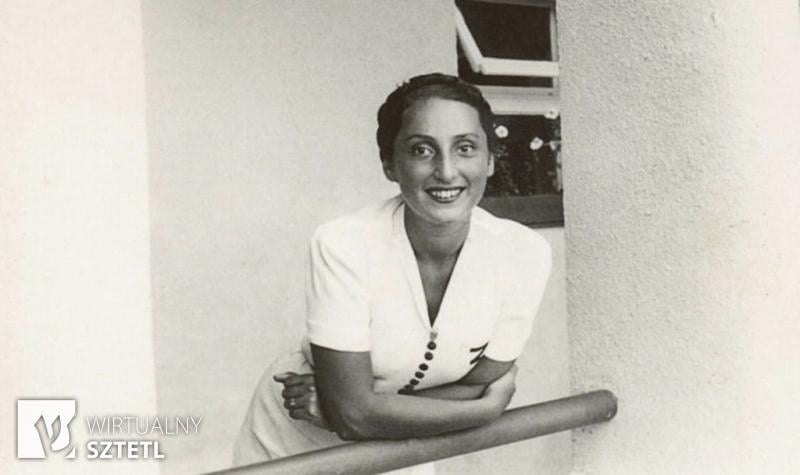
Zuzanna Ginczanka, actually Zuzanna (Szoszana) Polina Ginzburg (Gincburg) (09/03/1917 [or 15/03/1917] Kiev – 05/1944 Kraków) – Polish-Jewish poet, remembered primarily as the author of the poem *** (Non omnis moriar), which has entered the canon of Polish poetry.
She was the daughter of Szymon and Cecylia Ginzburg. After the outbreak of the civil war in Russia, the poet’s parents fled to Równe in the historical region of Wołyń. Soon after, her father left the family and went to the United States. Her mother remarried and moved to Pampelona. Ginczanka remained in Poland under the care of her grandmother, Klara Sandberg.
She made her debut, in 1931, with her poem Uczta wakacyjna (Eng. A Holiday Treat) within the pages of magazine “Echa szkolne” (Eng. “School Echoes”). In 1933, her poem Żyzność sierpniowa (Eng. Autumn Fertility) appeared in the “Kurier Literacko-Naukowy” (Eng. „Literary-Scholarly Courier”). Ginczanka was a fan of “Wiadomości Literackie” (Eng. “Literary News”). In high school, she corresponded with Julian Tuwim. In 1934, after being persuaded by the poet, she entered Turniej Młodych Poetów (Eng. Young Poets Tournament), organised by “Wiadomości Literackie”. She received a distinction for her poem Gramatyka (Eng. Grammar). In 1935, after graduating from high school, she moved to Warsaw.
In 1935, as the only woman, she joined the editorial staff of the satirical publication “Szpilki”. She also worked with “Wiadomości Literackie” and with Polish Radio. She was a regular visitor to literary coffee shops. In “Mała Ziemiańska” she met with Skamandrites, while in “Zodiak”, with her friend Witold Gombrowicz. In 1936, she began studying in the Humanities Faculty of the University of Warsaw (Pedagogy). However, due to the antisemitic excesses, she stopped attending lectures. In 1936, she published O centaurach (Eng. On Centaurs). It was the only volume of poetry which she published during her lifetime.
The War found Ginczanka in her hometown of Równe. She decided not to return to Warsaw, but moved to Lwów. In 1940, she married Michał Weinzieher, but remained in a close relationship with Janusz Woźniakowski. In Lwów, she joined the Union of Soviet Writers in Ukraine and published several items in the pages of the Soviet “Nowych Widnokręgów” [Eng: “New Horizons”] and in an issue of the “Almanach Literacki” [Eng: “Literary Almanac”]. In 1942, Ginczanka was denounced by the owner of the tenement building in which she was hiding. Based on these experiences, she created the poem *** (Non omnis moriar), in which she pointed to Zofia Chominowa as the person who denounced her. After the War, the work served as evidence in a case brought against Chominowa, for which she was sentenced to four years in prison.
In 1943, Ginczanka was hiding in Lwów, then in Kraków and the surrounding area. She presented herself as “Maria Danilewicz”, an Armenian in origin. In 1944, Michał Weinzieher and Janusz Woźniakowski were sentenced to death. In the autumn, after probably being denounced by a neighbour, she herself was arrested by the Gestapo. In the Montelupich prison, she was tortured and then taken to the prison on ulica Czarneckiego. It was probably in May 1944 that she was shot in the Płaszów concentration camp.
After the War, her works were recalled by Jan Śpiewak (Ginczanka Z., Wiersze wybrane, Warszawa 1953) and, beginning in the 1990’s, Izolda Kiec published a number of books and articles about the poet.
Maria Antosik-Piela
English translation: Andrew Rajcher
Bibliography:
- Araszkiewicz A., Wypowiadam wam moje życie, Warszawa 2001.
- Ginczanka Z., Wiersze zebrane, Sejny 2014.
- Kiec I., Zuzanna Ginczanka: życie i twórczość, Poznań 1994.