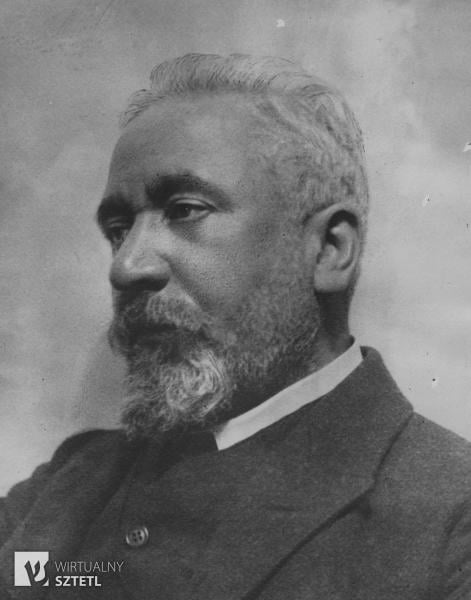
Morkowicz Jakub – (12.03.1876 Opoczno – 09.08.1931 Warszawa) – bookseller and publisher.
Morkowicz graduated from middle school in Radom. Due to his involvement in the conspiracy central section of student organisations in the town, he was not accepted to the University of Warsaw. He left for Munich, where he studied natural science and social science, and later for Brussels and Antwerp, where he graduated from the Academy of Trade. He was a chairman of the association of students – Poles.
In Brussels he was known as an engaged activist in the Union of Socialist Youth, and later in London in the Foreign Union of Polish Socialists. At that time he distributed illegal press to Poland and mediated in the purchase of fonts for a secret printing-house. He returned to Poland in 1898, and started to work in the Bank of H. Wawelberg as a foreign correspondent. He was active in the Economic Section of the Association for Support of Industry and Trade as well as in conspiracy under the penname “Dekadent” (“Decadent”). He sympathized with PPS (Polish Socialist Party) by distributing illegal press and conducting education campaigns. He was also active in the Polish Culture Society, University for Everybody – all these areas of his social activity, and in particular distribution of secret press and education campaigns became a reason to place Mortkowicz in the 10th Pavilion of the Warsaw Citadel by tsarist authorities in 1899-1900, and later to send him to Caucasus. After serving the sentence, he returned to Poland to perform his old job. However, he started to think of undertaking another activity on his own account.
In order to evade procedural obstacles which occurred as a result of his political activity, along with his friend from the bank, Henryk Lindenfeld, he purchased shares in Warsaw bookshop owned by G. Centnerszwer, which enjoyed popularity among readers from 1876. Centnerszwer himself stayed in the company for a short period. The company under the name Centnerszwer i S-ka (“Centnerszwer and Company”) commenced its activity in 1904 already with new management as a consignment bookshop and a bookshop with books published by the owner and by other publishers.
In 1906, together with B.A. Jędrzejowski and K. Praus, he established the Society of People’s Publishing Houses involved in publishing socialist brochures. For distributing and keeping books issued by that Publishing House, he was sentenced again to forced abandonment of Poland. However soon he returned and continued his work. In 1912 Mortkowicz paid off Lindenfeld’s shares and became the only owner of the bookshop. A year later he bought the World Bookshop and incorporated it into his own bookshop. He also took over financial liabilities of the Cracow “Książka” (“The Book”) towards Stefan Żeromski and acquired the right to publish his works. He published them in translation into various languages, undertook reissues of exhausted editions, published every new work of the writer, and he carefully prepared editions addressed to fans of the talent of the author of “Popioły” (“The Ashes”). Until the outburst of the First World War he also published the series: “Pod Znakiem Poetów” (“Under the Sign of Poets”).
However, extension of the publishing activity required new funds, therefore in 1915 Mortkowicz together with Teodor Toeplitz set up a joint stock company “Towarzystwo Wydawnicze w Warszawie” (“Publishing Society in Warsaw”). The period of the First World War did not foster the development of the publishing house, however neither problems with the censorship nor financial difficulties prevented Mortkowicz from issuing about 50 titles in 1915-1918. He also acquired an independence magazine “Myśl Polska” (“Polish Thought”), which he published and edited from April 1915. This caused repressions of the occupation authorities: the bookshop in Marszałkowska Street was closed down.
After the First World War, he entered the joint venture company “Składnica Pomocy Szkolnych” (“Repository of School Aids”) and continued publishing the series “Pod Znakiem Poetów” (“Under the Sign of Poets”) under which outstanding poems of the whole generation of "Skamander” were published (such as “Wiosna i wino” – “Spring and Wine” by K. Wierzyński, “Sokrates tańczący” – “The Dancing Socrates” by J. Tuwim, or ”Karmazynowy poemat” – “Crimson Poem” by J. Lechoń). He also introduced a number of new ones “Biblioteka Beletrystyczna Towarzystwa Wydawniczego” (“Fiction Library of Publishing Society”), “Biblioteka Humoru Towarzystwa Wydawniczego” (“Humour Library of Publishing Society”) ed. by J. Tuwim, “Dobre Książki dla Młodzieży” (“Good Books for Youth”) (which was a highly rated series; translations of works by English and Scandinavian writers were published there, as well as almost the whole output of J. Korczak, M. Konopnicka, works of B. Ostrowska, M. Dąbrowska, E. Szelburg-Zarembina, and J. Brzechwa), “Książnica wielkich Pisarzy Cudzoziemskich” (“Library of Great Foreign Writers”), “Książnica Współczesnych Pisarzy Polskich”(“Library of Contemporary Polish Writers”) (he published there works of A. Strug, M. Kuncewiczowa, P. Gojawiczyński, J. Kaden-Bandrowski, Z. Nałkowska, W. Sieroszewski), “Panteon” (literary and philosophical works) as well as “Plutarch Polski” (“Polish Plutarch”) (autobiographies of famous Poles).
Mortkowicz also contributed to publishing 19 volumes of “Pisma” (“Letters”) by L. Staff. Although the main place in the output of the publishing house was occupied by Polish contemporary poetry and prose, equally significant were album works in the area of art, which came out in individual series: “Arcydzieła Malarstwa Klasycznego” (“Masterpieces of Classical Painting”), “Arcydzieła Malarstwa Współczesnego” (“Masterpieces of Contemporary Painting”), “Dzieje Sztuki w Polsce” (“History of Art in Poland”), as well as albums presenting output of individual artists.
In 1928-29 Mortkowicz edited and published the bibliophile “Świat Książki” (“The World of Books”). He was also a member of the Propaganda Council of the Ministry of Foreign Affairs, Council of Society for International Dissemination of Polish Art, and Committee of International Congresses of Publishers. He was a member in the board of the Union of Polish Booksellers and editorial committee of “Przegląd Księgarski” (“Bookshop Overview”). He co-organized the First Congress of Polish Booksellers in Lublin in 1918. He participated in numerous international congresses, representing interests of Polish publishers and output of Polish Bookselling. He organized a lot of book exhibitions abroad. On behalf of the Minister of Foreign Affairs, he was a commissioner responsible for presentation of the Polish section in the “Międzynarodowa Wystawa Pięknej Książki” (“International Exhibition of Beautiful Book”) in Paris, for which he wrote and published a book entitled “Le Livre d’art en Pologne 1900-1931”. He was honoured with the Commander's Cross Polonia Restituta for his contribution in the area of bookselling, raising the level of publishing and editing culture, and dissemination of knowledge about the Polish book abroad.
In 1931-1939, after Mortkowicz’s suicidal death, the company was run by his wife, Janina, with the help of her daughter Hanna. The outburst of the Second World War finished the activity of this great institution. In 1944, the bookshop and publishing house completely collapsed. After the war, in 1946-50 Jakub Mortkowicz’s wife and daughter made efforts to continue his work, at least in a limited scope, by running publishing activity in Cracow as Wydawnictwo J.M. (J.M. Publishing House).