
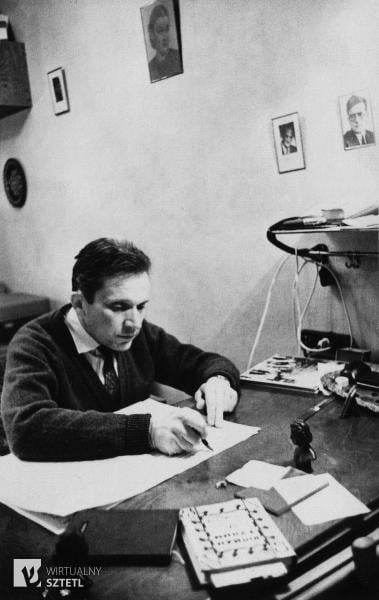
Wajnberg Mieczysław Mojżesz (Weinberg Mojsiej Samoiłowicz) (08/12/1919 Warsaw – 26/02/1996 Moscow) - pianist, composer.
He was the son of Samuel Wajnberg, a conductor and composer. He was exposed to music from childhood, accompanying his father when he worked in Jewish theatres. He began his musical studies at the age of twelve under Józef Turczyński. He continued his studies at music school and then at the State Music Conservatorium in Warsaw, from which he graduated in 1939. As a student, he worked in review theatres and also wrote the music for the film Fredek uszczęśliwia świat (Freddie Makes the World Happy) (1935). Following the outbreak of the War, he fled Warsaw. His family remained and were murdered in the camp in Trawniki. In 1939-1941, he studied composition under Vasily Zołotariov at the Music Conservatory in Minsk. At that time, he also performed as a pianist. After the outbreak of the German-Soviet war, Wajnberg moved to Tashkent. There, he found work as a tutor in the opera and also composed patriotic songs. He married Natalia Wowsi-Micholes (the daughter of the outstanding actor Solomon Micholes). In 1943, thanks to the intercession of Dmitry Shostakovich, the Wajnberg couple moved to Moscow. After the War, Wajnberg decided to remain in the USSR. He was active as a composer in Moscow. Most of his songs ended up in a drawer, because he was accused of being too pessimistic in his compositions and having too few references to folklore. After 1948, his works were banned. He earned money by composing songs for the radio and the circus. At the beginning of 1953, he was arrested for “Jewish bourgeois nationalism”. He was released following the death of Stalin. Wajnberg then composed music for films (among them, The Flying Cranes). He also composed twenty-two symphonies, eighteen solo concertos (the most well-known being his Cello Concerto (1956) written for Mstisław Rostropowicz), the ballet The Golden Key (1955), five operas (including. The Passenger (1968), The Portrait (1980), Idiot according to Fyodor Dostojewski (1986)), four cantatas and seventeen string quartets.
Bibliography:
- Die Musik in Geschichte und Gegenwart. Allgemeine Enzyklopädie der Musik, t. 17, red. F. Blume, Kassel 1986.
- Fuks M., Muzyka ocalona. Judaica polskie, Warsaw 1989.
- Sovetskie kompozitory. Kratkij biografičeskij spravočnik, by G. Bernandt, A. Dolžanskij, Moscow 1957.
- The New Grove Dictionary of American Music, vol. 27, ed. S. Sadie, London 2001.