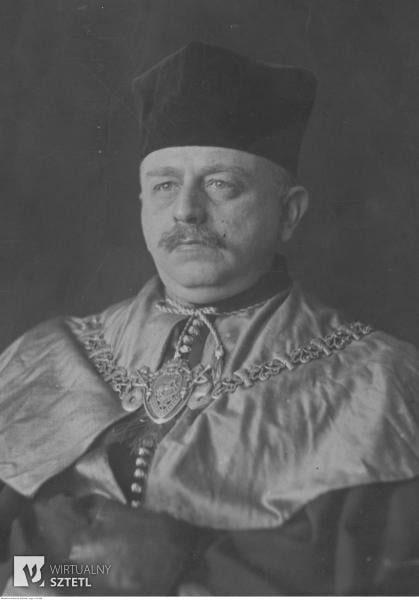
Handelsman Marceli, pseudonym Maciej Romański, Maciej Targowski (08/07/1882, Warsaw – circa 20/03/1945, Dora-Nordhausen) – outstanding medievalist and modern history scholar.
Handelsman was born in Warsaw in 1882. His Jewish family was polonised, with strong patriotic traditions. During the January Uprising, his uncle had fought as a commander in Gostyń. His brother, Józef, was an outstanding psychiatrist. His other brother, Bolesław, was an architect.
After graduating from high school, Handelsman began studying law at the Imperial University of Warsaw. In 1904, he graduated with the title of Candidate of Laws. He then studying history at the University of Berlin, under the supervision of professors Kurt Breysig, Joseph Kohler and M. Tangla. However, he then continued his studies at the École de Chartres and the Collège de France in Paris, as well as at the University of Zurich, where he gained his doctorate in 1908.
He then lived in Rappersville, Vienna and London, where he collected material for further academic work. In 1912, he returned to Warsaw and began lecturing, initially, at the Towarzystwo Kursów Naukowych (Academic Courses Society) and then, from 1915, at the University of Warsaw. In 1919, he gained the title of full professor.
Following Poland gaining its independence, Handelsman became involved in organising academic life. Throughout the entire interwar period, he served as director of the Central Archives of Historical Records. Together with Stanisław Kętrzyński, he edited “Przegląd Historyczny” (“Historical Review”). From 1920, he was a member of the Polish Academy of Learning (PAU), was active in the Warsaw Scientific Society, headed the Cabinet of Historical Science (1912–1939) and the Central Library (1914–1939).
He chaired the Historical Atlas of Polish Lands Commission (1920–1935). He was one of the co-founders of the International Historical Committee and, in 1933, in Warsaw, together with Tadeusz Manteuffle, he organised the International Congress of Historical Sciences, at which, at his initiative, a Jewish delegation also participated.
He belonged to many academic societies in both Poland and abroad, including as a board member of the Société d’Histoire Moderne in Paris. To a significant degree, Handelsman contributed to the establishment of the Institute of History of the University of Warsaw (1930/1931). He was co-founder and vice-president of the Institute of Nationality Research.
His areas of academic interest included the history of law, the political system, ideas and social history. Initially, he devoted great attention to the history of the Middle Ages, but his greatest passion was the 19th century. However, he endeavoured not to focus on just one area. He examined processes which occurred over the centuries.
Handelsman was a dedicated teacher, educating generations of outstanding historians, among them being Stanisław Arnold, Aleksander Gieysztor, Henryk Jabłoński, Stefan Kieniewicz, Marian Małowist, Tadeusz Manteuffel and Emanuel Ringelblum.
From the beginning of the 20th century, Handelsman was ideologically associated with the Polish Socialist Party (PPS). He belonged to the circle of supporters of Józef Piłsudski. During the Polish-Bolshevik War, he volunteered for the army. In 1922, he was an appraiser in the Polish delegation to the Mixed Commissions in Moscow, with a view to the recovery of Polish property and cultural heritage from the USSR (1922).
He condemned the Brest trial and spoke out against the limitation of the autonomy of universities and other institutions of higher education. He opposed the bench ghetto. In 1934, he fell victim to an attack by a right-wing militant. In the 1930s, he became closer to democratic circles (Democratic Clubs, the Democratic Party).
During World War II, he was forced to hide. He lived near Warsaw under a false name. However, this did not stop him from his teaching activities. He was involved in the conduct of secret classes. He also managed to continue his academic work. At that time, he was also working on the biography of Adam Czartoryski.
From 1942, he worked with the Home Army Headquarters’ Office of Propaganda and Information. His name appeared in a document, prepared in 1944 by the National Armed Forced (NSZ), entitled Jews in the ZWZ (Union of Armed Struggle). In July 1944, he was denounced and was arrested by the Gestapo. He was deported to the Gross-Rosen camp and then to Dora-Nordhausen. He died in the camp in March 1945.
Bibliography:
- Węcowski P., Marceli Handelsman (1882–1945), [in:] M. Handelsman, Historyka, by P. Węcowski, Warszawa 2010, pp. 335-346.
- Wierzbicka M., Marceli Handelsman, [in:] Słownik historyków polskich, ed. Maria Prosińska-Jackl, Warszawa 1994, pp. 175-177.