
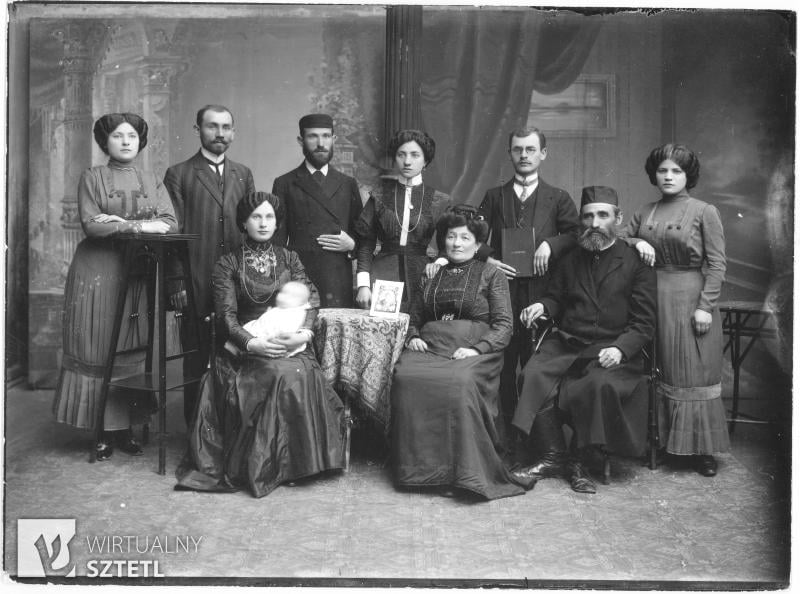
Family – in the realities of the Diaspora, each Jewish social institution had to bear responsibility or protection and cultivation of the basic values of culture and faith. This is particularly true when it comes to a family which – in a way – became a kind of microcosm of Judaism and its psychological, social and economic functions were doubled and transferred by additional cultural and religious tasks even more important since the home liturgy plays the role in Judaism which is not encountered elsewhere.
The first commandment given to people by God reads: “Be fruitful and increase in number” (Gen. 1:28, quotations according to a slightly modified Biblia Tysiąclecia, psalms translated by Czesłąw Miłosz), and then, it is confirmed in the covenant with Abraham (Gen. 15:5). Thus, the basic task of the family – procreation – obtains the character of the fulfilment of God’s order and at the same time of the confirmation of God’s covenant. The ideal of the family life is reflected in the following fragment of the Psalms: “Blessed are all who fear the Lord, who walk in obedience to him! You will eat the fruit of your labour, blessings and prosperity will be yours. Your wife will be like a fruitful vine within your house, your children will be like olive shoots around your table.” (Psalm 128: 1-3)/
As.the only social institution, the family is mentioned in the Ten Commandments: “Honour your father and your mother, as the Lord, your god has commanded you, so that you may live long, so that it may go well with you in the land that Lord, your God is giving you.” (Deut. 5:16); the wording of this commandment in Ex. 20:12 is slightly less expansive and at the same time, it reads: “You shall not covet your neighbour’s wife.” (Deut. 5:21). These rules set up the basic obligations of an individual towards his parents and towards other families.
The difference between the status of men and women marked in Judaism is reflected in different roles of parents. Hence, father is a head of the family (see Num. 26:55 “The land shall be divided by lot according to the names of the tribes of their fathers they shall inherit”), he gives orders (see Gen. 50:16 “… before your father died he commanded, saying..”), and he punishes (see Gen. 37:10 “..his father rebuked him…”). At the same time, God expects him to love his family (see Gen. 20:28 “Isaac loved Esau…” Gen. 37:4 “When his brothers saw that their father loved him more than any of them…”). The examples of treating one of the brothers and sisters in a favourable way and the consequences of this treatment led to a definite Talmudic order “not to distinguish one child from among other children”, Szab. 10) and have compassion upon him (see Ps. 103:13 “As a father has compassion on his children, so the Lord has compassion on those who fear him”). And finally, an extremely important prerogative of father is giving a blessing (see Gen. 27:27-30 – Isaac’s blessing).
Although wife was formally subordinated to her husband (The Gospel describes husband as baal ha-isza, literarily “woman’s master”, see. E.g., Ex. 21:22), she possesses, however, her inviolable rights. Her principle duty, however, is taking care of children since they are blessings (“Children are a heritage from the Lord, offspring a reward from him” – Ps. 127:3) while childlessness is the greatest of possible calamities (“She became pregnant and gave birth to a son and said: ‘God has taken away my disgrace’”. – Gen. 30:23). In practise, she also takes care of bringing up children (‘My son, listen to admonishments of your father and do not reject teachings of your mother”, Prov. 1:8; it is assumed that “mother’s teachings” have been absorbed and they might only be “rejected” while “father’s admonishments” have to be “listened to” now, and in future; father takes only the responsibility for his son’s education when he grows up (see Gen. 13:8).
Family should be tied with the links of mutual responsibility and solidarity. “The family is like a pile of stones. When one is removed, everything may collapse”. (Gen. 100:7). Hence, a great importance attributed to establishing a family. In a commentary to Gen. 5:2 („He created the male and female and blessed them and he named them ‘mankind’ [Adam]” we can read that “a man without wife is not fully a man” (Jew. 63a) since that name is attributed to a man and a woman together. The man without wife is not, for example, regarded as having right to study secrets of the cabalistic biblical exegesis and in particular to play responsible social and cultural roles. He simply has no desired experience. .
Marriage, on the other hand is treated as a breakthrough in an individual’s life, as achieving full humanity. And although the very wedding ceremony is not of a sacral nature, and in some extreme circumstances may be carried out even without a presence of a rabbi, its Hebrew name kiddushim – (sanctifying) fully reflects its fundamental meaning. The basis of a marriage is a wedding contact (Hebr. ketubah) negotiated between a bridegroom or his parents (see. Gen 29 – agreement between Jacob and Laban), and parents of a bride, concluded in a presence of a rabbi according to the principles of the Talmudic civil law. It enumerates mutual obligations of the married couple and the obligations of both families towards newlyweds; the lack of observing these obligations might be one of the indications to claim a divorce. .
In a shtetl, although marriages were arranged by families and the material aspect played an important role, particularly among ‘simple” Jews who had no possessions whatsoever to dispose, marriages were concluded more and more frequently out of love and parents only sanctioned the choice made by young people. As a result, an expectation of a romantic love between husband and wife began to play a decisive role in case of richer marriages.
The institution of divorce had already been known in the Bible (Deut. 24:1); the right to divorce, however, was attributed exclusively to man, and the range of reasons was quite broad. To obtain a divorce, it was sufficient to hand out a divorce letter (Hebr. get) to a wife prepared according to the rules of law. To secure wife’s rights, the “ketuba” usually contains a clause foreseeing a high compensation for a wife sent away against her will. The exception was her childlessness which was the reason for a divorce with no compensation. On the other hand, the rabbinical court (Hebr. bet din) can force a resistant husband to give divorce to a wife (Arach 5:6).
The status of a woman in the Talmudic tradition derives from a premise that “women are a separate nation” (Szab. 62a) and therefore, they have different rights and duties than men, although it results from the commentary (B. k. 15) to Ex 21:1 (“These are the rights which you provide her with”) that men and women are equal in the face of the Torah. Due to the above mentioned reasons as well as to practical reasons, possessing sons was valued more than possessing daughters. Imposing an obligation to be obedient towards their parents and obliging parents to bring up children to be good Jews, the Talmud forbids the behaviours harmful for a child as a person.
And thus, it is forbidden to threat a child with a punishment since punishment should be executed promptly or not executed at all because of the harmful impact of fear (Sema. 2:6) but, on the other hand, it is an obligation to keep promises given to children “not to teach them lies” (Suk. 46b). The true obligation of parents, however is to teach children the Torah. “Once you acquired knowledge you will lack nothing since the lack of knowledge makes you achieve nothing” (Lev. R. 1:6). This duty is directly allocated to a father who should provide knowledge to his son directly or find him a teacher. The role of a mother is to create a proper atmosphere at home, favourable for teaching. The duty to educate children is more associated with sons than with daughters; nonetheless, they were also educated although to a smaller extent. There were no theoretical obstacles for them to possess an equal education or even a superior one: “a woman is more intelligent than a man” (Nida 45). The Talmud mentions women of a great wisdom and knowledge like Rachel, wife and caretaker of the great Rabbi Akiva, and Beruria, a wife and the mentor of Rabbi Meir. .
The great pressure on expanding the religious knowledge by men, which was connected with many years of studies outside home did not leave much time for other activities, therefore, the burden of not only conducting a household but often simply maintaining the household was allocated to women. In consequence, it was them who took over a decisive role in a family life while father maintained a formal status of the household’s master. The position of a father, however remained untouched as far as religious knowledge was concerned (and hence – also education), which was his particular prerogative. And although many Jew made their living working hard physically this situation was regarded improper since physical effort “stupefies”, diverting thoughts from knowledge which is the only thing that counts.
Thus, a family had mostly social functions although the sexual life as such was not perceived in a negative light (apart from some Hasidic trends; on the other hand, a frequent custom of avoiding the company of women or even shaking hands with them by Hassidim is associated with the fear of giving up to an undesired sexual temptation not discarding sexuality as such; on the contrary, one should use sex as other God’s gifts but in a proper and modest way; giving it up would mean discarding God’s gift), although its principal purpose was procreation, of course.
But not only, according to the cabalistic tradition, a sexual relation between husband and wife, if performed in the aura of closeness and love, respect for a partner and care for him (or her) is an element of the tikkun, improving or redeeming the world contaminated with evil. It is also compatible with the superior value of shalom beit – the peace of a household signifying not only the lack of conflicts but also the existence of emotional entirety to which all members of the household contribute. However, since conflicts are inevitable, the open conflict is more desired than the false harmony. Hence, the acceptance of a full emotional expression, including male tears. ,.
Although in our times, the conditions of living in the majority of the countries of the world do not force Jewish families to assume that additional role and at the same time, the majority of these families do not perceive protecting and preserving tradition as the superior role for them, the cultural and psychological values generated throughout centuries do not disappear.
Konstanty Gebert
According to: Tomaszewski J., Żbikowski A., Żydzi w Polsce. Dzieje i kultura. Leksykon, Warszawa 2001.