
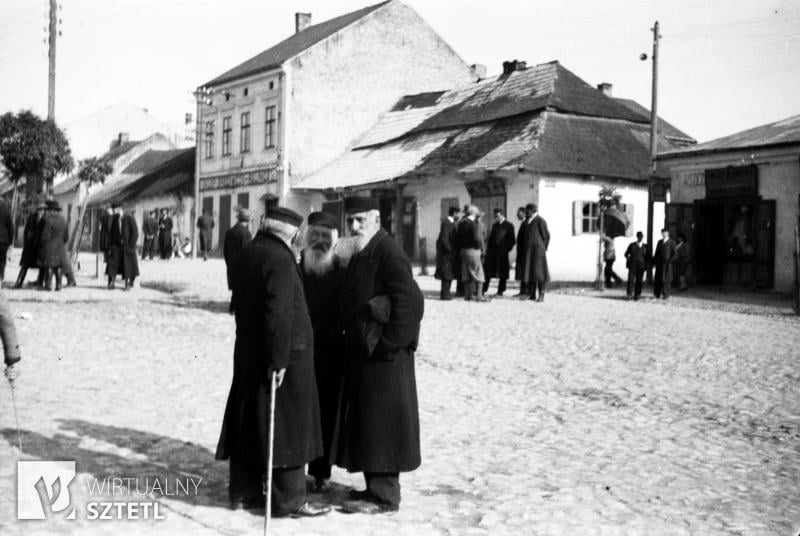
Shtetl – [Yiddish; plural: shtetlekh], a town, hamlet.
Among the many terms used in descriptive languages within the realm of Jewish studies, the term “shtetl” is one of those that are difficult to define but commonly understood, similarly to “antisemitism” or “pogrom”. Unlike the latter, “shtetl” carries a number of positive connotations. In the reviving 1990s in Poland, the interest in Jewish culture and the past, as a key word, “shtetl” became an imagined object ordering the place of Jewishness in social space without the presence of traditional communities. It attracted with its folklore colours and became a link to an old, non-existent world before the tragedy of the Holocaust, perceived in an idyllic manner. It comes from Yiddish, in which it simply means a town, and in a broader sense, a microcosm of a community struggling with Jewish daily life somewhere in the provincial conditions of an “inferior” part of Europe.
The social presence of the concept of the shtetl has entailed an increased interest in academic groups. Beginning with the famous work Life is With People: The Culture of the Shtetl by Marek Zborowski and Elizabeth Herzog, and continuing with the results of a number of academic conferences as well as the materials published as their aftermath, the academic world made an attempt to recognise the concept of “shtetl” in terms of scholarly analysis and scientific inquiry[1.1]. In succour of this was the development of a popular trend of visions of Atlantis with the crucial work of Eva Hoffman and the following documentary film by Marian Marzyński. Today, we still want the Jewish town to be more than an element of the historical imagination of a world without former Jewish communities. But is this possible?
The career of the term “shtetl” began not coincidentally at the turn of the 19th and 20th centuries. The literary discussion concerning the values of the traditional Jewish world was led by Mendele Mojcher Sforim describing genre scenes of Jewish town life, Sholem Aleichem (Tevye the Milkman, 1894), Sholem Asch (A Shtetl, 1904), and the novel by Isaac Meir Weissenberg (A Shtetl, 1906) questioning the latter. These most important voices concerning the town, were written at a time when its traditional functions were fading due to socio-economic changes, and the striving to preserve the historical heritage of Eastern European Jews was becoming one of the important demands of the activity of the emerging modern Jewish intelligentsia of the likes of An-ski, Winawer, or Dubnow.
In the pursuit of an inherently unrealistic, idealistic preservation of Jewish life, the everyday life wrapped around a religious calendar and the perpetuation of traditional family and community rituals, evocative and artistic images were created. To this day, they still delight audiences and stimulate nostalgia for a world that does not exist. Weissenberg's book, polemical towards Asch, must be worrying in this context. This is because it conveys revolutionary angst, stigmatises class divisions, and exposes the town's weaknesses: poverty, backwardness, anti-modernisation attitudes, resistance to change, clinging to harmful traditions and patterns. However, this discourse, radically different from the nostalgic descriptions of Sforim, Asch, or Aleichem, has not become canonical for the collective imagination[1.2].

Mayer Kirshenblatt, "Jews in Opatow synagogue", ca. 1991.
The second wave of the fashion of searching for functionalist values of the term “shtetl” emerged just after the Holocaust period. Jewish towns (shtetls) ceased to exist due to the tragedy of the Holocaust. Groups of survivors, scattered around the world, wanting to commemorate their Central European genealogies, as well as discuss it and pass it on to the following generation, initiated a great movement of writing yizkor books[1.3]. Often low-volume publications, collecting crumbs of documents, knowledge, and variously remembered historical stories from European towns. These books, written by people without historical backgrounds, constitute a perfect mirror reflecting the quintessence of the notion of the “shtetl” as a de facto non-existent formula for life, which nevertheless evokes longing and nostalgia.
Borrowing archetypes from the literature created by the aforementioned classics of Yiddish literature, they wrote about the Jewish world focusing on the local microcosm. In the memory books the shtetl was becoming, the centre of the Jewish world. The space of the town was Jewish, the non-Jewish inhabitants often unfriendly, alien, or even hostile, and constituted the margins of the settlement. In the town plans reconstructed from memory and accompanying these publications, we learn about a predominantly Jewish space, owned and managed by Jewish communities, tame and safe.
As in the nineteenth-century memoirs by Yechezkel Kotik, stepping outside it caused anxiety and gave rise to uncertainty. In this layout, the synagogue constituted the focal point of the town[1.4]. The causality of the Jews in a shtetl was supposed to manifest itself through the uncommon abilities of the leaders, divine providence, and the unheard-of activity of the community members. Archetypal characters are actually drawn on the pages of these monographic histories of shtetls, completing the community in terms of its structure. Prominent rabbis, community heads, economically successful people, dedicated teachers, war heroes, Jewish political party activists, but also others (meshugene).
A key element of this second iteration of the imagined shtetl consists in the victims of the Holocaust. Long lists of names (often incomplete), sometimes age, sometimes a few sentences of description. In the post-Holocaust imagination, a shtetl is not just about places and spatial keystones of Jewish life, but about people and community, united by a tragic fate. It is those who possessed the incredible and sung about potential of the pre-war period, bearing the hope of a bright future despite the difficult conditions created by the socio-legal systems of the countries of Central and Eastern Europe, which had grown up as a result of post-war treaties on the ruins of great empires - in a sense prisons of nations. In the course of the Holocaust, this potential was destroyed and the cycle of life - complemented in the literary manifestations of the first wave of the shtetl trend - came to an abrupt end, at odds with the philosophy and rhythm of life in a Jewish town.
We have been observing the third iteration of the discovery of the “shtetl” since the 1990s. It is based on a non-Jewish longing and, in a sense, an attempt to deal with the moral burden of the Holocaust and a premonition (there was as yet no developed research on the participation of the peoples of the countries conquered by the Third Reich in the Holocaust) concerning rather the moral and sometimes real responsibility for the tragedy of the Holocaust. The third phase of discovering the shtetl in the sphere of the collective imagination bears the hallmarks of folklore.
Reaching for simplistic, folklorised visions of idyllic life and community. This is when inclusive definitions emerge, speaking of a shtetl as a community of Jews and non-Jews, drawing attention to coexistence, an attractive and mysterious culture, the now widely unknown Yiddish language, as well as the elements of religious rituals. Memories of Chagall's crooked roofs are widely enjoyed, translations of idyllic turn-of-the-century novels are being revisited, klezmer concerts and Jewish art shows are being organised, and traces are being sought. A spoonful of tar in this picture consists in Eva Hoffman's[1.5] book and Marian Marzyński's film (Shtetl, 1996).
The perfect image breaks, and with this baggage of uncertainty, the public imagination entered the discussion on Jan Tomasz Gross' book as well as the social debates about the Poles' participation in the Holocaust. The perfect, untrue picture has been nuanced. “Shtetl” as an analytical category, even in the academically untrained sphere of social perceptions, the popular ones, has lost its value and remained a concept that is commonly understood and difficult to define.
And what was it “really” like? The analytical trap we face in making the notion of “shtetl” an analytical category consists in unjustifiably losing diversity. In a historical sense, towns and their structures as well as economic, social, and cultural mechanisms of operation constitute diverse collections that cannot be arranged into even a few models. The economic and legal symbiosis derived from the 16th-18th century legal relations of the state was likely to function until the period of the enfranchisement reforms and the reforms of the legal position of the Jews, thus depending on a given state: roughly until the middle of the 19th century.
The feudal economic system clearly defined the social roles and places of communities and groups, including Jews. Limited in their settlement, civil, civic (to use a category from the nineteenth century), and economic rights, the Jews constituted one of the necessary pieces of the puzzle of small-town communities in Central and Eastern Europe. Clearly assigned tasks of economic exchange placed the “shtetl” in the position of an exchanger of goods, services, and ideas in local communities.
In the reality of the nineteenth-century struggle for existence, nostalgia must give way to calculation. A town (shtetl) should therefore take on an image closer to Weissenberg's space of anxiety, angst, and instability. It is a zone of dispute, conflict, and struggle for existence. It is an area of social inequality (including in Jewish communities), struggles between various religious options and ideas concerning community organisation. The struggle for leadership, the battles to gain a livelihood, the sometimes dramatic defence against groups of the petty bourgeoisie and urban peasants reluctant towards the Jews.
Symbiosis in the reality of a 19th century town gives way to a vision of class strife, religious conflict and the real threat posed by emerging ideological prejudices (antisemitism). In terms of a historical diagnosis, an important question is when this shtetl ceased to exist, after all the social imagination uses the category to describe the annihilation of Jewish towns and even the post-Holocaust social void. Certainly, the enfranchisement of the peasantry, strongly changing economic relations and increasing the intensity of social mobility in Central and Eastern Europe, is a period when the traditional functions of the town changed. The processes within the Jewish community, acculturation, strong tendencies to seek social advancement, paid for by abandoning elements of traditional Jewish culture, or, in extreme cases, apostasy and using new, secular variants of Jewish identity, were also significant. But was this really the end of the shtetl?
If we consider that the “shtetl” constitutes a category of social imaginary, we can talk about the twists and turns it has undergone and is undergoing, but it must be admitted that, contrary to academic attempts to annex the “shtetl” to analytical scientific considerations, it is non-functional. It is therefore difficult to speak of its beginning or end as a viable research object. Therefore, it must be defined not as a place, a community, a religious-cultural conglomerate, with real significance in historical development. The shtetl should be understood as a tool organising a certain sphere of imaginations and social memory of the Jewish community. As this kind of abstract artefact, burdened with emotions and bearing a nostalgic longing, it should itself be an object of reflection rather than a category to order the study of Jewish history. It is a concept that does not stem from the complexities of Jewish history, but rather from the need of contemporary observers and amateurs of folklore stories, seeking a recipe for dealing with the difficult and not at all bright and optimistic past of this part of Europe in the mythologised layers of social imagery.
Artur Markowski
- [1.1] See: D. K. Roskies, D. C. Roskies, The Shtetl book. Augmented Edition. An Introduction to East European Jewish Life and Lore, Jersey 1975, J. Shandler, Shtetl. Vernacular Intellectual History, New Brunswick et al. 2014. The Shtetl. New Evaluations, ed. S.T. Katz, Nowy Jork 2006, The Shtetl: Image and Reality. Papers of the Second Mendel Friedman International Conference on Yiddish, red. G Estraikh I M. Krutikov, Oxford 2000, Sztetl XXI wiek. Polewyje issledowanija, red. W. A. Dymszic et al., Sankt Pieteirburg 2008,
- [1.2] P. Laskowski, Revolution in a Shtetl: Literary Image and Historical Representation, “Studia Judaica” 2017, no. 1(39), p. 17-46.
- [1.3] See.: Księgi pamięci gmin żydowskich: tam był kiedyś mój dom..., selection, comp. and preface. M. Adamczyk-Garbowska, A. Kopciowski, A. Trzciński, Lublin 2009.
- [1.4] O. Goldberg-Mulkiewicz, Itineraria miasteczek żydowskich: https://teatrnn.pl/files/websites/wystawy/Atlas/Goldberg_itineraria.pdf [accessed 29.03.2024].
- [1.5] E. Hoffman, Sztetl: świat Żydów polskich, Warszawa 2000.