Jews have lived in Bolesławiec probably already since 1190[1.1]. In that year, townspeople borrowed a certain amount of money from Jews which they needed to build town walls. In return, Jews were given their own street and a synagogue[1.2]. Although the information has been recognised by Marcus Brann for uncertain, it is likely that exactly Bolesławiec – along with Legnica, Lwówek Sląski, Zgorzelec and Wleń constituted – except Wrocław – the first Jewish settlement site in Silesia[1.3]. This hypothesis is enforced by the fact that Bolesławiec was one of the towns situated on an important trade route from Wrocław via Legnica, Chojnów and Zgorzelec to Leipzig. Further references to the Jewish population in Bolesławiec come from 1370.
The references confirming Jewish presence in the town can also be found in the chronicles of Holstenius from Bolesławiec: "The inhabitants built [...] a wall from the Obertor up to the Niclastor, encumbering Jews with cash tribute for this purpose: they were here then because mines, in which gold was found in pits and underground, were opened here in Lwówek Śląski and Złotoryja. Therefore, Jews were allowed to have their own synagogue and street”[1.4]. The earliest Jewish settlement in the town was probably associated with the activity of the gold mines because these were Jews who developed a lively trade exchange with Leipzig when trading minerals.
It is unclear where the Jewish quarter was located in the Middle Ages. What is certain, though, is that Jews lived outside the town walls, the construction and maintenance of which they had to pay for. According to one version, the Jewish quarter was located on the East side of the Jeleniogórska Street. This information might be confirmed by the fact that around 1935, while deepening the shaft in the neighbourhood of the Jeleniogórska Street, foundations were encountered which could constitute the remains of the medieval Jewish quarter[1.5]. According to another version, they lived at the Przedmieście Mikołajskie. They were concentrated primarily on the West side of the Lwówecka Street, which was called Judengasse[1.6].
In 1361, chronicler Ruthard mentioned Jews from Bolesławiec in his chronicle[1.7]. In the Middle Ages, 360 Jewish inhabitants lived in the town. They owned 31 houses. They were involved in small trade, craft and small services. In the 14th century, the residents of Bolesławiec funded the construction of the town walls between the Górna Brama and the Brama Mikołajska from the taxes imposed on the Jewish population. F. Holstein mentioned this in his 17th-century chronicle, Kronika Miasta Bolesławca[1.8]. Very little is known about as how the Jewish quarter looked like. It also included – apart from buildings – gardens and arable lands.
Jews were expelled from the town in 1454, sharing the fate of their co-religionists from other Silesian cities. This was due to numerous anti-Jewish instances which then swept through the area of Lower Silesia. The organised Jewish life disappeared from Bolesławiec for over 300 years.
Few Jews appeared in the town already in the 18th century, but the community was reactivated only after the emancipation edict of 1812. The pioneers of the Jewish community in Bolesławiec in the 19th century were Israel Hülse, Meyer Schindlower and Moritz Zaller. Fernbach was the first community official. In 1823, the first room for prayers was set up in the house of widow Böhm at the then Kirchplatz[1.9]. The Jewish population grew – from 21 people in 1822, through 99 in 1849, to 194 in 1880[1.10].
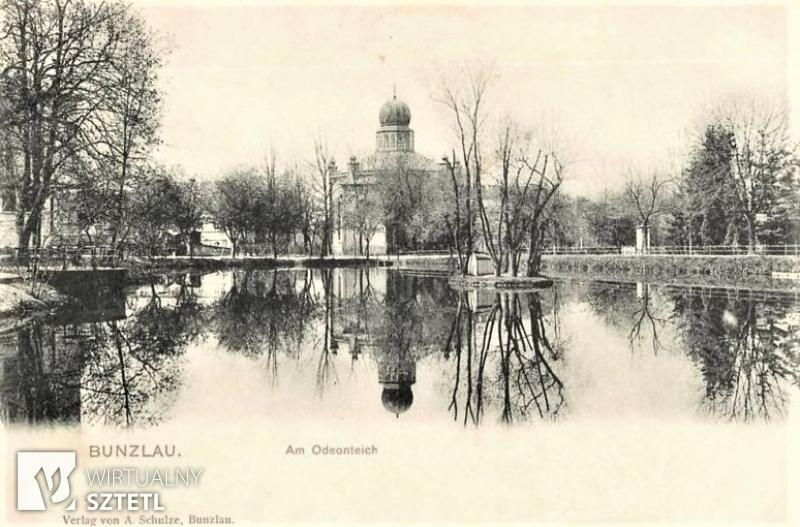
After Hitler came to power, the situation of Jews in the town deteriorated significantly. Already in April 1933, Jewish shops in the town were boycotted – uniformed SA functionaries photographed people who wanted to shop there. Once the Nuremberg Laws were enforced, Jews from Bolesławiec were removed from state posts, organisations and associations. During the Kristallnacht from 9 to 10 November 1938, Jewish businesses in Bolesławiec were plundered, and the synagogue set on fire. The synagogue was on fire, and firemen stood beside it making sure that the fire would not spread to its neighbouring buildings[1.11].
Little is known about postwar fate of the Jewish community from Bolesławiec. Names of Jews from Bolesławiec appear in the lists of prisoners of the so-called transit camps created for Jews of the Lower Silesia in Grüssau (now Krzeszów) and Riebnig (now Rybna). Klara Sachs, Sophie Sachs, Eugen Martin Schück were in the Grüssau camp – they were all deported to Terezin on 26 July 1942 during the so-called fourth evacuation operation, and Erna Hirschfeld, nee Kaiser, who was later deported to Terezin – in the Riebnig camp[1.12].
- [1.1] E. Wernicke, Chronik der Stadt Bunzlau, Bunzlau 1884, p. 125.
- [1.2] Codex Diplomaticus Silesiae, vol. 7: Regesten zur schlesichen Geschichte, ed. C. Grünhagen, Breslau 1884, p. 53.
- [1.3] F. Rosenthal, Najstarsze osiedla żydowskie na Śląsku, in: "Biuletyn Żydowskiego Instytutu Historycznego" 1960, no 34, p. 24.
- [1.4] F. Rosenthal, Najstarsze osiedla żydowskie na Śląsku, in: "Biuletyn Żydowskiego Instytutu Historycznego", 1960, no 34, p. 6.
- [1.5] Rosenthal F., Najstarsze osiedla żydowskie na Śląsku, in: "Biuletyn Żydowskiego Instytutu Historycznego", 1960, no 34, p. 6.
- [1.6] R. Żerelik, Dzieje Bolesławca w średniowieczu (do 1526 r.), in: Bolesławiec. Zarys monografii miasta, T. Bugaj, K. Matwijowski (eds.), Wrocław 2001, pp. 50, 52.
- [1.7] M. Olczak, J. Moniatowicz, Bolesławiec. Przewodnik historyczny, Jelenia Góra–Bolesławiec 2000, p. 20.
- [1.8] M. Olczak, J. Moniatowicz, Bolesławiec. Przewodnik historyczny, Jelenia Góra–Bolesławiec 2000, p. 19.
- [1.9] E. Wernicke, Chronik der Stadt Bunzlau, Bunzlau 1884, p. 605.
- [1.10] Bunzlau (Schlesien), [in:] K.-D. Alicke, Lexikon der jüdischen Gemeinden im deutschen Sprachraum, München 2008, p. 726.
- [1.11] K. Popiński, Dzieje społeczno-polityczne (1806–1945), in: Bolesławiec. Zarys monografii miasta, T. Bugaj, K. Matwijowski (eds.), Wrocław 2001, p. 124.
- [1.12] A. Konieczny, Tormersdorf, Grüssau, Riebnig. Obozy przejściowe dla Żydów Dolnego Śląska z lat 1941–1943, Wrocław 1997, pp. 135, 138, 153.