The first historical record of Jews living in Krzemieniec (Ukr. Kremenets) comes from the 15th century. Even though at the turn of the 15th century Jews were expelled from the Grand Duchy of Lithuania, many of them returned to Lithuania and to Krzemieniec as early as the beginning of the 16th century. It is very probable that a “Polish yeshiva” existed in Krzemieniec in the 16th century. The Jewish community of the town was very influential – so much so that between the 16th and the 17th century, a group of Jews from Krzemieniec and Ostróg (Ukr. Ostroh) represented the entire Jewish community of Volhynia at the Council of Four Lands held in Lublin. Towards the second half of the 16th century, there were 50 Jewish houses in the town, as well as a separate Żydowska (Jewish) Street, a permanent synagogue, a Jewish Community House, and a Jewish hospital. Mordechaj Jaffe, a well-respected rabbi, had strong ties with Krzemieniec and represented the town at the Va'ad (Council of Four Lands) in Lublin. Later on, Jaffe worked as a rabbi in Lublin, Prague, and Poznań. Another rabbi working in Krzemieniec was Szlomo Luria (known as the Maharshal), who was the rosh yeshiva in 1579. Later on, he became the rabbi of Lublin[1.1].
Before the Khmelnytsky Uprising, there were over 800 Jewish people living in Krzemieniec[1.2]. At that time, the town was one of the most important centres for the Jewish community of Volhynia. The rabbis of Krzemieniec actively represented their people during the Council of Four Lands.
In 1648, the town and its castle were taken over and destroyed by the Cossack army led by Maksym Krzywonos. Many inhabitants of Krzemieniec, including the Jewish community, were murdered. The town and the local Jewish Community Co-operative were rebuild in the second half of the 17th century. In 1765, Krzemieniec had 649 Jewish inhabitants and over 1,000 people were members of the kehilla – some of them were Jewish people living in the vicinity of the town[1.1.2]. The Jewish community was the second largest one in the Volhynia region (after Łuck [Ukr. Lutsk]).
In the 18th century, Krzemieniec became one of the most prominent centres of the Haskalah in Volhynia. Krzemieniec was the hometown of Izaak Ber Lewinsohn (1788-1860), a rabbi, writer, and satirist, who was known as the “spiritual leader of the Maskilim.” Even though his father-in-law, Nachum Twerski (1730–1797), was the tzaddik of Czarnobyl (Ukr. Chernobyl) and one of the most influential Hasidic leaders in the region, Lewinsohn did not condone orthodoxy. He tried to promote the ideas of the Haskalah in Volhynia, which caused him quite a lot of difficulty. Eventually, though, he became known as one of the forefathers of the Jewish Enlightenment in Russia. Lewinsohn was a friend of Tadeusz Czacki, who established the Liceum Krzemienieckie (a renowned Polish secondary school) in Krzemieniec. Thanks to Czacki's help, Lewinsohn worked as the school's librarian for a long time. Many inhabitants of Krzemieniec disliked Lewinsohn, which caused him to move to Brody, a small village near the town. Nonetheless, he died in his hometown and his body was buried there[1.3].
Between the 18th and the 19th century, Krzemieniec was also an important centre of Hasidic Judaism. One of the local rabbis was Mordechaj of Krzemieniec, who died in the town in 1817 and was the son of Jechiel Michel, the Maggid of Złoczów (Ukr. Zolochiv). Both the father and the son strongly opposed the activities of the Haskalah movement. When Mordechaj of Krzeminiec died, his private house of prayer started to serve as the main Hasidic synagogue in the town.
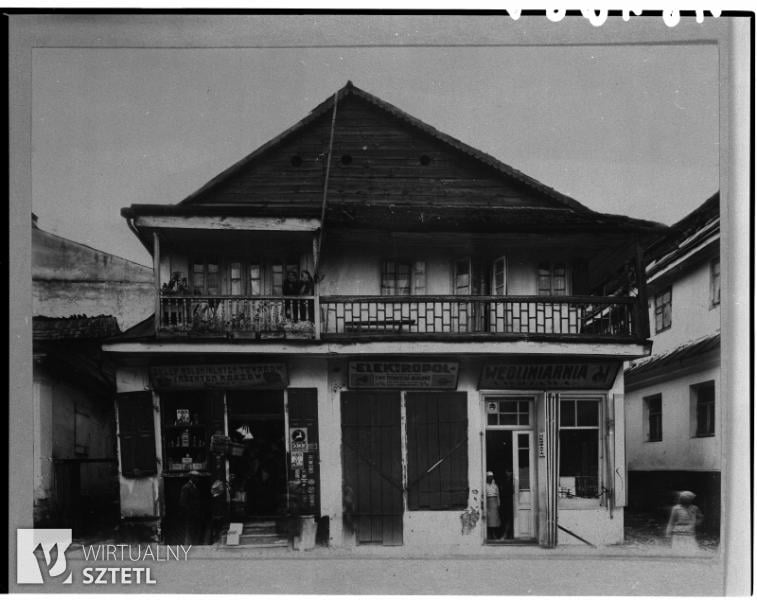
In the 19th century, Krzemieniec actively traded with Austria. Grain and tobacco were the products most frequently exported to Austria by Jewish merchants. At the time, the Jewish community constituted 37% of the town's population. In 1897, there were 6,537 Jews living in Krzemieniec[1.1.2]. During the Russian rule, especially in the 1880s, Russian administrative authorities believed that too many Jewish people lived near the border with Austria-Hungary. They sought to resettle a portion of the Jewish population, especially the people living near Krzemieniec, to other areas of Volhynia or to various locations in the Russian Empire. At the time, the Jewish school system of Krzemieniec was based primarily on traditional cheders. In 1910, a yeshiva was opened in the town, but most of its students came from outside Krzemieniec. Many Jewish children attended Russian elementary school and Gimnazjum Handlowe (a trade secondary school), where 40% of students were Jewish[1.4]. During the Revolution of 1905, Jews started to engage in modern political life. At the time, the town hosted representatives of the Bund, Poale Zion, and the General Zionists Movement. In 1907, advocates of Zionism opened two “progressive cheders” in Krzemieniec, where students were taught modern Hebrew.
In 1917, Krzemieniec entered a period of chaos. Despite increased activity of the communists, in reality there was no organised governing body in the town. In December, the soldiers stationed in Krzemieniec incited anti-Jewish riots which led to the looting of Jewish-owned shops and households and numerous houses being set ablaze. Jewish townsmen who had earlier served in the Russian army established a self-defence force in the town. It was dissolved once German troops entered Krzemieniec. They were advancing into Ukraine as a result of the Treaty of Brest-Litovsk which was signed with Soviet Russia.
During the interwar period, Liceum Krzemienieckie was re-opened as a high school. The Jewish community opened a Tarbut school and, in 1926, a public school (a seven-year primary school) was set up in Krzemieniec by the ORT organisation. At the same time, a Jewish orphanage started to operate in the town. The Jewish community of Krzemieniec also comprised the inhabitants of the nearby village of Pochaiv (Pol. Poczajów). There were six synagogues in Krzemieniec, two batei midrash and several Hasidic kloyzes (small houses of prayer)[1.5].
A weekly newspaper in Yiddish was published in Krzemieniec during the interwar period. It was called Kremenitser Lebn and 1,000 copies were circulated. There was also a daily newspaper called Kremenitser Vokhnblat, but it turned out to be much more short-lived. In 1931, the population of Krzemieniec amounted to 19,877 inhabitants: 8,428 Ukrainians, 6,904 Jews, 3,180 Poles and 883 Russians[1.6].
At the very beginning of the Russian occupation of Poland, many inhabitants of Central Poland fled to Krzemieniec. The estimated number of Jewish people living in the town in 1941 was over 8,500.
The German army entered the town on 2 September 1941 and the very next day Ukrainian nationalists organised a pogrom against the Jewish population. Even children took part in the killings. One of the known cases was a 12-year-old boy who murdered a Jewish woman by repeatedly hitting her with a brick. About 300 to 500 Jews died in the pogrom, which constitutes one of the biggest death tolls of pogroms perpetrated by Germans and Ukrainians in the Vohlynia region[1.7]. On 23 July 1941, Germans performed a mass execution of Jewish intellectuals and on 28 July, they arrested a number of members of the Polish intelligentsia, most of whom worked as teachers in Liceum Krzemienieckie. The list of people to be arrested was drawn up and handed to the Germans by the Organisation of Ukrainian Nationalists. On 30 July 1941, 30 arrested Poles were shot at the Hill of Crosses and Jews were forced to dig a mass grave for the murdered and to bury their bodies. The execution was performed by the same Eisatzgruppen that had earlier shot Polish professors in Lviv and Stanyslaviv (Pol. Stanisławów; currently: Ivano-Frankivsk)[1.8].
On 1 March 1942, a ghetto was set up in the central part of Krzemieniec. It was located in the area between Szeroka, Pierackiego and Krzemienickiego streets and about 12,000 people were forced to move inside it. Many of the ghetto's inhabitants died of starvation. On 10 August 1942, Germans started to liquidate the ghetto. According to various reports, a group of Jewish youth tried to withstand German violence. The ghetto was subsequently set on fire and its inhabitants were taken to a nearby tobacco factory where they were shot on the spot. To this day the question of who set the ghetto on fire is unresolved. It may have been either Jews acting in self-defence or Germans trying to force Jewish people to leave their hide-outs. The fire destroyed the historic part of the town. Only 14 people survived the liquidation of the ghetto. All the reports concerning the resistance movement in the Krzemieniec Ghetto came from Poles living in its close vicinity[1.9].
- [1.1] Etinger S., Shmeruk Ch., History of Jewish Settlement in Kremenets, [in] Pinkas Kremenits. Sefer Zikaron, Tel Aviv 1954, pp. 12–16.
- [1.2] Etinger S., Shmeruk Ch., History of Jewish Settlement in Kremenets, [in] Pinkas Kremenits. Sefere Zikaron, Tel Aviv 1954, p. 21.
- [1.1.2] [a] [b] Etinger S., Shmeruk Ch., History of Jewish Settlement in Kremenets, [in] Pinkas Kremenits. Sefere Zikaron, Tel Aviv 1954, p. 21.
- [1.3] Etinger S., Shmeruk Ch., History of Jewish Settlement in Kremenets, [in] Pinkas Kremenits. Sefere Zikaron, Tel Aviv 1954, pp. 35–37.
- [1.4] Goldenberg M., Changing Eras, [in] Pinkas Kremenits. Sefer Zikaron, Tel Aviv 1954, s. 50.
- [1.5] Gluzman A., Synagogues and Study Halls, [in] Pinkas Kremenits. Sefer Zikaron, Tel Aviv 1954, pp. 87–91.
- [1.6] Główny Urząd Statystyczny, Statystyka Polski, Seria C, zeszyt 70. Drugi powszechny spis ludności z 9.XII.1931. Województwo wołyńskie, Warsaw 1938, p. 28, table 12.
- [1.7] K.C. Berkhoff, Harvest of Despair. Life and Death in Ukraine under Nazi Rule, Harvard 2004, p. 57.
- [1.8] Motyka G., Od rzezi wołyńskiej do akcji Wisła. Konflikt polsko-ukraiński 1943–1947, Kraków 2011, p. 66.
- [1.9] Strumiński J., The Holocaust of the Jews from Krzemieniec 1942. Suplement, [in] Pinkas Kremenits. Sefer Zikaron, Tel Aviv 1954.