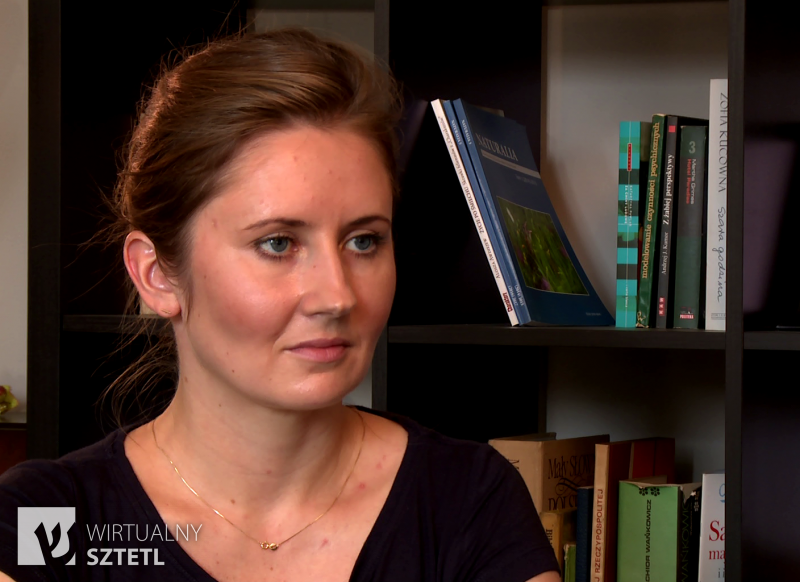
Kamila Wojda
Related places
Interlocutor biogram
Kamila Wojda was born in Kielce in 1986. The first time she was confronted with the issue of the Kielce pogrom was during a Polish language lesson in high school. This influenced the formation of her interests in the Jewish community of Kielce before World War II, the Kielce pogrom and discrimination mechanisms. She chose Jewish culture as the subject of a conversation during the high school graduation Polish oral exam. Kamila Wojda studied Polish philology and pedagogy, and devoted both master's theses to anti-Semitism. She participated in ethnographic expeditions led by Professor Joanna Tokarska-Bakir and takes part in events commemorating Jews of Kielce. She prepared an outdoor exhibition entitled “In a Good Place”, presenting the history of Kielce Jews. It could be viewed on the Kielce market square for a month. Kamila has established cooperation with descendants of Kielce Jews and cooperates with the Jan Karski Society.
Recording circumstances description
The interview was recorded at the Culture of Meeting and Dialogue Institute, 7 Planty Street.
Recording summary
- The interviewee’s origin from Kielce; learning about the Kielce pogrom during a Polish language lesson; participation in the commemorations of anniversaries related to the history of Kielce Jews and other events related to Jewish culture; preparing an exhibition dedicated to the history of Kielce Jews; 00:00:20
- An idea for the exhibition resulting from reading the book entitled ‘W starych Kielcach’ (In Old Kielce); desire to show the Jewish contribution to the development of Kielce; reception of the exhibition by passers-by and descendants of Kielce Jews, 00:03:00
- Arrangement of the exhibition, exhibited materials; 00:06:15
- Development of interest in Jewish subjects; 00:08:00
- Lack of family links with the history of Kielce Jews; the interviewee’s bond with Kielce and local patriotism; 00:11:00
- References to Jewish culture and the achievements of Polish Jews during Polish philology and pedagogical studies; 00:12:50
- Interest in anti-Semitism; comparison of modern hate speech to interwar anti-Semitism; 00:15:27
- The significance of the supposition about the provocation of Kielce pogrom and conversation on this topic; 00:18:50
- Reflection on how to communicate one’s beliefs; 00:22:10
- The need for self-reflection, acknowledgment of guilt and apologizing to the victims as a condition for change for the better; 00:23:35
- Contact with the descendants of Kielce Jews and their expectations; 00:31:50
- Difficulties in combining different points of view as shown in the example of the Auschwitz Museum; difficulties in understanding the perspectives of other nations and groups; 00:36:25
- Israelis not blaming contemporary Poles for the Kielce pogrom; 00:40:10
- Differences of viewpoints between the interviewee and the Israelis; misunderstandings about the subject of communism and the Polish Peoples’ Republic; Israelis’ use of generalizations; 00:43:48
- Reluctance to differentiate Poles and Jews at the naming level in the interwar context; interest in the identity of Kielce Jews; 00:50:15
- A contemporary tendency to categorize; 00:56:05
- Knowledge of the pogrom as a starting point for further interest in Jewish topics; 00:57:50
- Reflections on humanity and human nature; 01:01:50
- Responsibility for deeds even if they result from circumstances; 01:05:50
- Limits of acceptance and tolerance in interpersonal relations, activation of the dehumanization mechanism in language; 01:09:20
- Recognizing the threat that the history of the Holocaust may be repeated; 01:12:20
- The necessity to disseminate knowledge about the pogrom; 01:14:00
- The idea for a new investigation to prove the thesis about provocation of the pogrom; alternative theories explaining the causes of the pogrom; 00:18:08
- Rivalry between the suffering of Poles and Jews; 01:24:30
- Satisfaction derived from differences of outlooks on life as long as they don’t lead to discrimination; 01:25:10
- Facing anti-Polonism of some Israelis; 01:29:10
- Dealing with the stereotype of being from Kielce; 01:36:50
- The conviction that every national group, regardless of historical experience, has the same aspirations; 01:44:24
- Anti-Semitism in Poland - changes in recent years; 01:47:20
- Positive reception of the exhibition; experience of much support from many sides in creating the exhibition; 01:49:00