The earliest records of the Jewish population date back to 1581, when the bishop of Kraków, Piotr Myszkowski, accused the Jews of host desecration. As a result of the trial, however, they were cleared of the charge[1.1].
In 1598, an inspector, Fr Krzysztof Kazimirski, forbade the Catholic population to allow Jews into their homes, while after 1635, Stanisław Warszycki expelled the Jews from the settlement. The brick synagogue building was then designated for the church of St Barbara.
Jews returned to Pilica after 1690, when the subsequent owner of the town, Michał Warszycki, allowed Jewish settlement in Pilica. Thanks to this permission, in 1700, Jews already had a synagogue, a cheder and a bathhouse in Pilica. Further privileges followed in 1731, 1733, 1753 and 1787. In 1763, the last session of the Council of Four Lands (Waad Arba Aracot) was held in Pilica. It was an assembly of Jewish delegates from all over Poland. In 1765, 506 Jews lived in the town. In 1790, there was a Jewish school. In 1791, there were 225 buildings, 171 of which belonged to Christians and 54 to Jews.
The town actively participated in the fight for independence, for which, in 1869, the tsarist regime stripped it of its municipal rights despite the fact that it had 3,357 inhabitants, including 2,267 Jews[1.2]. Three consecutive great fires in the 19th century also contributed to the town’s fall.
At the beginning of the 1870s, a paper factory owned by C. A. Moes was built there. In 1876, it employed 166 people. The mining industry also developed.
In 1883 the settlement had 4,604 inhabitants living in 220 houses. In 1885, the following was written about Pilica: “[...] puddles on the streets never dry up, and all the yards are dirty like skips.”[1.3]. In 1886, a fire destroyed the settlement once more. As a result, over 200 Jewish families were left homeless, with most leaving Pilica and moving to Zawiercie, Łódź and even Kraków. In 1897, 1,287 Poles and 2,688 Jews lived in Pilica. Most made a living from crafts and trade. Some noted merchants in the country were the intermediaries from Pilica.
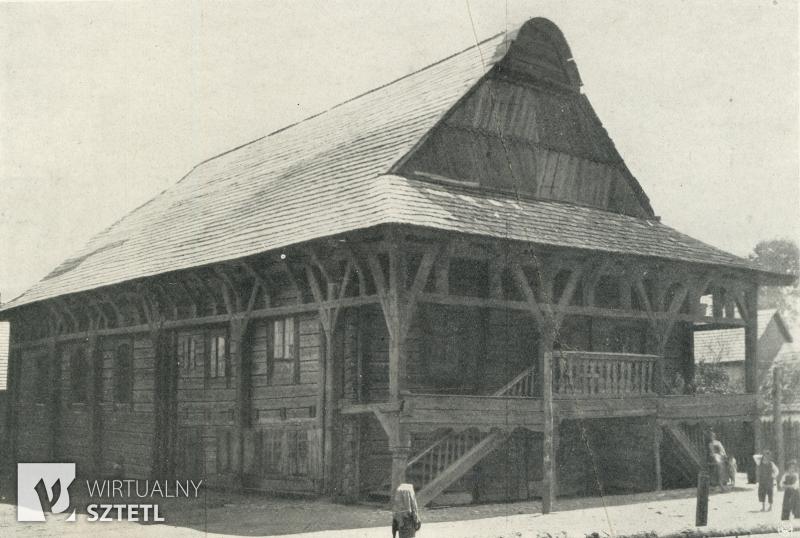
In the late 19th and early 20th century, Pilica became a well-known centre of Hasidism: “After the death of the famous Tzadik from Góra Kalwaria, a significant number of Hasidim began to go on pilgrimage to the brother-in-law of a well-known rabbi, who is the rabbi of Pilica”[1.4]. Rabbi Pinkus Rotenberg was the head of the Jewish synagogue precinct. Pilica, as one of the few settlements, could boast a three-hundred-year-old synagogue built of larch wood.
After the end of World War I, Pilica became part of the Second Polish Republic. In 1927, there were 225 houses in the settlement, mostly single-storey ones. There were 3,300 people. “On average, there were four families per house...” [1.5]. So the density was high. In the interwar period, Pilica was known for the production of footwear.
At the end of the 1920s, the largest factories owned by Jews included the power plant and mill of G. Lichtensztajn, the sawmill of D. Rajzner and the soda factory owned by L. Jakobson. Moreover, the following businesses merit a mention: the sheet metal plant of Ch. Kac, cap maker I. Jakobson, bookbinder A. Wasserman, shoemaker W. Hochman, tailor L. Sztylman, bakeries of M. Grosfeld, H. Lancman, F. Sztybel, B. Wajnreb, Ch. Zegielman, Ch. Zylbersztajn, I. Zyzman, slaughterhouses of Ch. Fajman, M. Feder, A. and L. Gentrajchendler. The largest retail outlets included S. Rajzman’s silk store, A. Szwarcbaum’s flour shop, grocery shops owned by M. Binensztok, M. Feder, B. Frydrych, K. Goldkorn, H. Hagierman, L. Hercberg, N. Hochcajt, R. Rotsztajn, R. Szwarcberger, M. Wasserman. A. Rapaport traded in tobacco, M. Mendelson was selling clothes, R. Ehrenrajch and I. Kaner traded in coal, D. Leichter – in grain, A. Orbach, E. Zylbersztajn and A. Wajnsztajn were trading in iron.
Moreover, F. Gildkorn ran an inn. The transport services and car company was owned by Miński and Taborowicz. A loan could be taken at the following banks: Ludowy (People’s Bank), Spółdzielczy (Cooperative Bank), Przemysłowy (Industrial Bank) and Kupiecki (Merchant Bank)[1.6]. The PKO Bank cheques could be used by Hersz Majer and Lejbuś Goldkorn – wine and vodka wholesalers, Alter Herberg, Abram Lewental and the Board of the Jewish Religious Community[1.7].
The first documents concerning the religious community from the interwar period were issued in 1923. They show that the salary of Rabbi Baruch Kalma Sztrenfeld, approved by the Ministry, was set at 1 million Mp. The county office informed the community board that it could lease a bathhouse and a mikveh, as they were unprofitable. The slaughter tax was also determined. For the slaughter of an ox or cow, 10 thousand Mp were collected, calf and sheep – 7 thousand Mp, goat – 5,000 Mp, goose – 1800 Mp, chicken – seven hundred Mp[1.8].
The board, elected in 1924, was composed of Josek Moszek Jakóbson, Enoch Zelcer, Chaim Paryzer, Moszek Konopiński, Dawid Paryzer, Lejbuś Cymerman, Chaim Rotsztajn, Dawid Hercberg. J.M. Jakóbson was a member of the former board. All described themselves as Orthodox. Professions – 1 shoemaker, 1 worker, all others were merchants and traders[1.9].
In 1924, a representative of the county office carried out a comprehensive inspection of prayer houses. As a result, it was ordered that prayer houses in the buildings belonging to Samuel Monowicz, Perla Erlich, Rafał Rusinek, Alter Baum, Henryk Wajnsztok and Szapsa Rajzman must be closed. The order resulted from the terrible hygienic conditions. It was also noted that Pilica has two synagogues, so there were places to pray.
In 1924, a new tax was introduced. For the slaughter of an ox or cow – 5 million Mp, heifer – 4 million Mp, calf – 3 million Mp, sheep – 2 million Mp, goose – 600 thousand Mp and chicken – 300 thousand Mp[1.10]. There were two shochetim: Mendel Binsztok and Szloma Sztajnfeld.
In 1925, the county office drew the attention of the board to the necessity of settling the matter of slaughter. The shochetim collected money from ritual slaughter, which was contrary to the recommendations of the Ministry.
In 1925, the Jewish community included 2,850 people; the chairman was E. Zalcerz. 291 families were to pay the contributions[1.11]. The slaughter was expected to generate 11,248.94 zlotys. There was a burial society in the community. It collected some fees from families, which violated the applicable legal regulations. Accounting was deemed rational. Rabbi Sztrenfeld’s monthly salary amounted to 400 zlotys, i.e. 4,800 zlotys a year.
In August 1925, the Ministry recommended an 800 zlotys increase in the rabbi’s salary. At the same time, it was determined that the income from slaughter was understated in relation to the number of families[1.12].
When assessing the budget for 1926, certain irregularities were brought to the attention of the community board. Firstly, the board did not have its own premises, and the documents were kept in the house of secretary Icek Zielony. It was ordered to remove from the budget the projected revenues from the koshering of stoves, weddings and circumcision because these were due to the rabbi[1.13]. Other issues raised included the lack of care for the historic synagogue and unrealistic income projection from the ritual slaughter and the bathhouse. In the case of the latter, it was to be 3,000 zlotys. It was also pointed out that the contributions should be calculated without groszy. The slaughter tax from 6 to 0.20 zlotys was considered appropriate.
In 1927, the budget revenues amounted to 25,350 zlotys. The average contribution was 12 zlotys. And the budget expenditure involved mainly the salaries of the rabbi and the shochetim. In 1927, the community board met eight times. The main topics were the matter of contributions and the question of the poor.
The preserved draft of the budget for 1928 shows that slaughter was to bring 12,350 zlotys, contributions – 1,798 zlotys, burial fees – 25 zlotys, tombstones – 100 zlotys, Torah reading – 491 zlotys, lease of the bathhouse – 1,231 zlotys, sale of matzah – 350 zlotys [1.14].
The expenditure included spending 5,760 zlotys per year on the rabbi’s salary, 1,200 zlotys on the lower rabbi salary and 2,880 zlotys on two shochetim per year each. In the opinion of the inspector, the board did not discuss important matters, such as the renovation of the synagogue where the shingle was rotting, the collapsed funeral home in the cemetery and the collapsing cemetery wall. The prayer house, school and rabbi’s house were similarly in bad repair. The community did not have any mortgage-regulated property. The cash books were considered perfectly kept[1.15].
In 1929, the projected revenue was 20,200 zlotys, including 13,500 zlotys from ritual slaughter, 1,340 zlotys from contributions, 50 zlotys from burial fees, 70 zlotys from tombstones, 490 zlotys from reading the Torah, 600 zlotys from the lease of the bathhouse, 294 zlotys from matzah, 260 zlotys from seats in the synagogue and 710 zlotys in voluntary contributions. The expenditure was to include: payment for rabbi Baruch Kałma Szternfeld – 5,700 zlotys per year, for shochetim Mendel Binsztok and Szloma Szajnfeld – 3,000 zlotys each. Chazan Alter Korenwald was to receive 250 zlotys, secretary Icek Zielony – 1,040 zlotys, shkolnik Froim Mendelson – 200 zlotys, and slaughterhouse collector Alter Korcwald – 400 zlotys. In addition, 3,000 zlotys were earmarked for maintaining cleanliness, 1,000 zlotys for supporting the poor, 500 zlotys for treating the poor, and 740 zlotys for religious education[1.16].
In 1929, Rabbi B.K. Szternfeld was the head of the board, the members were Icek Moszek Jakobson, Lejbuś Gwercman and Icek Zielony. The board held 14 meetings[1.17]. The board’s position was weakened by the conflict between the rabbi and Icek Moszek Feder, who wanted to be a lower rabbi. The latter was supported by I. Borzykowski, who performed circumcisions in the community for many years. The disputes also concerned debt, which amounted to 5,648.23 zlotys.
In 1930, the community comprised 1,908 Jews, and 265 families were obliged to pay contributions. The lowest contribution was 2 zlotys. The budget revenue was to amount to 30,357 zlotys, including 17,200 zlotys from the slaughter, 3,980 zlotys from the contributions, 600 zlotys from the bathhouse, 50 zlotys from burial fees, 70 zlotys from tombstones, 1,000 zlotys from voluntary donations. Expenses: Rabbi B. K. Szternfeld's salary 6,240 zlotys, shohetim Wigdor Binsztok – 3,640, Szlama Szajnfeld – 3,120, secretary Zielony – 1,040 zlotys, chazan – 250 zlotys, shkolnik – 200 zlotys, slaughterhouse collector – 500 zlotys. The poor were allocated 650 zlotys and 1600 zlotys for the Healthcare Fund, and 6,000 zlotys for building repairs[1.18].
In 1931, the board composition changed. The rabbi was still its head, but the members were Chaim Paryzer, Lejbus Gwarcman, Chaim Rotsztajn and Enoch Zelcer.
In 1932, there were considerable disagreements between the board and the county office regarding the income from ritual slaughter. The board projected 9,000 zlotys, while the county office thought the community should receive 12,850 zlotys. The position of the county office was that this source of income should be used to the maximum while the community was permanently in debt.
In 1933, it was determined that the community consisted of 1,500 Jews, and 253 families were to pay contributions. The contributions ranged from 5 to 1,000 zlotys. The budget revenue was estimated to amount to 25,010 zlotys, including 3,405 zlotys from contributions. There was a problem with overdue contributions. From 1926, 4,355.90 zlotys were not collected, but it was hoped that some of this amount would be recovered. The main expenses were the salary of Rabbi B.K. Szternfeld – 6,240 zloty, shohetim W. Binsztok – 3,640 zlotys, Sz. Sztajnfeld – 3,129 zlotys, chazan Koronwald – 250 zlotys, servant Mendelson – 200 zlotys, repairs – 8,784.64 zlotys.[1.19]
In 1938, the Jewish community in Pilica had 1,711 people, and 217 families were to pay contributions. The movable property was estimated at 11,700 zlotys, and real property at 62,000 zlotys; the debt was significant, amounting to as much as 11,186 zlotys. After the Second World War outbreak, Pilica was occupied by the German army in September 1939. In 1941, the Germans set up a ghetto in Pilica, in which around 2,000 Jews were enclosed. In 1942, all Jews were transferred to the ghetto in Wolbrom and then to German Nazi concentration camps.
On 15 January 1943, the German military police shot Maria Rogozińska (38) and her one-year-old son (Piotr Rogoziński) at the castle in Pilica for hiding Jews. A local guard was also shot for failing to report the presence of Jews in his village. Then, on 14 November 1943, the military police shot a labourer from Dobra Piotr Domagała (36) for hiding Jews. He was buried in the Pilica cemetery. Also, in Pilica, near the forest behind the monastery, the Germans shot the nine-person Janus family together with the Jews they were hiding. Bronisław Janus, the only survivor, was awarded the Righteous Among the Nations title.
Bibliography
- Adamczyk S., Ludność żydowska Pilicy w drugiej połowie XVII wieku, “Almanach Historyczny” 2002, vol. 4, p. 151
- Błażkiewicz H., Dzieje parafii Pilica, Kraków 1988
- [1.1] Adamczyk S., Ludność żydowska w Pilicy w drugiej połowie XVII wieku, “Almanach Historyczny” 2002, vol. 4, p. 151.
- [1.2] Wiech S., Miasteczka guberni kieleckiej w latach 1870–1914, Kielce 1995, p. 120
- [1.3] "Gazeta Świąteczna” from 1885, no 226.
- [1.4] Quoted in: “Gazeta Kielecka” from 1906, no 78
- [1.5] Błażkiewicz H., Dzieje parafii Pilica, Kraków 1988, p. 80.
- [1.6] Księga Adresowa Polski (wraz z W.M. Gdańskiem) dla handlu, przemysłu, rzemiosł i rolnictwa, Warsaw 1930, pp. 256–257.
- [1.7] Spis uczestników obrotu czekowego P.K.O., Warsaw 1933, p. 569
- [1.8] State Archive in Kielce, Provincial Office in Kielce I, call no. 1752, p. 485
- [1.9] State Archives in Kielce, Provincial Office in Kielce I, call no. 1501, p. 195
- [1.10] State Archives in Kielce, Provincial Office in Kielce I, call no. 1749, p. 302
- [1.11] State Archives in Kielce, Provincial Office in Kielce I, call no. 1400, p. 388.
- [1.12] State Archives in Kielce, Provincial Office in Kielce I, call no. 1400, pp. 382
- [1.13] State Archives in Kielce, Provincial Office in Kielce I, call no. 1650, p. 4
- [1.14] State Archives in Kielce, Provincial Office in Kielce I, call no.. 1650, p. 9.
- [1.15] State Archives in Kielce, Provincial Office in Kielce I, call no. 1650, p. 57.
- [1.16] State Archives in Kielce, Provincial Office in Kielce I, call no. 1650, p. 83
- [1.17] State Archives in Kielce, Provincial Office in Kielce I, call no. 1650, p. 193
- [1.18] State Archives in Kielce, Provincial Office in Kielce I, call no. 1650, p. 159
- [1.19] State Archives in Kielce, Provincial Office in Kielce I, call no. 1650, p. 412.