
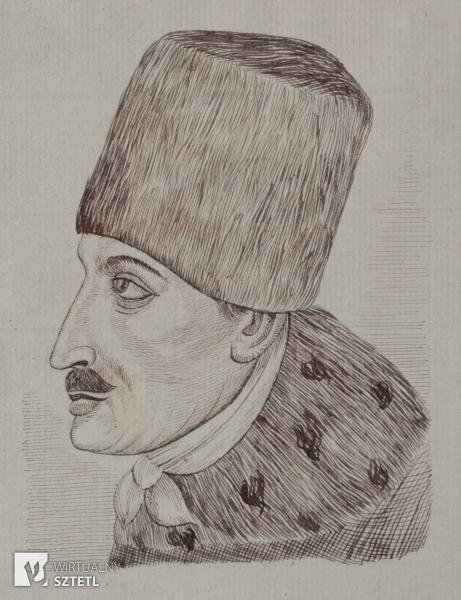
Frank Jakub, Józef baron von Dobrucki, born in 1729 in Korolówka (Podolia), died on 10 December 1791 in Offenbach near Frankfurt am Mein. A founder of the Jewish religious and mystical movement of Frankism. The Frank family had to leave Poland, when in 1727 they were accused of favouring Sabbateanism. It was a pseudo-messianic movement Judaism contended with. They came to Thessaloniki via Bukovina and Wallachia, where in 1752, Frank joined the Sabbateans. In 1755, at their instigation, he returned to Poland. In 1756, together with a group of his followers, he was excommunicated by the rabbis, who gathered at a convention in Brody, and then expelled from the country. In 1757, in Giurgiu (Romania), he converted to Islam. In 1758, he declared himself successor of Sabbatai Zevi and Messiah. In mid-1758, he returned to Poland. In 1759 a public debate was held in Lviv, with Frank’s participation, between Frank’s supporters and the rabbis, after the completion of which Frank, along with about 2,000 companions, was baptised in the Catholic Church. Afterwards, he moved to Warsaw with his family where he was baptised again. The Polish king August III was his godfather. However, Frank still considered himself a messiah. He was accused of being involved in sexual orgies, and for this reason he was arrested in 1760 and sentenced by a consistory court to perpetual isolation in the monastery of Jasna Góra. He stayed there until 1773, when Russian troops pacifying the Bar Confederation set him free. He settled down in Brno. After the death of Empress Maria Theresa, who took care of him, Frank moved to Offenbach, where, with his followers’ money, he rented the castle of the Prince of Isenburg and received the title of baron. Frank’s teachings were written down in The Book of the Words of the Lord. A feature of Frank’s doctrine, based on the Kabbalah, was religious syncretism. For Frank, his conversions to other religions (Islam, Christianity) had antinomic sense — it was a banishment of the Messiah, enabling him to collect the scattered sparks of the divine light (I. Luria). He rejected religious law and institutions.
J. J. Doktór Jakub Frank i jego nauka na tle kryzysu religijnej tradycji osiemnastowiecznego żydostwa polskiego, Warsaw 1991;
Księga słów Pańskich. Ezoteryczne wykłady Jakuba Franka, J. Doktór (ed.), Warsaw 1997.
The entry was prepared on the basis of PWN source materials.