In the mid-17th century the Jewish kehilla had its cemetery. However, today it is hard to locate it. It is only known that the cemetery was situated on municipal property as a result of which the Jews paid 40 groshen to the municipal treasury[1.1] every year on St Martin ’s Day. Another cemetery was established outside the town and was located about 600 meters from the church, on the so-called town field by the road from Fordon to Miedzyń. Until 1918 Jews from the Bydgoszcz community (which subordinated to the Fordon’s community) were buried there[1.2]. 4 acres (over 2.2 ha) in area and almost square in shape, at the turn of the 19th and 20th centuries the cemetery was surrounded by a brick wall. The oldest gravestones with preserved inscriptions date back to the 1740s and 1750s. Inscriptions on other gravestones have vanished with age. The cemetery was probably established in the second half of the 17th century, and at the turn of the 19th and 20th centuries gravestones of some well-known people were still preserved. Among them, gravestones of the following martyrs could be found: Samuel ben R. David and R. Hirz, a rabbi and a scholar R. Ahron, a rabbi Seeb Wolf ben Jacob Koppel, a rabbi Icchak, dajan Mosze ben Rachman (died in 1762), a rabbi Benjamin ben Schoul, a rabbi Chanach Henoch ben David (died in 1741), a rabbi Abraham ben Zwi, a rabbi Arje Löw ben Mosce (died in 1821), Jacob ben Nachman, a dayan Jehuda Löw ben Nachman, a rabbi Mosze ben Arje Löw, Aron ben Icchak, Joel ben Abraham, a rabbi Izrael ben Gisig (from Leszno), Zwi Hirsch ben Joel, a dayan Nachman Samuel ben Löw, Josef ben Icchak, maggid Mosze ben Jacob, Jona ben Eliezer Halewi, a rabbi Salomo ben Nachman (known as Amsterdam, died in 1832), Icchak ben Simeon (known as Tugendreich, died in 1837), David ben Mosche Maggi, a rabbi Simon Halevi ben Joschua (died in 1842, a rabbi of Fordon from 1828 to 1835, and a rabbi of Rogoźno), a rabbi Mordechaj Michael ben Mendel (from Krotoszyn, a rabbi in Zduny and Śmigiel; after leaving Fordon he was a teacher at bet ha-midrasz in Hamburg), a rabbi Icchak ben Henoch (died in 1755, known for both being religious and saving Torah scrolls from a fire). During WWII the cemetery was eliminated. Gravestones were used as a building material for strengthening the Vistula banks in A. Frycza-Modrzewskiego Street and have remained there until the present day. Fragments of gravestones in Targowisko Street have been saved by one of Fordon’s inhabitants[1.3].

Cemetery
Verified article
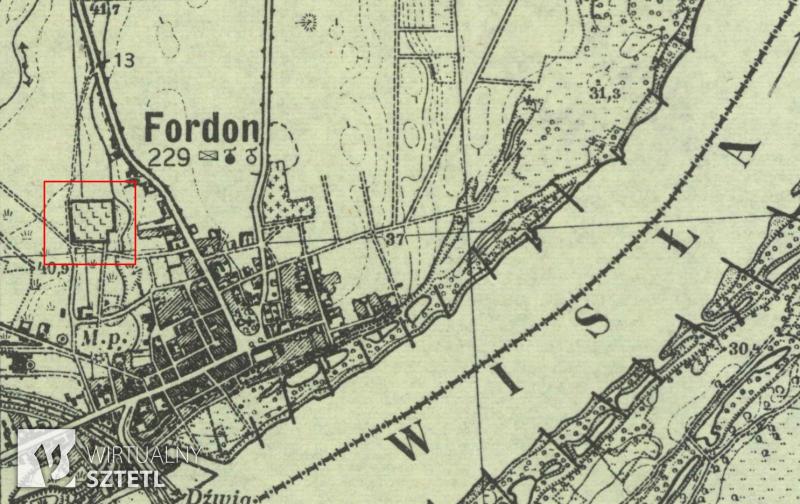
Data about cemetery
Town:
Bydgoszcz
Cemetery type:
Jewish
Street:
Sielska
Creation date:
ca. / around 1650
Graves of the Holocaust victims:
No
Area:
2,2 ha
Working:
No
The Administrator has made all possible efforts to present the content accuratly and up-to-date in a way that does not infringe upon the rights of third parties, including copyrights, but cannot guarantee it. Therefore erroneous information on the website may not be the basis for claims. If you have any questions, please contact us at the following e-mail address: [email protected]