On 23 June 1941, Wehrmacht troops entered Grodno, which had been under Soviet occupation since 21 September 1939.
Elka Pamin, who was returning home from a pioneer camp near the city at the time, recalled the occupation of Grodno by the Germans in the following way,
“Along the way, we met many fleeing Soviets, who advised us to go deeper into the forest. As we came closer to the city, we saw something horrible - the city was on fire on four sides, the panic was enormous”[1.1].
Grodno was incorporated into the Bialystok district (Bezirk Bialystok), which became part of the enlarged East Prussia. The German civil administration, replacing the wartime commandant's office, was formed at the end of July 1941. The board was first headed by Zawadzki, who was succeeded by Zygmunt Gorbaczewski. In September of that year, von Pletz took over. Stein was appointed mayor.
From the very beginning, the German occupation authorities implemented restrictive measures against the Jewish community. These were various in nature. Elka Pamin recalled:
“A week after the Germans came, Jews were forbidden to walk on the footpaths and they were also forced to wear white armbands with the Star of David. I, as a child, did not wear an armband. My older sister, who forgot to put on her armband one day, was punished with a beating of twenty-five lashes and two days in prison. She then lay in bed for three days”[1.1.1].
Józef Fleischman reported:
“The persecution of the Jews began immediately, with them being hauled off to perform hard labour. Searches were carried out in houses, during which everything they liked was taken from the house. Once, all Jews encountered on the street had their shoes taken from their feet and were let go barefoot.”[[refr Archives of the Jewish Historical Institute in Warsaw, ref. 301/885: Report of Józef Fleischman, Provincial Jewish Historical Committee, Przemyśl, 29 IX 1945]].
One of the first orders from the authorities was to prohibit Jews from appearing in the markets and from walking on the footpaths. They could only walk on the right-hand side of the carriageway, and in single file. It became compulsory to remove headgear when passing a uniformed German. Every Jewish adult had to wear a white armband with a blue Star of David on his or her left arm. It was later replaced by yellow stars sewn onto the upper garments on the chest and back[1.2]. During the war, Ghetto No. 1 was identified as being located at the Rybny Square. The main entrance was on the side of ul. Zamkowa. Ghetto No. 2 occupied the area between today's streets Kosmonautów (praspekt Kasmanautau), Lidzka (Lidskaja wulica), Biełusza (wulica Biełusza), and Antonowa (wulica Antonawa). Based on the former name of the latter street, Słobódka, the district was referred to as “Na Słobódce” (At Słobódka). It was the location of one of the poorest suburbs of Grodno.
Both ghettos were surrounded by an eight-metre high barbed wire wall. Each ghetto had only one exit, guarded by gendarmes and soldiers. Arbitrarily leaving the place of isolation could be punishable by being shot on the spot or hanged in the ghetto[1.3]. In both ghettos, there were approximately 22,000 Jews. Ghetto No. I was used to imprison those deemed fit and qualified for work, while Ghetto No. 2 was intended for the elderly and unfit for work. However, in practice, due to the lack of space, many craftsmen were located in the ghetto 2[1.4].
The ghettos were guarded by Germans and the Jewish militia. Each had its own Judenrat and militia. The head of the first ghetto, in Rybny Square, was Dr. Brawer (former principal of the Grodno junior high school), and the militia commander was Aaron Rubinczyk, who helped the Germans to detect hiding places during operations.
“The ghetto was surrounded by barbed wire, through which I often sneaked outside to earn a piece of bread. I was horribly beaten by the Gestapo on multiple occasions and sat in prison, but the instinct to live was stronger, I knew that death by starvation was much worse than death by a bullet.”[1.5].
Relocating the Jews of Grodno to the ghetto began on 2 November 1941. Approximately 15,000 people were imprisoned in Rybny Square, approximately 10,000 at “Na Słobódce”. The occupiers decided that one square metre of housing was sufficient for one Jew. Everyone was only allowed to take as many things into the ghetto as they could fit into a wheelbarrow, into a child's pram, or as much as they could carry in their hands.
The head of ghetto No. 1 was Kurt Wiese and of ghetto No. 2 was Otto Streblew. At “Rybny Square”, the Judenrat's headquarters were located in the spacious edifice of the former Sapieha palace, where the Zionist school “Jawne” operated until the war. The Judenrat of “Na Słobódce” was located in a renovated barrack. The chairman of the Jewish council in ghetto No. 1 was Izaak Górzański. In No. 2, it was Abraham Zadaj. Both of them were subordinate to the aforementioned chairman David Brawer, whose right hand for administrative and financial matters was Jehoszua Suchowlański. The Judenrats were quite effective in organising food supplies, and they also imposed taxes on contraband and speculation, on electricity and water, on craftsmen and baths. Survivors of the Grodno Jewish precincts reported that their inhabitants, although hungry, did not die of starvation as was the case in many other large ghettos[1.6].
The basis for the economic functioning of the ghettos was a system of small craftsmen's workshops, known as “szopy”, which produced items for, among others, the German army. There was a shoe factory, a locksmith workshop, a carpentry workshop, a sewing workshop and a small ammunition factory. All sorts of objects were created in small “szopy” - matches, brushes, bowls etc. A garden was established next to the Judenrat building, where vegetables were grown[1.7]. Elke Pamin recalled:
“Jews were partly employed in the ghetto and most of them outside the ghetto. For work, one received 30 dkg of bread and lunch, which consisted of a light soup. Children and old people received soup from the Judenrat kitchen. Those, who worked outside the ghetto, took things to sell when leaving the ghettos and brought back products. Most of the ghetto inhabitants made a living by selling their belongings”[1.8].
There was a hospital in both ghettos - in No. 1, it was located in the building of the Great Synagogue and was headed by Becalel Suchowlański. In addition, a polyclinic and a pharmacy were also located there. A great achievement of the chairman of both Judenrats, Dr. Brawer, was considered to be that he managed to persuade rich Jews to systematically help the poorest. As a result, a free distribution of hot soup and the distribution of bread and fat were organised, under a card system. Those working hardest were given extra rations. Religious activity was limited - nevertheless, efforts were also made to prepare kosher food and to ensure the observance of ritual rules at funerals[1.9]. Elka Pamin reported:
“In the first year of the ghetto's existence, the deceased were buried in the new cemetery outside the ghetto on ul. Grandzickiego (?) but, when the ghetto was closed in November 1942, a ghetto cemetery was established”[1.1.8].
The German authorities did not allow schools to be opened, but the Judenrat launched craftsmen's further training courses for young people and adults. During the evenings, the most ambitious teenagers attended secret classes. Libraries, located in both ghettos, also played a major cultural and social role. They were managed by teachers Abraham Lifszyc and Zeew Jekiel. Mini concerts were given by the distinguished music teacher Ruben Wigdorowicz, who wrote, for example, music for children's songs, despite the difficult times. Before the deportations, he hid the notes in his house, believing that he would return for them after the war[1.10].
Underground political life was forming in the ghetto. The youth activists primarily came together in Zionist organisations - Dror (a Dror he-Chaluc cell with fifty-six members was founded in November 1941), He-Chaluc ha-Cair, and Ha-Shomer ha-Cair. Already, in the first days of the German occupation, a kind of federation of associations took place, whose members were supposed to “try to meet in working groups and not lose the clarity of their minds”. They gathered at the home of the liaison officer and later participant in the resistance movement in Bialystok, Bronia Winicka-Klebanowska. In the summer of 1942, members of Dror, concentrated in ghetto No. 2, together with members of Ha-Shomer ha-Cair, formed a small community to cultivate a garden next to the Judenrat. A month-long seminar concerning the ideology and assumptions of the Zionist movement was also organised at that time. Tzvi Belko was the head of the Poale Zion - CST - Hitachdut group, which had twenty-eight members.
In January 1942, an anti-fascist communist group was formed in ghetto No. 1, including, for example, I. Chmielnik, Ł. Lipski, I. Rejzen and komsomolniks from the period of the Soviet occupation, K. Lubicz, Liza Czapnik, and Anna Rud. They were involved in the “production” and distribution of information leaflets (handwritten), based on reports from Soviet radio. They mediated and enabled escapes from the ghetto by organising false documents, maps, compasses, etc[1.11].
The ghettos in Grodno also had their own chronicler and archivist. This was the secretary of the Judentrat, Tzvi Belko, who was supported by the lawyer Firstenberg, and the economist Abraham Brojde. In December 1942, the archive, together with the sacred books of the Torah, was hidden in the Great Synagogue building. After the war, forty-five books were found, but no archives[1.1.11].
From the end of 1941, emissaries from the ghettos of Wilno and Warsaw reached Grodno, initiating the formation of local cells of associations and organisations, also warning the community about the intentions of the occupation authorities to “exterminate” the Jews.
Following these visits, there was an attempt to organise a militant organisation, bringing together communists, Bundists, and Zionists. It was initiated by Izrael Landa of Poale Zion - CS. The conspirators began to meet in the bakery of Eliasz Tankus. However, the Gestapo came across their trail. The activity was postponed until a “better time”. At the beginning of 1942, the Grodno ghetto was visited by the later leader of the Białystok ghetto uprising, Mordechaj Tenenbaum, together with Ha-Szomer ha-Cair activist Tosia Altman. They passed on the information concerning the plans to exterminate the Jews and appealed for armed resistance to be organised. Members of the political organisations in the ghetto were divided into supporters of the uprising and those in favour of escaping the ghetto and making their way to the forests[1.12]. In November 1942, Zerach Zilberberg arrived from the Białystok ghetto and, again, tried to unite the Grodno Jewish underground, also seeking contacts on the “Aryan side”. In Grodno, the underground leadership consisted mainly of women from Ha-Szomer ha-Cair - Johewed Taub from Warsaw, Cilia Szachnies, Miriam Popko, Chasia Bielicka, and Eliasz Tankus.
In late 1942 and early 1943, groups of young people escaped, several times, from the Grodno ghetto “into the forest”. In January 1943, a group of eighteen men, led by I. Pankus, broke through into the Augustów Forest. However, they were captured in the village of Korobczyce and all were killed (among them M. Popko, G. Rybarcki and Ch. Marsz). On the night of 6 February 1943, a group of approximately thirty Jews, led by Ł. Rejzner, B. Lipski and S. Garbulski, reached the Podgrodzeńska Forest. Thanks to help from railway workers, the Jews from Grodno were also transferred to the Wilno ghetto (e.g. I. Jezierski, M. Zamoszczański, J. Trachtenberg, R. Lubicz), from where it was easier for them to escape to the Soviet partisans. Thanks to false “Aryan” documents, created in a small factory in the ghetto, several young female resistance fighters escaped to Bialystok (among them, Liza Czapnik, Anna Rud, Chasia Bielicka, and Cilia Szachnies).
Faced with slim chances of escaping from the ghetto, the local underground decided to change tactics. An attempt was made to organise the assassination of the head of ghetto No. 2, Otto Streblow. The operation failed and some of the conspirators were killed. In February 1943, Zerach Zilbergberg planned an uprising to break out at the Great Synagogue, during the following wave of deportations. The Judenrat, which was opposed to armed struggle, nevertheless provided material support. During a gathering of Jews in the synagogue, Zilberberg, along with two comrades, called on others to fight. In the resulting confusion, the unarmed insurgents threw pieces of iron at the head of ghetto No. I, Kurt Wiese, and broke out onto the street. However, no one took up the call[1.13].
The collapse of the functioning of the communities took place in November 1942 with the liquidation of the ghetto “Na Slobódce”. Dr. Brawer lost his influence over the Germans' decisions towards the Jews, although until the end of his life he believed that his fellow Jews could be saved by the “ghetto's productivity”.
At the end of 1942, the Germans began a five-month operation to liquidate both ghettos in Grodno. On the night of 1 November 1942, the ghettos were surrounded by SS troops. The process of displacing Grodno Jews had begun, coordinated by the head of the local Gestapo, H. Errelis, and his deputy E. Schott. Only small groups of Jews, working for the Gestapo, and the army were allowed to work outside the barbed wire. On 7 November 1942, the head of ghetto No. I, Kurt Wiese, ordered the hanging of the merchant Szpindler, the wigmaker Drukner, and the tailor Prenkuj.
On 9 November 1942, approximately 4,000 Jews, primarily professionals in various fields, were transported from the “Na Słobódce” ghetto to the ghetto at the “Rybny Square”. On the night of 13 November, approximaately 1,600 Jews from ghetto No. 2 were herded into freight wagons at the railway station in Grodno. After three days, they arrived at Auschwitz, where they were exterminated. A similar “operation”, which involved approximately 2,400 people, was repeated on the night of 20 November 1942. The “Na Slobódce” ghetto ceased to exist[1.14].
Immediately afterwards, the liquidation of the ghetto at the “Rybny Square” began, where approximately 17,000 people were gathered into extremely cramped conditions. At the end of November 1942, a column of prisoners was led out of the ghetto, headed by the chairman of the Judenrat, Izaak Górzański, who was fitted with a clown hat on his head. He was accompanied by fiddlers, and everyone was to sing the song Jidl mitn fidl. The Germans directed the column to the transit camp (Sammellager) in Kiełbasin, from where the Jews were later transported to the camps in Auschwitz and Treblinka.
“The Kiełbasin camp was underground, a dark pit with no windows, no floor and no bunks. People lay on top of one another, in dirt, cold and hunger. When the bread was brought in, small children would run out to lick the flour that spilled out of the wagon. Many of them were killed for this great crime. The dead bodies were returned to the kitchen, where they were cooked and fed to the unfortunate prisoners. Of the people there, 90% died before they were led out,” was the account given by Elka Pamin[1.1.1].
According to a report, dated 9 December 1942, there were 12,418 Jews living in Ghetto No. I, mainly craftsmen. Two trends conflicted amongst the German authorities - the ideological one, advocating the murder of Jews, and the economic one, opposing the former, arguing that Jewish craftsmen were necessary to the functioning of many businesses.
At the beginning of 1943, the Germans began the next phase of the ghetto's liquidation, with the so-called “10,000 operation”, organised in January and the “5,000 operation” in February. On 18 January 1943, with the support of the Jewish militia, the expulsion of residents from their homes and hiding places began. Approximately 1,700 Jews were herded into the courtyard of the Great Synagogue. In the following days, from 19 to 22 January 1943, a total of approximately 10,000 ghetto inhabitants were chased out and then transported to the camps at Auschwitz and Treblinka[1.15].
On 13 February 1943, the Germans entered the Judenrat and arrested its members. At 10:00 pm, Kurt Wiese shot Dr. Brawer. Several residents were also imprisoned and incarcerated in the Great Synagogue. All those, who tried to escape, were shot on the spot. “Hunting” for approximately fifty Jews, who had escaped from the ghetto, was carried out in the village of Pyszki and in Miałowe Góry - eighteen of those were caught and herded back to the ghetto. Later, the prisoners were led to the railway station in Łosośno, from where they were taken to extermination camps[1.16].
The final and third stage of the liquidation of the Jewish community of Grodno took place in March 1943. The Jews, who remained in the town, were taken to the Białystok ghetto. They shared the fate of others in Białystok. Von Pletz's records show that 20,577 Jews from Grodno and the surrounding area were taken to the camps from 5 March 1943. In total, approximately 41,700 people of Jewish origin were “transported”. On 12 March 1943, it was announced that Grodno had been “cleansed” of Jews[1.1.15].
From the spring of 1944, the Germans covered the traces of the crime. The graves were levelled, masked by lawns and flower beds (in the prison yard). Some of the mass graves in Grodno, Kiełbasin and Łosośno were opened, after which the corpses were burnt.
Grodno was taken over by the Red Army on 16 July 1944. Along with the Soviets, approximately 2,000 Jews from Grodno returned home[1.17].
For helping Jews, the non-Jewish residents of the city could have faced death. For such activities, the Germans executed Maria and Hipolit Jaskielewicz, who lived in one of the villages near Grodno. For hiding his wife, a Jewish woman, a labourer Mikołaj Umiński from Grodno was executed[1.18]. But it was also thanks to the help of Christian neighbours that some families of Grodno Jews were saved.
At the end of 1942, Paweł Charmuszko transported two families out of the ghetto – the families of Bolesław Szyf and the well-known doctor Hirsz Woroszylski, comprising a total of six people. In March 1943, Charmuszko transported the Jews to the Gawrończyk family in the village of Nowosiółki, where they lived until liberation in July 1944.
In 1997, Stefania and Józef Gawrończyk were honoured with the title of Righteous Among the Nations. In 1987, this title was also given to Anna and Jan Puchalski, who hid six Grodno Jews in the village of Łosośna - Feliks Zandman, Sender Fejdowicz, Motel and Gołda Bass, Borek Szulkies, and Meer Zamoszczański.
In 1979, Aniela and Edward Staniewski, who hid the family of physician Chaim Blumsztein on their farm, from January 1943 to July 1944, were able to plant their tree at Yad Vashem[1.19].
In 1967, a trial of criminals from the Bialystok district, which included Grodno, took place in Bielefeld. H. Errelis was sentenced to six years in prison, Kurt Wiese received a life sentence[1.20].
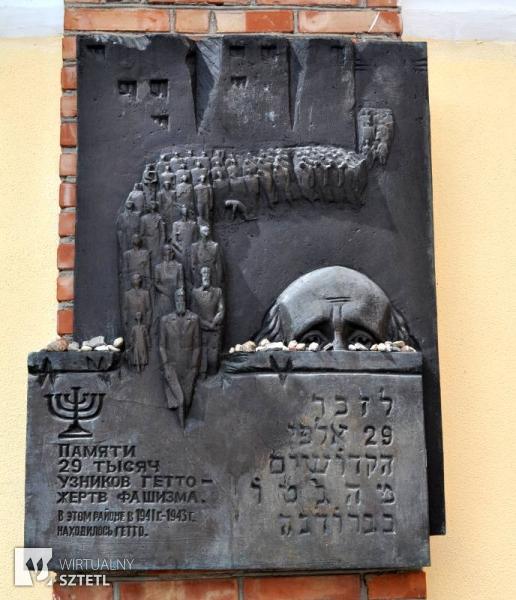
In 1960, on the grave of approximately 3,000 murdered Jews, by the Grodno-Sopoćkinie road, a monument was erected depicting the figure of an agonised woman laying a wreath on a grave. In 1965, at the site of the former camp in Kiełbasin, on ul. Olga Sołomowa, an obelisk, dedicated to the victims of fascism, was unveiled. In 1993, a plaque was erected on the wall of the building at the former entrance to ghetto No. I on ul. Zamkowa, in memory of approximately 29,000 ghetto inmates. In March 2007, a monument was unveiled within the former ghetto[1.21].
Bibliography
- Encyclopedia of Camps and Ghettos1933-1945, vol.II: Ghettos in German-Occupied Eastern Europe, part A, ed. M. Dean, Bloomington 2012.
- Piwowarczik S. M., Grodno, [in:] Holokost na tieritorii SSSR, ed. I. A. Altman, Moscow 2009
- [1.1] Archives of the Jewish Historical Institute in Warsaw, ref. 301/2125: Report (Przeżycia) of Elka Pamin, Provincial Jewish Historical Committee, Białystok, 27 XII 1946, No. 209/46.
- [1.1.1] [a] [b] Archives of the Jewish Historical Institute in Warsaw, ref. 301/2125: Report (Przeżycia) of Elka Pamin, Provincial Jewish Historical Committee, Białystok, 27 XII 1946, No. 209/46.
- [1.2] Piwowarczik S. M., Grodno, [in:] Holokost na tieritorii SSSR, ed. I. A. Altman, Moscow 2009, p. 242].
The German wartime command ordered the former director of the “Tarbut” junior high school, Dr. David Brawer, to organise a ten-member Judenrat. Its members included lawyers Izaak Górzański and Abraham Zadaj, the former merchants Abraham Lifszyc and Jakow Efron, factory owner O. Kosowski, former deputy mayor Jehoszua Suchowlański, Rabbi Berman, Dr. Sholom Byk, and teacher T. Tarłowski. Later, the Judenrat comprised twenty-four members - the composition of the board corresponded to the distribution of political forces among Jews from Grodno before September 1939. In early July 1941, the Gestapo forced the preparation of a list of local Jewish intellectuals. It included the names of eighty people, who were arrested and shot[[refr:|Piwowarczik S. M., Grodno, [in:] Holokost na tieritorii SSSR, ed. I. A. Altman, Moscow 2009, p. 242].
At the end of September 1941, Jews were evicted from their homes located in the main, representative parts of the city. On 1 October 1941, the occupation authorities decided to create two ghettos. The first (No. )1, was delimited by the present-day streets Zamkowa (Zamkawaja wulica), Sowiecka (Sawieckaja wulica), Wileńska (Wilenskaja wulica) and the Horodniczanka River. This was the area of the former Jewish precinct centred around the Old Synagogue[[refr:|Reichelt K., Patt A., Crago L., Grodno [in:] Encyclopedia of Camps and Ghettos 1933-1945, vol.II: Ghettos in German-Occupied Eastern Europe, part A, ed. M. Dean, Bloomington 2012, p. 891.
- [1.3] Piwowarczik S. M., Grodno, [in:] Holokost na tieritorii SSSR, ed. I. A. Altman, Moscow 2009, p. 242.
- [1.4] Reichelt K., Patt A., Crago L., Grodno , [in:] Encyclopedia of Camps and Ghettos1933-1945, vol.II: Ghettos in German-Occupied Eastern Europe, part A, ed. M. Dean, Bloomington 2012, p. 891.
- [1.5] Archives of the Jewish Historical Institute in Warsaw, ref. ARC 2128: Testimony by Elka Famin (Pamin), Provincial Jewish Historical Committee, Białystok, 31 XII 1946, No. 213/46.
- [1.6] Reichelt K., Patt A., Crago L., Grodno, [in:] Encyclopedia of Camps and Ghettos1933-1945, vol.II: Ghettos in German-Occupied Eastern Europe, part A, ed. M. Dean, Bloomington 2012, p. 891.
- [1.7] Piwowarczik S.M., Grodno, [in:] Holokost na tieritorii SSSR, ed. I.A. Altman, Moscow 2009, pp. 242-243.
- [1.8] Archives of the Jewish Historical Institute in Warsaw, ref. ARC 2128: Report by Elka Famin (Pamin), Provincial Jewish Historical Committee, Białystok, 31 XII 1946, No. 213/46.
- [1.9] Piwowarczik S. M., Grodno, [in:] Holokost na tieritorii SSSR, ed. I. A. Altman, Moscow 2009, p. 243.
- [1.1.8] Archives of the Jewish Historical Institute in Warsaw, ref. ARC 2128: Report by Elka Famin (Pamin), Provincial Jewish Historical Committee, Białystok, 31 XII 1946, No. 213/46.
- [1.10] Piwowarczik S. M., Grodno, [in:] Holokost na tieritorii SSSR, ed. I. A. Altman, Moscow 2009, p. 243.
- [1.11] Piwowarczik S. M., Grodno, [in:] Holokost na tieritorii SSSR, ed. I. A. Altman, Moscow 2009, p. 244.
- [1.1.11] Piwowarczik S. M., Grodno, [in:] Holokost na tieritorii SSSR, ed. I. A. Altman, Moscow 2009, p. 244.
- [1.12] Reichelt K., Patt A., Crago L., Grodno , [in:] Encyclopedia of Camps and Ghettos1933-1945, vol. II: Ghettos in German-Occupied Eastern Europe, part A, ed. M. Dean, Bloomington 2012, p. 892.
- [1.13] Piwowarczik S.M., Grodno, [in:] Holokost na tieritorii SSSR, ed. I. A. Altman, Moskwa 2009, pp. 244-245.
- [1.14] Piwowarczik S. M., Grodno, [in:] Holokost na tieritorii SSSR, ed. I. A. Altman, Moskwa 2009, pp. 245–246.
- [1.15] Piwowarczik S. M., Grodno, [in:] Holokost na tieritorii SSSR, ed. I. A. Altman, Moscow 2009, p. 246.
- [1.16] Piwowarczik S. M., Grodno, [in:] Holokost na teritorii SSSR, ed. I.A. Altman, Moscow 2009
- [1.1.15] Piwowarczik S. M., Grodno, [in:] Holokost na tieritorii SSSR, ed. I. A. Altman, Moscow 2009, p. 246.
- [1.17] Piwowarczik S. M., Grodno, [in:] Holokost na tieritorii SSSR, ed. I. A. Altman, Moscow 2009, p. 246.
- [1.18] Piwowarczik S.M., Grodno, [in:] Holokost na tieritorii SSSR, ed. I. A. Altman, Moskwa 2009, pp. 246–247.
- [1.19] Piwowarczik S. M., Grodno, [in:] Holokost na tieritorii SSSR, ed. I. A. Altman, Moscow 2009, p. 247.
- [1.20] Piwowarczik S. M., Grodno, [in:] Holokost na teritorii SSSR , ed. I. A. Altman, Moscow 2009, p. 247
- [1.21] Piwowarczik S. M., Grodno, [in:] Holokost na tieritorii SSSR, ed. I. A. Altman, Moscow 2009, pp. 241, 247.