Originally, the Jews of Tarnobrzeg belonged to the kehilla in Dzików. In the first half of the 17th century the community already had its house of prayer. In 1655, the Swedish army murdered 27 Jews from Dzików. Another house of prayer was built in Tarnobrzeg in 1718; the first information about the local Jewish cemetery comes from 1727. In 1748, Jews owned 45 houses in the town, with the community comprising 233 people. In 1757, Jews were accused of committing a ritual murder. One of the alleged culprits was tortured to death, while several others were hanged or burnt at the stake. In 1765, there were 569 Jews living in the area controlled by the kehilla in Dzików, 410 of which resided in Tarnobrzeg. In 1772, 42 Jewish families had their own dwellings in the town, 57 other families rented houses. There were 135 Jewish children in the town, including 79 boys. Since 1779, the local Jews were allowed to join artisan guilds.
In the first half of the 19th century, Meir, brother of Menachem Mendel of Lesko and uncle of Naftali of Ropshitz, became the local tzaddik. He was the author of the Divrei Noam treatise. The town became a vibrant centre of Hasidism. One of Meir’s daughters married Yaakov Isaak, a tzaddik from Żabne, another one married Salomon Halberstam from Piekło, tzaddik of Nowy Sącz (Sanz). Meir was succeeded by Eliezer Horowitz (died on 19 October 1860), son of Naftali of Ropshitz and author of Imrei Noam. He was followed by his son, Meir of Dikov (born in 1819 and died on 19 July 1877), author of Imrei Noam, later succeeded by son Joshua of Dikov (died 21 November 1912). When Joshua died, his son Alter (1879–1943) became the last tzaddik of Dzików. Alter died in Kraków, murdered by the Nazis in March 1943 (5 Adar). His son Mendel Horowitz, commonly known as Mendele, was the last rabbi in Dzików and Tarnobrzeg. He was imprisoned in the Płaszów concentration camp and then transported to Mauthausen, where he died in 1944. His wife died in Gdańsk, his two sons: Meir and Yehele also lost their lives. His third son, Yehudele, survived and settled in Jerusalem after the war.
In 1870, the Jewish community comprised 2,658 people. It owned a synagogue and two cemeteries. In 1880, there were 2,768 Jews living in the town, amounting to 80% of the total population. The Credit Association, headed by Leib Eckstein, was established in Tarnobrzeg in 1890, followed by the Discount Mercantile Association headed by Noe Goldmain in 1892. In 1900, there were 3,090 Jews in the kehilla, 2,535 of them living in the town itself. The Jewish community organised various charitable activities, including an alsmhouse. In 1912, Jews made up 76.3% of the total population of the town, with the numbers consistently dropping over subsequent years – in 1921 there were 2,146 Jews in the town, i.e. 67.7% of the total population. This decrease in the number of Jewish inhabitants of the town was connected with the wave of migration to Western European countries and the United States. At the beginning of the 20th century, a Hebrew school was established in the town. It was founded by the Maurice de Hirsch foundation.
During the interwar period, Tarnobrzeg boasted a branch of the Central Association of Jewish Craftsmen in Poland (with 100 members), a branch of the Craftsmen Association (headed by Lejb Just in 1939) and the Folk, which had 372 shareholders in 1932. Before the outbreak of World War II, there were 3,800 Jews living in Tarnobrzeg.
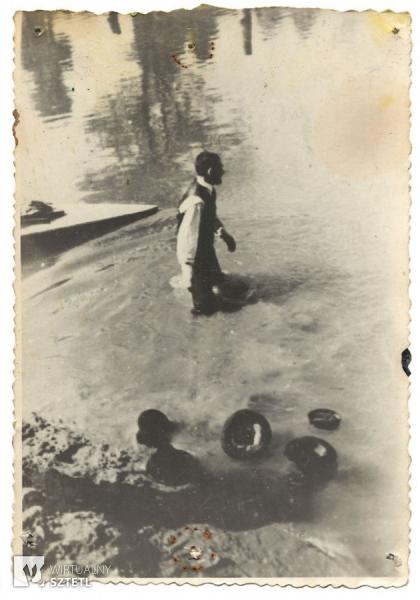
When the town was seized by the German army on 17 September 1939, the Nazis executed five Jews in the town square. On 2 October, they resettled a part of the local Jewish population to Mielec and Sandomierz, and expelled another group to the other side of the river San, to the Soviet-occupied zone. The demarcation line could be crossed near Radomyśl and Sieniawa. Jews resettled from Radomyśl were transported to the other side of the San by gendarmerie officers from the post in Grabczyny. They would often force Jews to jump out of the boat in the middle of the river. Many people drowned, including Józef Nassbaum and Samuel Zamojre, teachers from the Tarnowski School in Tarnobrzeg. A couple of families who returned to the town were executed in 1942 in Baranów Sandomierski.
At the beginning of 1940, the Nazis established a labour camp for Jews in the buildings of the rabbinate and house of prayer, where they kept ca. 100 people. Those who died of emaciation were buried at the local Jewish cemetery. The camp was dissolved in 1942. After the war, the Jewish community in Tarnobrzeg was not reborn.
Bibliography
- Gutwein Y., Memories of my shtetl, Dzikow (Tarnobrzeg), Paris 1948.
- Lipiec G., Pamięć o tarnobrzeskich Żydach. Co zostało w mieście po ludności wyznania mojżeszowego?, echodnia.eu, 21.10.2011 [online] https://echodnia.eu/apps/pbcs.dll/article?AID=/20111021/POWIAT0304/412950846 [Accessed: 28 Aug 2014].
- KehilaLinks: Tarnobrzeg – Dzikow, [online] https://kehilalinks.jewishgen.org/Tarnobrzeg/ [Accessed: 28.08.2014].
- “Tarnobrzeg – Dzików,” [in] Encyclopedia of Jewish Communities in Poland, Volume III / Pinkas Hakehillot Polin, ed. S. Spector, Jerusalem n.d., pp. 191–194 [online] https://www.jewishgen.org/yizkor/pinkas_poland/pol3_00191.html [Accessed: 30 Sep 2019].