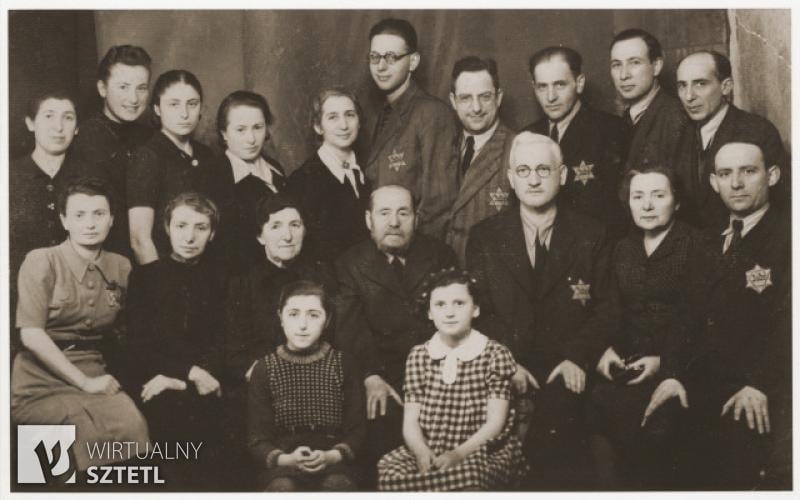
Repression, concerning the dress code, included the Jewish community, in particular. Jews were ordered to wear given markings at all times which, depending on the location, could take the form of armbands bearing the Star of David worn on the right sleeve or patches sewn onto the clothing. Despite their apparent triviality, these symbols are often present in the memories of Holocaust survivors as well as other historical testimonies, and can also be found in museum collections.

Gitel Peterfrojnd from Trzebinia during her imprisonment in the ghetto in Będzin (?), ca. 1941
Genesis - a medieval mark of shame
The first city, after the German attack on Poland, in which stigmatising the Jewish population, was ordered, was Włocławek, located in the areas incorporated into the Reich [1.1]. An ordinance, issued on 24th October 1939, forced Jews, residing in the city, to wear a yellow triangle on their backs. This applied to everyone, without indicating, for example, a minimum age or gender. Łódź also quickly included the ordinance, concerning yellow armbands, which were replaced in November 1939 by Star of David-shaped patches, also in yellow. In the General Government, the introduced orders in turn referred to white armbands with blue Stars of David.
The ordinances, concerning marking, constituted the earliest of the restrictions imposed on the Jewish community by the occupying forces in Polish cities. German regulations described these items of clothing in great detail, providing dimensions, colour, or position on the garment. The severity of this racist labelling is evidenced by numerous references in memoirs from 1939. In an interview included for the POLIN Museum's collection of oral history, Janina Goldhar recalled,
"The first restrictions against Jews [were] the armbands. I didn't have to wear an armband as a child, but I remember exactly the discussions about whether mum should wear an armband or not. I remember my grandparents and aunts wearing armbands or, for example, they wore them, but they wore a coat or something so that it was covered up."
Jolanta Chmurowska recalls the order to wear armbands in Staszów,
"Of course, the Jews were ordered to wear an armband, a white band, a blue Star of David, that is, two triangles together, and it was compulsory to wear this band, God forbid that one should not have one and, if one had an armband, then that person could also be a target, due to having one. Well, simply said, they had to stand out" [1.2].
It was quickly recalled that the marking of Jews has a tradition of at least several centuries. Dawid Sierakowiak, in his diary describing life in the Łódź ghetto, in a note dated 16th November 1939:
"We are going back to the Middle Ages. A yellow patch, once again, becomes part of Jewish attire. An ordinance was released today that all Jews, regardless of age or gender, must wear a "Jewish-yellow" coloured armband, 10 cm wide, on the right arm, under the very armpit. […] The armband has been in force since Saturday, the eighteenth, and the ban on going out applies from today" [1.3].
Władysław Szpilman thought similarly in Warsaw [1.4]:
“Whereas, at the end of the month, an announcement was made which no one, at first, could believe. It exceeded our darkest expectations: between 1st and 5th December, all Jews were to acquire white armbands with a blue and white Star of David sewn on them. Therefore, we were supposed to be stigmatised and publicly singled out from the crowd as destined to be shot. Thus, several hundred years of progress in humanism were cancelled and replaced by the methods of the dark Middle Ages.”
The frequent reference to the Middle Ages resulted from the fact that it was in this era that the first attempts to isolate Jews, by means of different clothing, took place. Such an order, affecting the entire non-Christian population, came into force in 1215 with the Fourth Council of the Lateran. Following this, Jews in Europe were forced to wear a round yellow patch on their clothing or to put a pointed hat on their head [1.5]. Precisely such headgear can be seen on a wood engraving by Conrad Dinckmut from 1483, in the collection of the Jewish Historical Institute [1.6]..
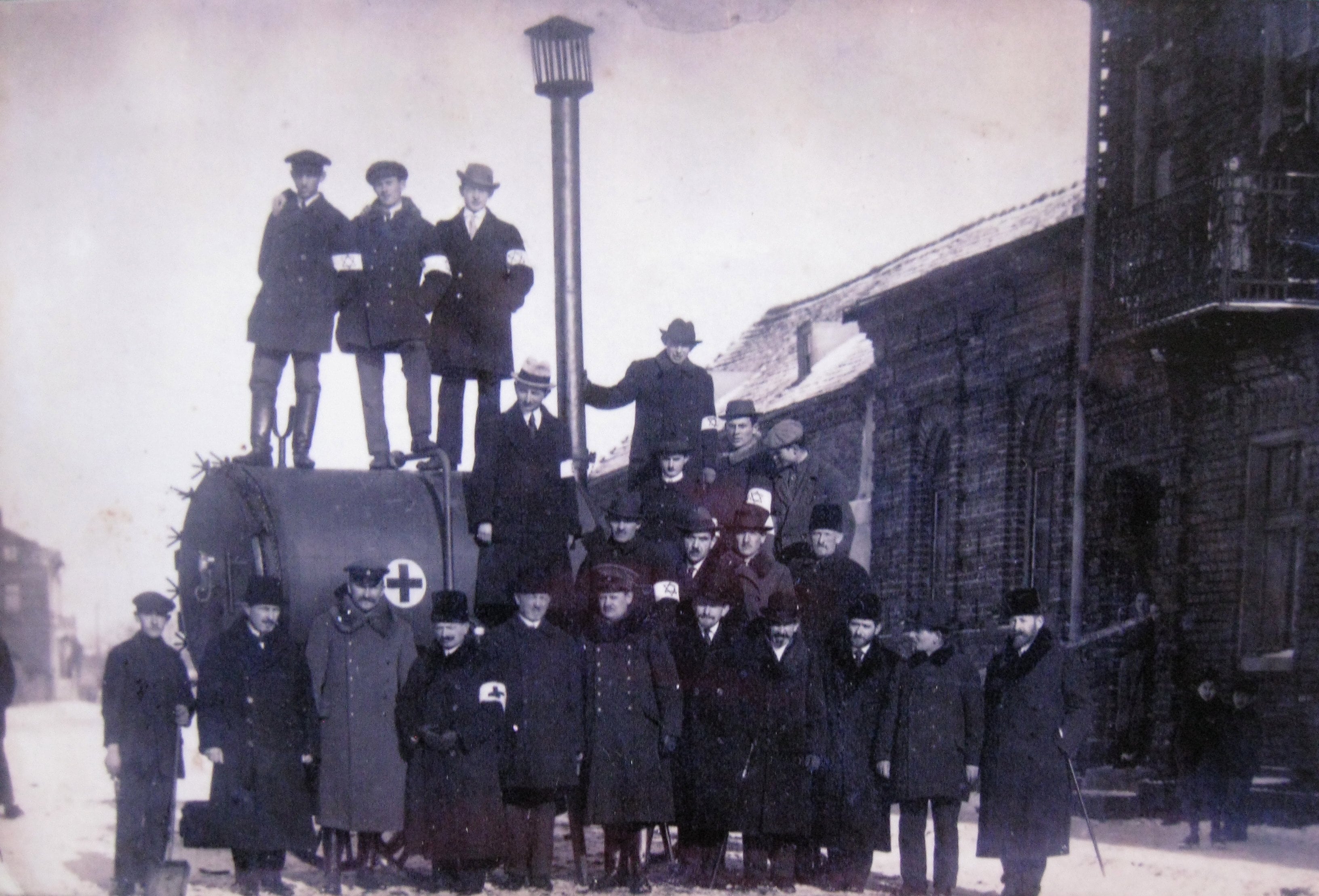
Kalisz. Red Cross volunteers - Jews wearing armbands with the Star of David. March 1918
The idea of imposing armbands on Jews was also grounded in the popular culture of the interwar period. At the time, armbands constituted a popular way of communicating that the wearer belonged to a political group, sports club or organisation. Moreover, in the collection of the POLIN Museum of the History of Polish Jews, a photograph from 1918 can be found presenting a group of Red Cross volunteers in Kalisz wearing armbands with Stars of David on their left sleeves [1.7]. The photograph provides evidence that an element of clothing, currently associated with the Holocaust period, had already appeared before and functioned in a completely different context at the time.
The popularity of armbands, before the Second World War, was referred to by Jerzy Jurandot in his Humor w opasce (Humour in an armband), adding a detail exposing the perfidy of the Germans:
"According to the order, an armband with the blue Star of David was to be worn on the right arm. This was additionally an expedient German piece of chicanery. An armband on the left arm is something somewhat natural, this is how armbands are always worn by clubs, organisations, or parties, whereas walking around with an armband on the right arm among people without armbands before establishing the ghetto, I personally had a constant sense of disorder in my wardrobe, as if I had put my trousers on backwards, or that I had tied a tie around my belly and a leather belt around my neck" [1.8].
Whatever form the German-imposed markings took, they were referred to explicitly as a "mark of disgrace". Many people were reluctant to leave their homes after the order to wear armbands was introduced, as mentioned by both Szpilman [1.9], and Janina Bauman in Zima o poranku [1.10]. Failure to comply with the ordinance was punishable by "severe penalties" - as stated - one of which was imprisonment.
Despite this, resistance was chosen, for example, by Janusz Korczak:
"I have nothing against this beautiful emblem but, after all, the intention of those who make Jews wear the armband on their sleeve is to humiliate, to dishonour both this sign and those who wear it. In the situation I find myself, the only right path I can and must take - is to preserve my own dignity. I will not wear the armband!" [1.11].
Some hoped that the order would not apply to them and wrote letters, addressed to Hans Frank, to obtain an exemption from wearing the armband. Their requests were rejected [1.12].
General Government - armbands with the Star of David
The armbands appeared primarily on the streets of cities in the General Government, but were also initially present in areas incorporated into the Reich, such as Łódź. The local ordinances introducing them varied, resulting in that there was no single type of marking. This is evidenced by items preserved in museum collections. Some of them are made of white canvas, others of cardboard or plastic. The applied stars also vary.
In the Polish capital the "Ordinance on: Identification markings for Jews of the Warsaw district" was published on 24th November 1939. The obligation concerned everyone from the age of twelve, and the armband had to be worn outside one's home, positioned on the outer garment, on the right forearm. The ordinance also specified exactly how the armband and the star, drawn upon it, were to look [1.13].
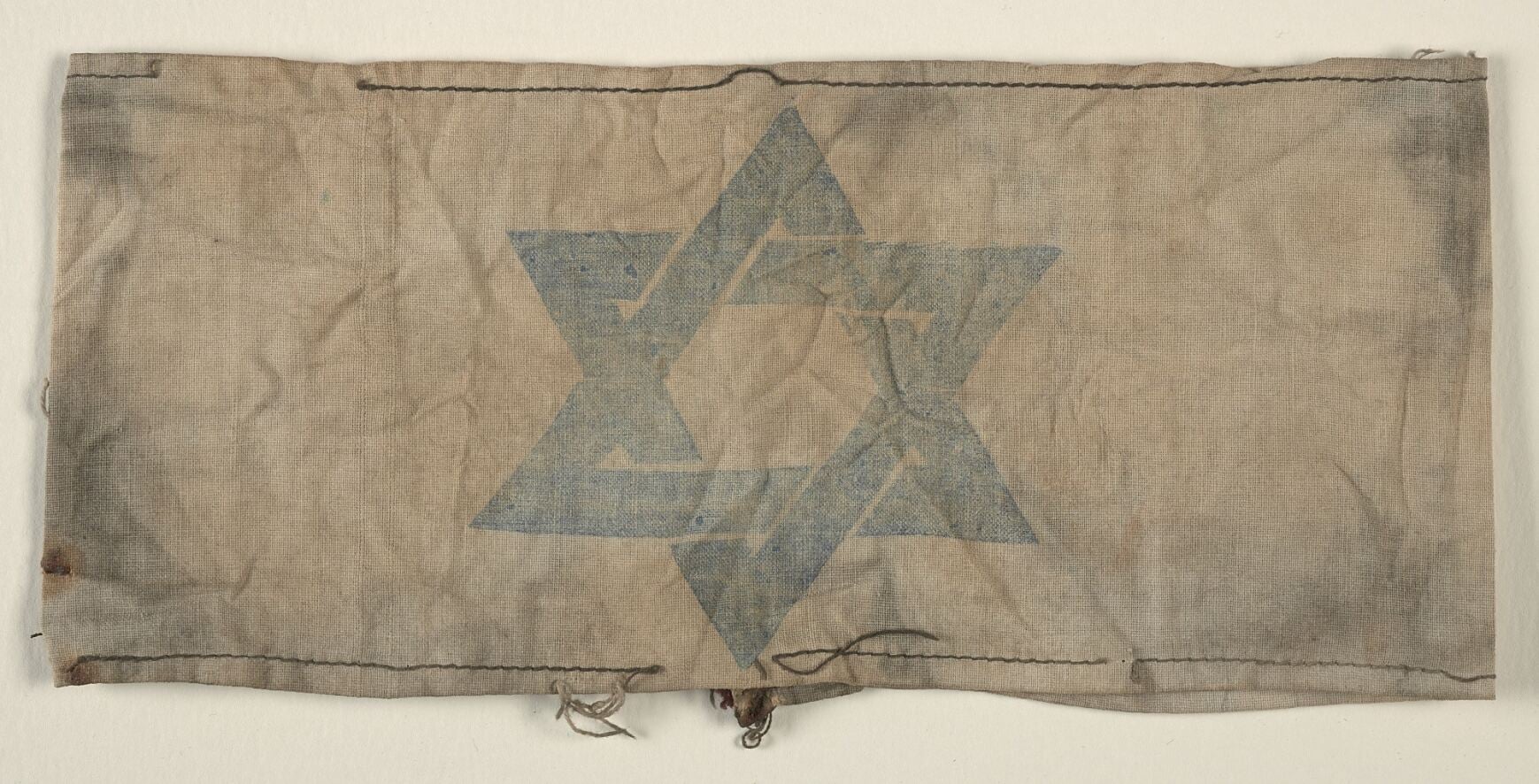
A discrimination armband with a printed Star of David of the type used in the General Government (Warsaw?)
Where did the armbands come from? What were they made of? The orders stated that the star was to be drawn or printed. Some of the bands, preserved in museums, were made of cotton canvas, upon which the outlines of the Star of David were applied with blue paint. An example of such an armband, from the POLIN Museum collection, can be seen in its Core Exhibition. Others include a simple stitching in navy blue thread [1.14]. Bands sewn from stitched pieces of fabric can also be seen. An armband, fastened with sewn-on loops and two, significantly different coloured, Bakelite buttons is included in the collection of the Jewish Historical Institute [1.15].
Making armbands at home was also mentioned by Lidia Siciarz in an interview conducted by the United States Holocaust Memorial Museum in 2000. She recounts that one was made by her father from a small piece of Plexiglas, that could be slipped over so that the Star of David was hidden from the inside [1.16].
The deceitful nature of the armbands is discussed by Sarah Tuller in her account of the Lublin ghetto, where such markings were introduced from 31st January 1940 [1.17]:
"What have we done? We have said:, ‘We're going to make such bands that are going to look like art, so that they won't look like a rag. […] We've spent hours. At night... We would go to work during the day, sit all evening, and each band was like a painting. It was embroidered. One was prettier than the other. There was supposed to be a blue star on white. But each star was like a piece of art. Everyone sat down and worked, made it like art.’" [1.18].
This recollection also shows that, despite its stigmatising function, the armband could also be an expression of creative rebellion against the oppression of the occupying forces. Among younger people, it might have also been perceived in a very different way. Henryka Shvefel talks about this in another interview with Brama Grodzka - Teatr NN:
"I don't remember when [we had to put on armbands], but I remember that there was an armband and I remember that I, at my age, maybe didn't need one yet, but I really wanted one because I liked it, and I had an armband. A yellow patch, I didn't have that, but I had an armband because I liked it, such a stiff armband, white, nice. I remember asking for it and getting it, but I didn't have to wear it at my age."" [1.19]
Unlike the other acts, the ordinance from Zawiercie (in the Core Exhibition at the POLIN Museum), in addition to the precise guidelines for the armband, also includes a guideline on how to obtain it: "Such armbands are available for purchase from the Jewish religious community in Zawiercie at ul. Hoża at a price of 30 pfenigs per piece. Armbands, without the stamp of the Jewish religious community in Zawiercie committee, must not be worn". This means that armbands were mass-produced here.
The emergence of more technologically advanced armbands is confirmed by Jerzy Jurandot in Warsaw:
"There were no problems with obtaining armbands. Vendors offered a variety of types - from bands made of plain fabric with a star cut out with a stencil, through bands made of exquisite material with a star embroidered with silk thread, up to special ones bound in cellophane for protection against the rain. Their prices varied accordingly, of course." [1.1.8].
The sale of factory-made armbands is confirmed by a photograph taken by Willy Georg, a German, showing the sale of '"Gazeta Żydowska". Hanging from the upper part of the furniture-exhibitor are stiff bands with a Star of David in the middle. The manufacturers of such bands are indicated by an advertisement from an issue of "Gazeta Żydowska", dated December 1940: "First workshop for celluloid, cardboard and other bands from 1.20 a dozen. We send samples. M. Fiszer, Warsaw Leszno 27/76". The same company stated, in another advertisement, "Manufacturer of modern cloth armbands, celluloid, and various cardboard bands from 80 gr per dozen. M. Fiszer, Warsaw, ul Leszno 27".

Seller of newspapers and armbands, possibly on Plac Muranowski in Warsaw. Summer 1941
Serial armbands were also manufactured in Kraków. Their producers were the most frequent advertisers in "Gazeta Żydowska". As early as October 1940, between the advertisements for drive belts, a stamp factory and a treatment centre in Jugowice near Kraków, there was the following announcement:
"For the attention of all! Avoid a penalty for wearing an unregulated armband by using an authority-recognised prescribed armband, made of rubber, with embossed and indelible paint, a star, with a practical fastening device for adjusting. Exclusive sale: L. Bławat - Kraków, Meiselsa 9. Trust facility. Resellers for the entire Governorate wanted" [1.20].
The April 1941 issue of "Gazeta Żydowska" advertised, in turn, "Jewish celluloid armbands with a spotted star suitable for washing in any quantity at low prices", which "are supplied by the company J. Geisler, XXII, Krasickiego 18/20" [1.21]. Before the war, the Fabryka Wyrobów Metalowych Braci Thorn (Thorn Brothers Metal Products Factory) was located at this address, and was later taken over by the Germans during the war. Advertisements also appeared in 1942. In January, two Kraków companies recommended their "Jewish armbands" - S. J. Cellnik at Benedykta 2/10 and "Venus" at Wita Stwosza 10/20 [1.22]. Some producers approached Jewish communities directly as distributors, as evidenced by the Zawiercie order cited above.
Advertisements in the press suggest that, over time, discrimination through clothing became part of everyday life in the Jewish communities of the General Government. Władysław Szpilman wrote [1.1.4]:
“The armbands didn't bother us anymore - they were worn by everyone and, after the ghetto had been in existence for a while, I caught myself getting used to them. When I dreamt of my friends from before the war, I saw them with their armbands, as if they were an integral part of their clothes - like a tie or a handkerchief.”
Jurandot also became accustomed to the armband as part of his clothing. He also mentions a sign in the flat reminding not to leave home without it. The armband penetrated into everyday life and, soon, in the face of the increasingly severe restrictions and repressions introduced by the Germans, it appeared to be less important, less frightening.
The obligation to wear the armband continued in the General Government until the liquidation of the ghettos. Those, who were transported from the ghettos to German Nazi concentration camps, encountered there another system of stigmatisation in the form of a striped uniform, a number, and a patch.
Łódź - yellow patches
In contrast to the armbands introduced in the General Government, in areas incorporated directly into the Reich, Jews were usually ordered to sew, onto their clothing, yellow Stars of David made from a piece of cloth.
According to the occupier's "Nowy Kurier Warszawski", as of 13th November 1939, the yellow armbands in force in the Wartheland, which included, among others, Łódź and Poznań, were to be replaced by Stars of David of the same colour, 10 cm high [1.23]. Patches were ordered to be worn on both the chest and back. Dawid Sierakowiak wrote about this change on 12th November 1939:
"By the way, I read an ordinance changing the Jewish yellow patches to yellow ten-centimetre "Magen David" (Davidstern) on the right breast and right shoulder blade. The barbarism is advancing. I think it won't be long before they make us walk around with blackened noses and in short shorts. As we know, the ingenuity of sadism knows no bounds. In the evening, a new task - ripping off armbands and sewing on new ornaments[1.24].
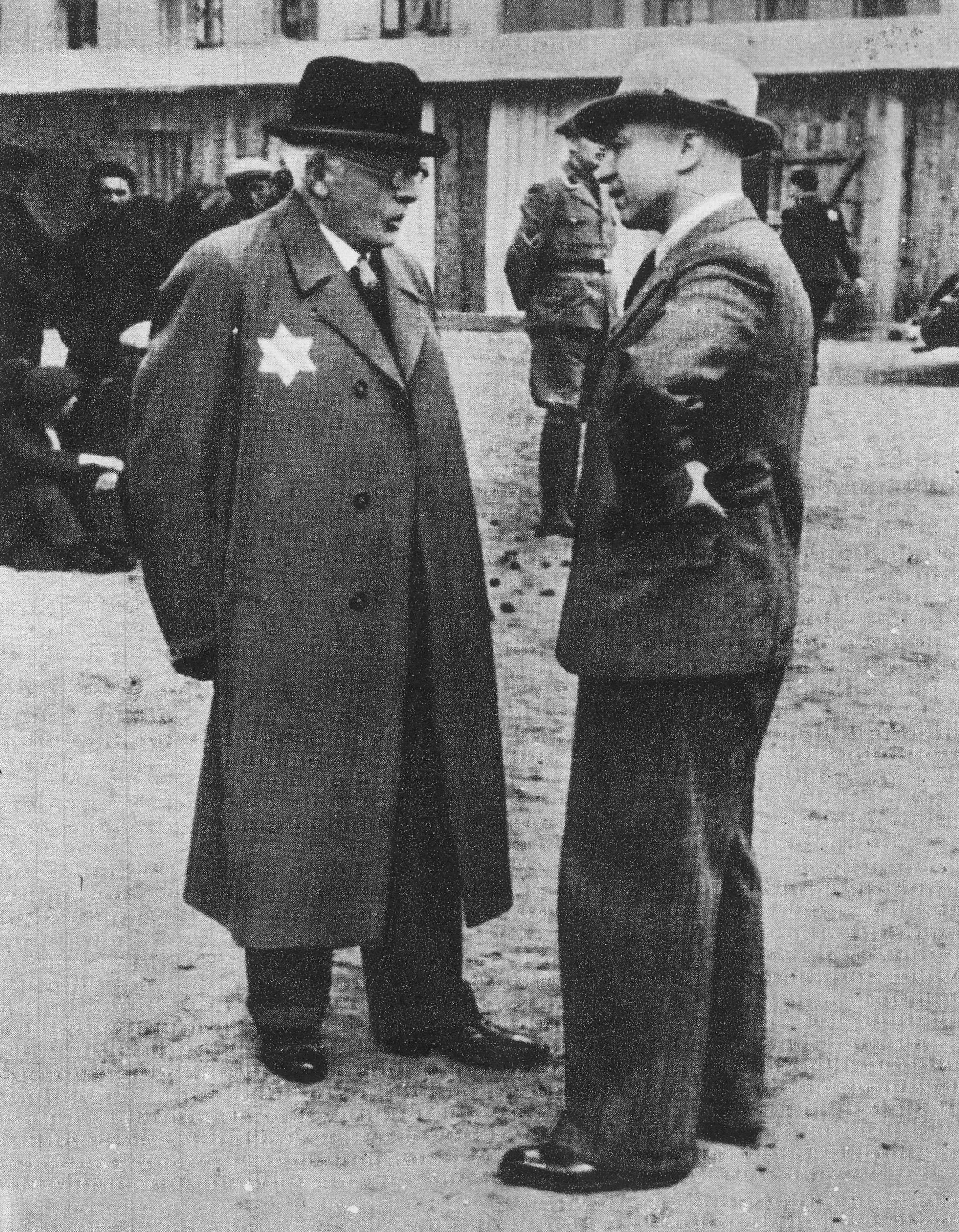
Ghetto in Łódź. Chaim Rumkowski wearing a coat with a sewn-on Star of David patch
The author of the article in the "Nowy Kurier Warszawski" also directly pointed out the manner in which the relevant markings were made, which differed from the solutions adopted in the General Government. In Łódź, it was not possible to buy ready-made markings - one had to sew the stars onto one’s own clothes. This is confirmed by the patches preserved in the museum's collections, made from a variety of fabrics and materials. In order to make them more rigid, they were lined with an additional layer of material, such as paper. The edges were mostly left unfinished [1.25].
Bedzin, Sosnowiec - yellow patches with "Jude" written on them
More sophisticated forms of patches were adopted in the Dąbrowa Basin - including in the ghettos of Będzin and Sosnowiec. Here, in 1941, the Germans ordered Jews to wear a yellow Star of David with black outlines and the inscription "Jude". Numerous photographs, depicting people with such patches, can be found in our museum's digital collection (including the Polish Roots in Israel group). They were made of yellow fabric that had been previously printed. Similar ones also appeared in other countries occupied by the Germans during the war - France, Belgium, Yugoslavia, or Romania.
An interesting example of the star can be found in the collection of the POLIN Museum - the outline of the star and the inscription has been embroidered on it with brown thread [1.26]. Sometimes, the stars were not sewn onto the clothing, but pinned with a metal safety pin, as can be seen in the archival material showing Alfred Rossner's sewing workshop [1.27]. This made it easy to reposition the piece of fabric from a coat to a dress or shirt.
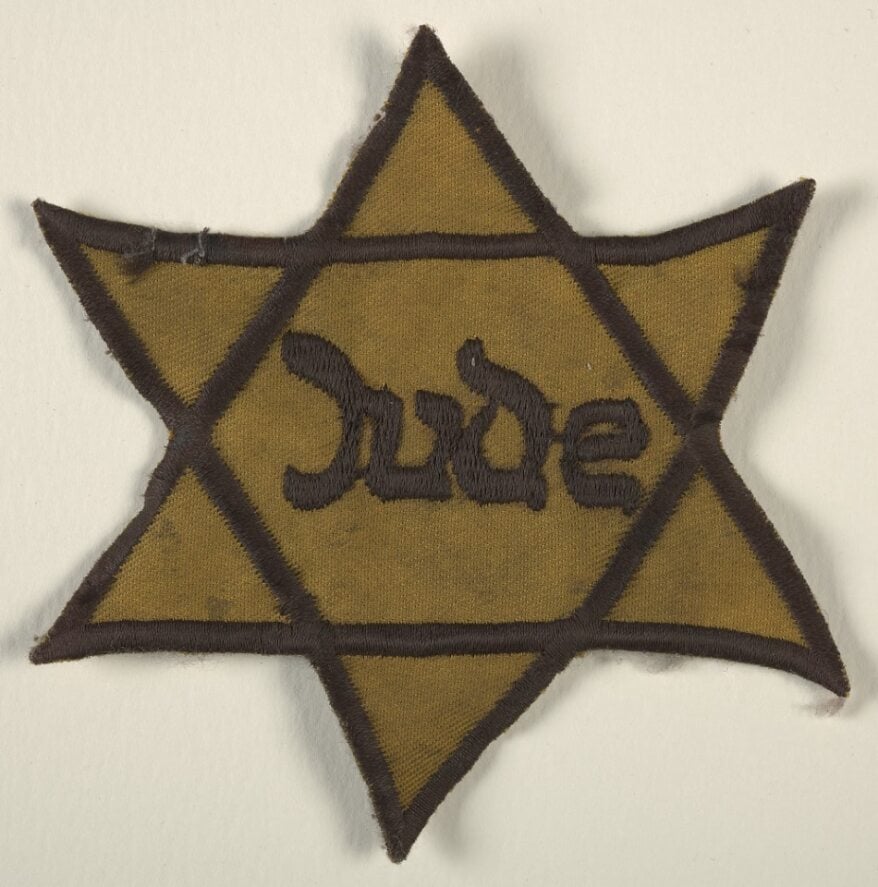
Naszywana gwiazda Dawida z napisem "Jude" - typ stosowany w gettach w Zagłębiu Dąbrowskim
Płock - triangle and circle
Whereas, in Płock an ordinance was issued on 20th November 1939 ordering Jews, over the age of 10 and "irrespective of their religion", to wear two triangles - one on the back and the other on the right breast [1.28]. In November 1940, the triangle was changed to a circle:
"The existing markings for Jews within the city of Płock - a yellow triangle on the chest and back - are changed as follows: All Jews of both sexes are ordered, irrespective of their religion, starting from the age of ten, within the city of Płock, to sew onto their outer clothing, namely on the back and on the left side of the breast, a circular shield of yellow colour with a diameter of 10 cm. The mentioned markings are available for purchase at the Jewish community council [...]"[1.29]].
Therefore, the ordinance explicitly stated the possibility to purchase from a distributor. An example of a marking from Płock can be found in the USHMM collection [1.30].
The armbands and patches, preserved in museums, provide important material testimony to the first stigmatising restrictions concerning the Jewish community in German-occupied Poland. Researching them allows us to look at the first months of the occupation from the perspective of a person's relationship with personal clothing, which one was forced to mark with compulsory, humiliating symbols. Once outside the ghetto, some people hid their armband, while hiding on the "Aryan side" meant there was no discriminatory element at the same time. The tragedy of the Jews has also made its mark in the history of clothing, showing the symbolic significance a minor element of attire can have.
Aneta Dmochowska
References
- Bauman J., Zima o poranku: opowieść dziewczynki z Warszawskiego Getta, Warsaw 1989.
- Gutkowska-Rychlewska M., Ubiory przymusowe w okresie feudalnym (XIII I XIV wiek)[in:] Historia ubioru, Warsaw 1968.
- "Gazeta Żydowska" from the years 1940–1942.
- Jurandot J., Humor w opascew Miasto skazanych: 2 lata w warszawskim getcie / Jerzy Jurandot, Dzieci getta / Stefania Grodzieńska, Warsaw 2017.
- Kowalski J., Żydowskie listy do Hansa Franka (1940): sprzeciw czy strategia przetrwania?, "Zagłada Żydów. Studia i Materiały" 2013, No. 9, pp. 488-500.
- Olczak-Ronikier J., Próba biografii, Warsaw, 2011.
- Przedpełski J., Żydzi w Płocku podczas okupacji (do czasu wysiedlenia), "Notatki Płockie" 1991, No. 2.
- Sulej K., Rzeczy osobiste: opowieść o ubraniach w obozach koncentracyjnych i zagłady, Warsaw 2020.
- Szarota T., Reakcja okupowanej Europy na oznakowanie Żydów gwiazdą Dawida, "Kwartalnik Historyczny" 2001, No. 1.
- Szpilman W., Warszawskie wspomnienia 1939–1940, Kraków 2001.
Interviews
- Interview with Jolanta Chmurowska from the collection of oral history of the POLIN Museum, ref. 119.
- Interview with Jadwiga Goldhar from the collection of oral history of the POLIN Museum, ref. 597.
- Interview with Lidia Siciarz from the collection of the United States Holocaust Memorial Museum, ref. RG-50.030.0405.
- Interview with Henryka Shvefel from the collection of "Brama Grodzka – Teatr NN" of 5 July 2017.
- Interview with Sarah Tuller from the collection of "Brama Grodzka – Teatr NN" of 14 December 2010.
- [1.1] Szarota T., Reakcja okupowanej Europy na oznakowanie Żydów gwiazdą Dawida, "Kwartalnik Historyczny" 2001, No. 1, p. 25.
- [1.2] Interview with Jolanta Chmurowska from the collection of oral history of the POLIN Museum of the History of Polish Jews.
- [1.3] Sierakowiak D., Dziennik: pięć zeszytów z łódzkiego getta, Warsaw 2015, p. 116.
- [1.4] Szpilman W., Pianista. Warszawskie wspomnienia 1939–1940, Kraków 2001, p. 40.
- [1.5] Gutkowska-Rychlewska M., Ubiory przymusowe w okresie feudalnym (XIII I XIV wiek) , [in:] Historia Ubioru, Warsaw 1968, pp. 165–166.
- [1.6] Arnschein Johann von [?], Dysputa między chrześcijanami a Żydami, MŻIH B-443/57/19, collection of the Jewish Historical Institute.
- [1.7] The photograph was donated by Anna Channa "Anka" Ben-Sira from her family archive - Polish Roots in Israel project from the collection of the POLIN Museum of the History of Polish Jews.
- [1.8] Jurandot J., Humor w opasce, [in:] Miasto skazanych: 2 lata w warszawskim getcie / Jerzy Jurandot, Dzieci getta / Stefania Grodzieńska, Warsaw 2017, p. 445.
- [1.9] Szpilman W., Pianista. Warszawskie wspomnienia 1939–1940, Kraków 2001, p. 40.
- [1.10] Bauman J., Zima o poranku: opowieść dziewczynki z Warszawskiego Getta, Warsaw 1989.
- [1.11] Olczak-Ronikier J., Korczak. Próba biografii, Warsaw 2011, p. 343.
- [1.12] Kowalski J., Żydowskie listy do Hansa Franka (1940): sprzeciw czy strategia przetrwania?, "Zagłada Żydów. Studia i Materiały" 2013, No. 9, pp. 488-500.
- [1.13] The ordinance is included in the collection of the Institute of National Remembrance.
- [1.14] Items from the Permanent Exhibition at the POLIN Museum as well as from the collections of the USHMM and the Jewish Historical Institute.
- [1.15] Discrimination armband made of pieced fabric, Jewish Historical Institute [online] https://delet.jhi.pl/pl/library/item/1322089 [accessed on: 30.10.2023].
- [1.16] Oral history interview with Lidia Siciarz, United States Holocaust Memorial Museum [online] https://collections.ushmm.org/search/catalog/irn507294 [accessed on: 30.10.2023].
- [1.17] Earlier in Lublin, from 27th November 1939, it was mandatory to wear a yellow Star of David sewn on the chest and back. Armbands, introduced from the end of January 1940, could be purchased at the Municipal Office. The announcements can be found in the collection of the National Archives in Lublin
- [1.18] Order to wear an armband with the Star of David – Sarah Tuller – fragment of a report by a witness of history, Brama Grodzka – Teatr NN [online] https://biblioteka.teatrnn.pl/dlibra/publication/101685/edition/96346#info [accessed on: 30.10.2023].
- [1.19] Armband with the Star of David – Henrika Shvefel – fragment of a report by a witness of history of 5 July 2017, Brama Grodzka – Teatr NN [online] https://teatrnn.pl/historiamowiona/fragmenty/opaska-z-gwiazda-dawida-1/ [accessed on: 30.10.2023].
- [1.1.8] Jurandot J., Humor w opasce, [in:] Miasto skazanych: 2 lata w warszawskim getcie / Jerzy Jurandot, Dzieci getta / Stefania Grodzieńska, Warsaw 2017, p. 445.
- [1.20] "Gazeta Żydowska" 1940, No. 28.
- [1.21] "Gazeta Żydowska" 1941, No. 33.
- [1.22] "Gazeta Żydowska" 1942, No. 10.
- [1.1.4] Szpilman W., Pianista. Warszawskie wspomnienia 1939–1940, Kraków 2001, p. 40.
- [1.23] Yellow armbands have survived, for example, in the collection of the Emanuel Ringelblum's Jewish Historical Institute of Łódź.
- [1.24] Sierakowiak D., Dziennik: pięć zeszytów z łódzkiego getta, Warsaw 2015, p. 131.
- [1.25] Examples in the collections of the Jewish Historical Institute and USHMM.
- [1.26] A patch presented at the Permanent Exhibition at the POLIN Museum.
- [1.27] Jews in ghetto of Dabrowa Gornicza & Bedzin, Poland; street scenes, workers, sewing workshop of Rossner, United States Holocaust Memorial Museum [online] https://collections.ushmm.org/search/catalog/irn1001215 [accessed on: 30.10.2023].
- [1.28] Przedpełski J., Żydzi w Płocku podczas okupacji (do czasu wysiedlenia), "Notatki Płockie" 1991, No. 2 (147), p. 34. A copy of the order can also be found in the Permanent Exhibition at the POLIN Museum
- [1.29] Cit. after Przedpełski J., Żydzi w Płocku podczas okupacji (do czasu wysiedlenia), "Notatki Płockie" 1991, No. 2 (147), p. 34.
- [1.30] Item from the USHMM collection, No. 2002.49.3.