Introduction
The period when Augustus III was the king of Poland, the most horrible in the country history, was also the saddest and darkest for Polish Jews. celebrated Orgies of intolerance spread over the state in which, under the rule of Jagiellonian dynasty and the first elected kings, dissenters and followers of other faiths were treated as almost equal. The courts of magnates were full of wantonness, the rule of law was trampled on, the poorer nobility was subservient to the Lords and at the sejmiks (local parliaments) voted as the Lord-bread giver wished. Hence the rapes and raids, ejectments and robberies, liberum veto, etc.
Polish cities, impoverished by wars and heavily depopulated, were looking for a way to return to their former glory, but this was impeded by the customs policy of the nobility, the maximum tariffs set by voivodes, unsafe roads and the lack of credit. The town dwellers, however, did not see these obstacles, it had become so used to this reality that it did not try to change it. It saw the main obstacle in Jewish trade and by all means tried to destroy it completely, or at least limit it to the smallest dimensions. The inhabitants of Warsaw were constantly referring to the law de non tolerandis Judaeis, confirmed for the first time by Sigismund I the Old I in 1527. In Krakow there was still an ancient treaty from 1485, by which Jews "voluntarily and without any coercion" renounced the right to trade and craft. In Lviv, the struggle to limit Jewish trade had been going on for three hundred years. It was referring to the so-called pacts from the 16th century, and Lublin - like Warsaw - underlined its privilege de non tolerandis Judaeis and did everything to expel Jews from the "city" where they got after the Deluge (Swedish invasion) and the burning of their quarter near the castle in 1655. The same fight raged in the cities and towns of Greater Poland – in Poznań, Wschowa, etc., while the constitution of 1768 on Jewish trade did not take the matter any step further. Order commissions, which did so much good for the cities, were unable to untie this townspeople-Jewish knot.
Private towns looked no better, although there the conditions for "fighting" were sometimes better for Jews; for there the "will of the Lord" was unquestionably decisive. Thus, Jews from “private” Leszno (Greater Poland), Tarnów or Rzeszów (Lesser Poland) could live at the market square and engage in trade and crafts, because the lord of the town - Sułkowski, Sanguszko or Lubomirski – allowed it. But as the Polish proverb has it „lord’s grace rides on a motley horse”, which means that every whim of the lord, the heir's bad mood, could expose a single Jew, and even the entire community, to the worst misfortune. Even more dependent on this grace was a Jew who worked for the heir as a country leaseholder, whom the heir needed all the time and treated him no better than his serfdom, or as a domestic or even wild animal. We can read that the Lubomirski family ordered their Jews (in Rzeszów) to sign chirographs that they would not leave the town, or even not let their daughters to another town without lord’s consent, or that Ochocki locked up his Jewish leaseholders who did not pay him the lease instalment in due time, in a pigsty among pigs, and their children he gave to the priest for education, in order to prepare them for baptism. Horrible things are told by Salomon Majmon (a philosopher and the best expert on Kant) about his youth, spent in Lithuania in the property of the “loving lord” Radziwiłł, while the tricks and ploys of the aldeman of Buczacz, Rzewuski, have already became part of the folk tradition.
The interior of Jewish life was no better than the exterior. Pushed to cramped, dark and dirty Jewish quarters, the Jews endured there a sad life. During the Polish Renaissance in Krakow, or rather in Kazimierz, the borders of the ghetto were expanded three times (1553, 1583 and 1608), but from 1608 until the end of the Polish-Lithuanian Commonwealth, the Jews did not manage to gain any more land and were suffocating on 212 plots and as many houses, mostly wooden and heavily dilapidated. In Lviv and Poznań, the number of Jewish properties was limited to 49 plots, and any attempts to extend further, i.e. outside the Jewish gate, were severely punished. Although life was stronger than any prohibition and Jews here and there settled outside delineated boundaries, the reaction raised its head again and again, and then they were pushed back into the cramped Jewish quarter. This fight went on not only about Jewish living space, but also about Jewish trade in the "town". In 1708 the Jews of Lviv occupied almost the entire market square (all shops), and several dozen years later they were all expelled from there. In Krakow, in 1776, the Jews lost a case against the city, a case that had been going on intermittently for several hundred years and had to leave Krakow. And when, according to an agreement with the Kazimierz magistrate, they set up their shops in the so-called Christian Kazimierz, and the Krakow trade moved there as well, the Krakow merchants began a fight to expel Jews from new places and to force them into the cramped "Jewish town".
It was even worse for the Jews of Warsaw. Not tolerated in the city they came to agreements with the magnates, Sułkowski and Potocki, who organized separate towns for them: New Jerusalem and Nowy Potok behind the Warsaw trenches. The townspeople of Warsaw, seeing that trade was moving along with the Jews beyond these trenches, persuaded the Crown Marshal Lubomirski to destroy their competitors. On January 22, 1775, Lubomirski ordered that all goods from the Jewish warehouses be taken and deposited in the municipal warehouses, and that the houses and warehouses in both towns be demolished.
The economic condition of Jewish communities
This external struggle was accompanied by an internal struggle in Jewish communities, a struggle for the balance of community budget, and with it a struggle for dominion in the community, in the Jewish areas, in the Council of Four Lands (parliament of Polish and Lithuanian Jews).
For a long time the taxes and consumption fees paid by Jews were not sufficient for the maintenance of communities and higher kehila and land organizations, therefore kehila seniors, as well as delegates to sejmiks (regional assemblies) and sejms (parliaments) increased these fees again and again. In the mid-seventeenth century in Krakow, the so-called meat fee, i.e. a fee for a kosher slaughter amounted to a dozen or so groschen, and in the 1820s – to over 30 zlotys per head of cattle. Some towns in Greater Poland had fees so exorbitant that only the wealthiest Jews could afford a meat dinner during the week. In Krakow, Lviv, Poznań, Leszno, Krotoszyn, Lublin, Vilnius, etc., there were kahal fees for meat, milk, vodka, beer, and also high taxes on the sale of all other goods of daily use; but even this was not enough to cover the expenses of the kehila, which as a result of domestic misfortunes, fires, and above all as a result of the constantly recurring anti-Jewish riots organized by school and craft youth, and also as a result of the so-called rituals trials, grew disproportionately from year to year. Individual kahals and local governments had to resort to borrowing money, sometimes on high interest, i.e. to the so-called wyderkaf (right of repurchase). In time, all churches, monasteries and all Catholic spiritual foundations were by wyderkaf transferred to kehila funds, which at that time were considered the surest places for capital deposit. The laymen also lent large sums to the kehila and landowners, while the kehila seniors had to rack their brains to sort out how to cover old debts with new loans.
Already in 1700, the Poznań kehila owed to various monasteries (apart from the Jesuits) 109,278 zlotys, while to the Jesuits themselves it owed 293,744 zlotys. In 1719, the Krakow kehila owed to secular lords 242,287 zlotys, and 345,240 zlotys to monasteries and churches. In 1727 the Lviv kehila owed to the magistrate 438,410 zlotys for the enemy fighting contributions, in 1765 the Przemyśl kehila owed 381,999 zloty to the clergy and secular lords, the Leszno kehila - 535,493 zlotys, in Wronki - 200,000 zlotys, in Inowrocław - 194,907 zlotys, etc.
The constant increases in kahal taxes by seniors in order to cover at least the most important needs of the community, and above all to pay interest and gifts for state, city and clergy officials, caused dissatisfaction of the "common man" who was not admitted to kehila offices, and thus to control the accounts. Almost in every community this was the background against which there was a struggle between the kahal oligarchy and the "common man", which led to armed struggle in some town. Both sides were supported by powerful lords, voivodes, starosts, and so on, and in the Jewish market, and even in the synagogue, the magnate’s hajduks were engaged to win hegemony for their masters' minions. Here and there the "arch-seniors" or the commanding individuals come to the fore and tyrannically oppress their brothers. In Drohobych to this day, a tradition tells about Zelman Wolfowicz, who, trusting in the help of the forewoman Tarłowa, attacked and plundered Christians and Jews, and in Krakow during the Bar Confederation and the first Austrian occupation (1772-1776), such a tyrant was Febus Abrahamowicz, who knew how to find his way to the Confederates, Muscovites, Austrians and Polish authorities. Such autocrats also come to the fore of Jewish regional assemblies, and the fight for the position of the marshal of the Jewish Sejm between Abraham of Leszno and Abraham Chaimowicz Halpern of Lublin (1753) is a perfect example of these aspirations for hegemony over Polish Jewry. The same happened with the rabbinic appointments, where the family, the protection of powerful lords, and especially money played a greater role than the candidate's learning. The fight for the Kraków rabbinate, in which (behind the scenes) the Radziwiłł and Lubomirski families (1742-1745) took part, or the Lviv land rabbinate in 1720, which was decided by Jabłonowski, the Ruthenian voivode, numerous attempts to get the support of the Leszczyński and Sułkowski families for the rabbinate in Leszno, all these cases make a very colourful mosaic of relations in Jewish communities in Poland in the 18th century. It should be remembered that, apart from personal and family ambitions, this was also affected by the struggle between the growing Hasidism and the traditional synagogue, defending itself against this innovation
Mystical movements. Sabbatai Zevi
As early as in the mid-seventeenth century, the so-called practical kahal, hatched in the sick brains of Spanish exiles, penetrated Jewish communities in Poland. From Safed in northern Galilee, via Italy and Muntenia, it reached us and stood in the way of the rationalism developing in Polish communities and Polish universities. In the 16th century, during the Polish Renaissance, the light of reason began to illuminate Jewish communities and Jewish quarters. Through Maimonides, a scholastic philosophy based on Aristotle, and a certain understanding of universal and Jewish history, and even astronomy, although still in terms of astrology, reached the schools in Kraków or Poznań. Jewish women enjoyed reading romances that were translated or converted from German into Yiddish. But already in the 17th century, especially in the period of the Deluge and after it, all this was lost and only the study of Talmud in a strongly scholastic way was left, and next to it, the study of the kahal, both theoretical and practical, encroached into our synagogues and academies. Polish Jewry, broken by numerous wars, sought relief from pains in fasting and Kabbalistic practices, faith in evil spirits, in dybbukes and in unsaved souls invades Jewish homes and brains, and all this was to hasten Israel's salvation from this terrible misery. But only the messiah could save Israel, so all Polish Jewry awaited this messiah with impatience that increased with the deterioration of living conditions in this land. And in fact, in the period of the most horrible persecution, commotions and pogroms, i.e. in the years 1660-1682, during the Turkish wars, the Jewry lived to see that messiah, and he was Sabbatai Tzvi from Smyrna, who announced urbi et orbi his mission in the "year of salvation", i.e. in 1656.
Polish Jewry relaxed for a moment; ceremonies and processions were held in Jewish quarters, and the images of the messiah and his prophet Nathan of Gaza were carried by his singing followers. No attention was paid to the warnings of the Catholic clergy, nor to King John II Casimir Vasa, who saw in this messianism an offense to the Christian religion. During this period the Jews did not guard their shops or warehouses, did not sow or plough, and that was taking place in the west of the Polish-Lithuanian Commonwealth - as Wacław Potocki tells us - as in the east: in Podolia, Volhynia and Ukraine, which deeply outraged the Orthodox Bishop GaIatowski.
But soon the illusion vanished; The messiah Sabbatai Zevi, who went to Constantinople to "strip the crown from the sultan's head," lost heart and converted to Islam. The official synagogue in Poland, through the mouths of delegates and rabbis gathered at the Jewish Sejm in Jarosław (1670), cursed the "hypocrite and all who believe in him and spread this faith among the people."
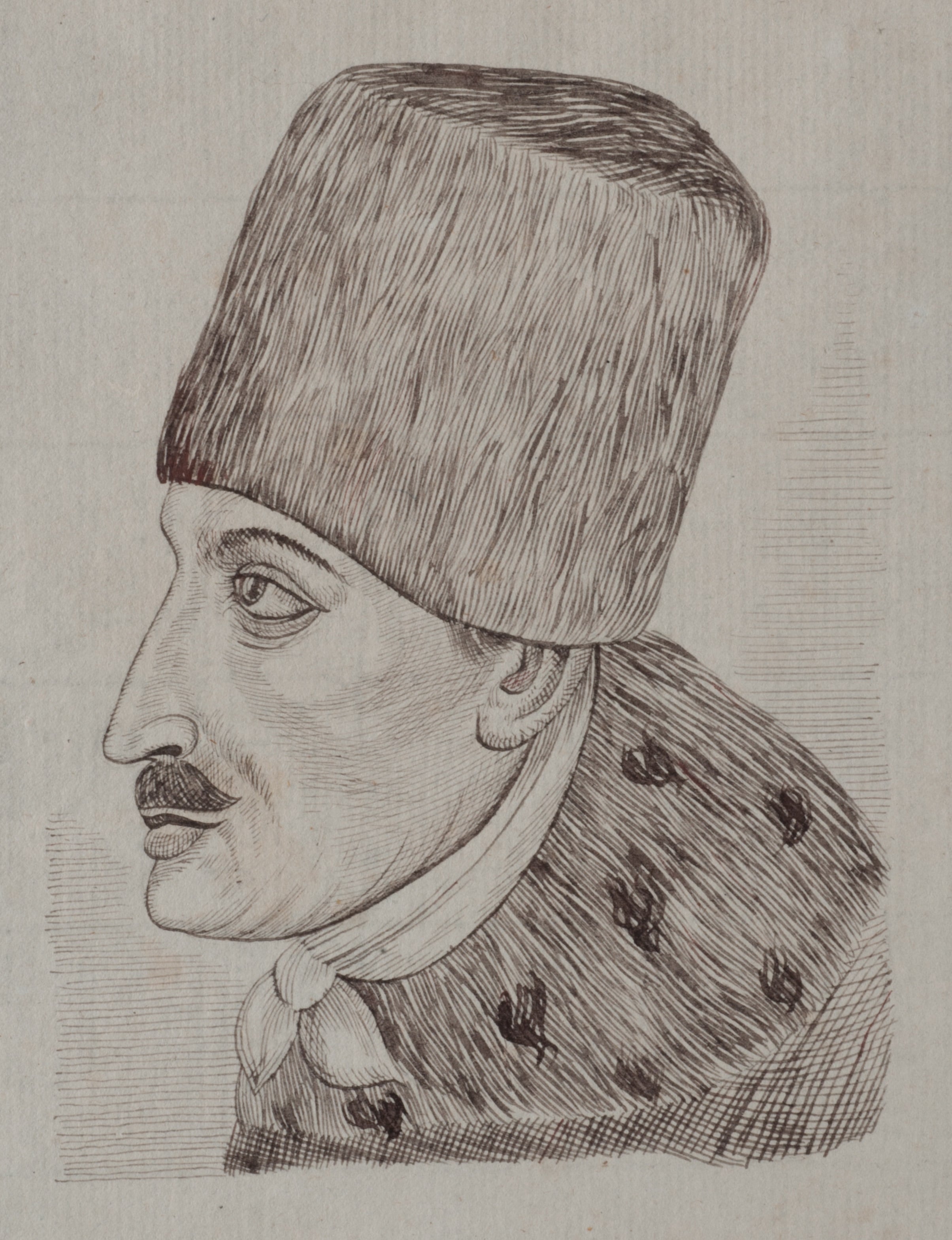
Portrait of Jacob Frank. The collection of the Emanuel Ringelblum Jewish Historical Institute
Jacob Frank
The curse did not entirely eradicate the optimism of the unhappy and the most miserable; the faith in Sabbatai, sustained by his successors, and spread here from Thessaloniki (a sect called Dönmeh lived there) managed to hold on despite persecution for almost 100 years, until in 1755. At that time a new "messiah" appeared and gathered around him "the withered bones” of fizzling out Sabbatianism. It was Jakub Lejbowicz Frank, who, although born in Podolia, gained his faith at the very source, in Saloniki, from one of Sabbatai's successors and transplanted it through Muntenia and Wallachia to Ruthenia, Lviv, and therefrom to Podolia.
However, hard pressed by the official synagogue, Frank threw himself into the arms of the bishop of Kamieniec, Mikołaj Dembowski, and called the rabbis of Podolia to a dispute in which he was to prove the correctness of his theses, their connection with Catholic dogmas, and the pernicious influence of the Talmud. The dispute took place with all the medieval pomp; both sides defended their position, although the priests present did not understand a word of all this. Rabbis-Talmudists and anti-Talmudists (Frankists) did not know Polish at all, so they spoke only in Yiddish.
Frank won for a while, but after Dembowski's sudden death, he succumbed to Jewish force and left Poland. However, soon after he sought the help of the Archbishop of Lviv, at the cost of drawing into the orbit of his theses the proof that Jews murdered Christian children and used their blood to bake matzah. It is clear that during the period of darkness in our country during the reign of Augustus III, when a ritual trial "erupted" in one of the towns almost every year, and the courts, sometimes in good faith, sentenced Jews to the most horrible and most painful torments, when, after the Żytomierz (1753) ) and Jampol (1756) trials, the case was based in the Vatican, and Cardinal Lawrence Ganganeli (later Pope Benedict XIV [Autor’s mistake – Giovanni Vincenzo Antonio Ganganelli became Clement XIV; Benedykt XIV was born as Prospero Lorenzo Lambertini] directly condemned the conduct of bishop Sołtyk, accusing him of impure motives when staging the trial in Żytomierz, at a time when one of many such trials was also taking place in Przemyśl (1759) and the defendants waited in great fear for the verdict, Frank's help was handy for some circles, so they organized a new dispute in the Lviv cathedral.
This dispute was even more pompous, and it lasted intermittently from July 17 to September 10, but here too the Christian audience did not have much comfort, because they did not understand a word. It was a tragedy for the Jews that they had no one who could explain the whole thing in Polish and expose the tawdriness of Frankists intentions. The rabbi of Lviv, Chaim Rapaport, a great Talmudist, could barely read his defence from a piece of paper, and his assistant, Ber Brezower from Bolekhiv’s grasp of the Polish language was also poor. The non-integration of Polish Jewry , complete neglect of secular teachings, ignorance of church and even secular literature, took a sever revenge on the Jewry and prompted thinking individuals to revise the programme of educating young people in line with the rationalist currents reaching us from the west.
There were, however, in Poland, especially in its south-eastern territories, large communities of Jews who, despite Frankism and its deviation, and despite the rationalist breezes from the west, and perhaps in spite of Frank's bankruptcy and in order to defend themselves against these gusts of "enlightenment", strove for even more impenetrable closing in the Middle Ages, in the circle of "practical kahal".
Here is the genesis of Hasidism, which came into being in our Podolia region, on the same section as Frankism and from the same premises, but it followed different paths and managed to win over numerous Jewish communities within several decades. The growth of Polish Hasidism took place in the last two decades of the 18th century, that is in the period when Mendelsohn's teachings reached us, and the reforms of the Great Sejm began and were carried out.
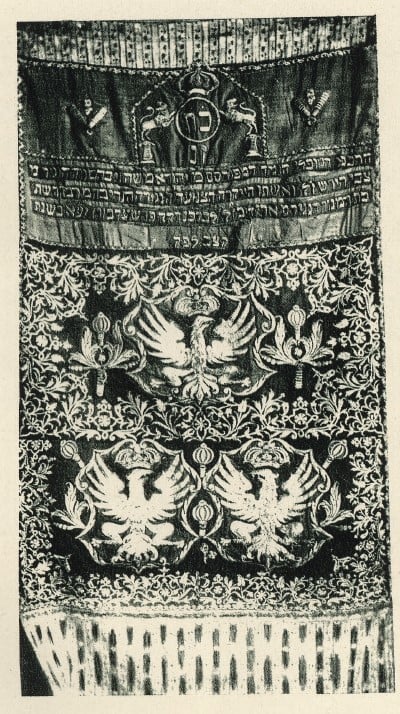
Patriotic parochet from the synagogue in Przedbórz, probably the second half of the 18th century. Szymon Zajczyk, ca. 1934.
The beginnings of the Enlightenment
Light to the Jewish quarters came from two sides, from Jewish sources in Germany and Austria, and from Polish sources, i.e. from those men who understood that with a general reform in the country, Polish Jews must not be left to their fate, but should be drawn into the orbit of plans aimed at healing the motherland. The Jewish source which radiated very strongly all around was Moses Mendelsohn, a translator of the Bible into German; all the "reformers" of Jewry of that time came from his school. Among them were Polish Jews, such as Solomon of Dubno, Israel of Zamość, Mendel of Satanov, Solomon Maimon of Lithuania, and many others, who saw in the enlightenment of the people the only way to get them out of their misery. Those innovators saw practical results (though not very effective till then) in Galicia, where on the orders of Joseph II, Mendelsohn's student, Herz Homberg (a Czech Jew) opened about 100 folk schools for Jewish children in a short time. This encouraged the Jewish "innovators" to work, and soon, during the Great Sejm period, they came up with their projects, roughly corresponding to those of the Great Sejm representatives.
These representatives were, in large part, under the patronage of King Stanislaus II Augustus himself, who, despite his numerous flaws, was a man of profound knowledge and an advocate of progress. Already as a young man, when asked in Amsterdam by a Portuguese Jew, Suasso, what he thought about the so-called ritual murders, he ensured that he was against insinuating similar beliefs and condemned Kajetan Sołtyk, who at that time staged such a trial. This view was upheld by Stanislaus II Augustus, when he was already sitting on the throne o0f Poland. During his stay in Krakow (1787), he summoned the young Wodzicki and said these words to him: "I did not expect from you, the noble Lord, that having received a higher education, you would still be able to believe in medieval fairy tales that Jews needed Christian blood for Easter. Although the history of all the nations mentions trials of this kind and severe punishments to which the accused of these crimes were sentenced, the education of this century has convinced us of the innocence of these victims of prejudice and superstition.”
The Jews soon felt the difference between the new ruler and Augustus III, especially since many knew him from the times when, as a young boy, he travelled with his father to his family estate in Jazłowiec and Zaleszczyki. The Poniatowski family, the king and his father, knew well the rabbi of Jazowiec, Hirsz Margulies; thanks to their protection, or rather thanks to the protection of the king, one of his sons, Majer, became the rabbi of the part of Ruthenian land with its seat in Komarno, the other, Izaak Ber, the rabbi in Podolia. There were many Jewish factors at the court of Augustus III, which Stanislaus II Augustus then took over and appointed them agents, i.e. court factors. Also, two Jewish court doctors: Dr Samuelsohn and Dr Solomon Polonus, mentioned in historical sources.
No wonder, then, that the Jewish communities trusted the young ruler and welcomed him during his journey not only formally, but also very cordially. During Stanislaus II Augustus journey to Lithuania (1784), he was greeted in Kobryn by the local rabbi "offering him a sugarloaf, wrapped in a blue cloth, with an inscription in Hebrew, embroidered with gold and silver threads".
The king was ceremoniously welcomed in Pinsk, where the well-known reformer and friend of Jews, Butrymowicz, gave an appropriate speech and, while guiding the ruler next to the newly built Ogiński canal, promised that an obelisk would be erected in this place with an inscription in Latin, Polish, Ruthenian and Yiddish.
The second royal trip (to Kaniów and therefrom to Krakow) also induced the Jewish population to show their attachment to the ruler. The king was greeted very ceremoniously in Niemirów, and Miller, the director of the cloth factory, while taking the king around the workshops showed him that there were numerous Jewish women among the workers.
The Jewish community in Krakow ceremoniously welcomed its ruler, recalling that "it had not been so lucky for over a century and a half". The king's arrival was on Saturday, and the place for the Jewish representatives was designated far beyond the town, as far as Czyżyny. So, the kehila's elders together with the rabbi carrying the Torah scrolls left on Friday after lunch and went as far as Dąbie, where they spent the night, and then at five in the morning went to meet the king. It was still a very medieval cavalcade, similar to those that welcomed German emperors in Czech Prague.
“At the head, a clown rode on a wooden horse, followed by musicians, after the musicians, little Jews with pennants, then older and older in years, then clergy and elders, each of these groups was separated by a canopy, of which there were six, very richly decorated. The king came on horseback, and the elders, carrying "God's Commandment" under the canopy, greeted the king".
First ... the first rabbi ... blessed the ruler, then the king was given a hymn in Polish language, in which the Jews praised liberalism and the king's paternal protection;
„u którego ten przesąd nie mieści się gruby,
że przyczyną jesteśmy chrześcijańskiej zguby”
(who does not believe in this gross superstition
that we are the cause of Christian bane)
…
Przyjmij łaskawie nasze te szczupłe dary,
Które Tobie wzgardzeni i nikczemni dają,
Bo jak miłe, choć drobne, Bogu są ofiary,
Od ubogich, a szczerym sercem mu składają,
Tak niech będą przyjemne szczupłych wierszy pienia,
W których upokorzeni przynoszą życzenia.
(Kindly accept our slim gifts,
Which the scorned and so-called wicked give to you,
For how pleasing, though small, these sacrifices are to God,
From the poor with a sincere heart offered
So let the slim chants of these rhymes be sweet,
with which the humiliated bring wishes.)
Stanislaus II Augustus spent almost two weeks in Krakow and during that time he met several representatives of the magistrate and the inhabitants, and listened to an extensive elaboration on the needs and pains of Christian merchants, delivered by the mayor of the city, Lichocki. On this occasion Lichocki mentioned Jews several times, but he did it very carefully and with restraint, knowing the liberal views of the ruler.
Stanislaus II Augustus visited “the Jewish town”, he was in the Old synagogue, where he was greeted by the Jews with songs and prayers prepared for that occasion.
Polish Jewry reform projects
Barely a year after the king's stay in Krakow, the Great Sejm also known as Four-Year Sejm began its sittings (1788—92). It was to rebuild the Commonwealth in capite et in membris. Along with many other matters, including the issue of towns and the rights of the townspeople, the Jewish question came up for deliberation. A few years earlier it was raised by two Polish representatives: Zamojski (1775) and "Nameless"; the first from a very medieval angle, the second liberally and in a modern way. Literature on this issue began to flow in abundance only during the Sejm itself, when it was foreseeable that the parliamentary groups would deal with it as soon as possible. Thus, the project by Butrymowicz emerged: Sposób uformowania Żydów polskich w pożytecznych krajowi obywateli [The method of forming Polish Jews into citizens useful to the country] (Warsaw 1789), strongly reminiscent of the aforementioned project of the Nameless. Butrymowicz also published and a second, more precise project entitled Reforma Żydów [Reform of the Jews] (Warsaw 1789), and there were other projects, such as „Myśli patriotyczno-polityczne“ [Patriotic and political thoughts], Zgoda i niezgoda [Agreement and disagreement], Projekt albo światło nowe [Project or new light], by Krzysztof Milewski, Myśli polityczne dla Polsk [Political thoughts for Poland], etc.
The Jewish issue was thoroughly considered by Tadeusz Czacki, who, as a high-ranking treasury officer, often had to deal with it, and Fr. Hugo Kołłątaj also expressed hie view on this subject and wrote it down in 11 succinct paragraphs. Stanisław Chołoniewski, representative from Bratslav, excellently raised this issue. He presented his project directly on the so-called Jewish deputation (see below) and it was approved by most of its members.
All these deputies started with an assumption, common not only in Poland but also in Western Europe, that Jews were harmful to the state because they were excluded from the society in which they lived. In order to make them useful, they should be assimilated with the help of schools, clothes, etc. Some of the reformers followed the representatives of the former style and the rulers of the partitions (Frederic the Great and Joseph II) advised to remove Jews from villages, take away their leases for taverns and breweries and induce them to engage in crafts; others proposed to engage Jews in agriculture.
Fr. Stanisław Staszic had a negative attitude towards Jewery (Przestrogi dla Polski [Warnings for Poland]), but as a practical statesman he understood that something had to be done with them and advised to let them work as farmers (Uwagi nad życiem Jana Zamojskiego [Comments on the life of Jan Zamojski]).
However, not only did Christians take the floor on the Jewish question, but also the Jews, as the ones most interested, spoke about it, each of them from his own personal and regional angle. The most radical plans were given by the so-called enlightened Jews, i.e. those who had already been it in the West, in the Mendelsohn’s circle, had already read the so-called enlightenment literature, that is the Haskalah.
Salomon Majmon, a Lithuanian Jew, brought up in a country inn, having abandoned his wife and family place, wandered around Germany for many years, and there, having acquired culture and education, became one of Kant's closest students and an interpreter of his philosophical thoughts. However, he did not forget about his homeland and in his work dedicated to Stanislaus II Augustus, entitled Versueh über die Transcendentalphilosophie (Berlin 1789), he wrote, inter alia: “I would be doubly happy if I could draw the attention of my people to the real benefits of education and inspire them to have courage and zeal, so that they would strive to gain more and more respect of the people among whom they live, and that with the help of education and justice".
Mendel Lewin, the second Jewish reformer of that period, came from Satanów in Podolia. While in Berlin to heal his eyes, he met Mendelsohn, Solomon of Dubno and other reformers. After returning to his homeland (1783), he began to spread Western education among his fellow believers. Under the influence of Adam Czartoryski, Lewin developed his project in French entitled Essai d'un plan de reforme ayant pour objet declairer la nation juivs en Pologne et la redresser par ses moeurs, and in it he explained that the Jewish issue was solely a matter of making Jews more culturally aware, i.e. their assimilation.
These voices should include the essay of Dr Salomon Markuze, a doctor from Królewiec, practicing in Turyjsk in Volhynia, who in his popular medical book entitled Sefer Refuot (in Yiddish, Poryck 1790) advised his fellow believers to abandon taverns and municipal activities and get involved in agriculture.
The old system was defended by the rabbi of Chełm, Hirszel Józefowicz in his dissertation entitled Myśli stosowane do sposobu uformowania Żydów w pożytecznych obywateli państwa [The thoughts about the way of forming Jews into useful citizens of the state], and a very shallow court factor of Stanisłlaus II Augustus, Abraham Hirszowicz, saw the way of reforming Jews in the expansion of communities, funding of hospitals, more modest attire, etc.
We hear a highly cultured, but also quite naive voice from Leszno. Samuel Mankiewicz, the syndic of this community, suggests Extract on how to ensure peace from Ethics by Aristotle (!) the teacher of Alexander the Great, pars IX, caput VII published in Greek and translated into Latin, then some 400 year ago translated into Hebrew by Mayer, the doctor of the Castile king, and as late as in the year 1789 in oriental print (!) in Berlin translated from Hebrew into Polish…, and from Vilnius we hear two voices: one, of a man of the old way, Szymel Wolfowicz, and the other, the voice of a physician, Solomon Polonus.
For years, Szymel Wolfowicz had fought against the kehila oligarchy of his town. Like in other Polish towns, it ruled the community autocratically, preventing people who were outside its clique from gaining power. Elected together with his colleague as the "tribune of the Jewish people" in Vilnius, Szymel (Szymon) obtained the king's iron letter (July 10, 1788), but the ruling clique was not afraid of the royal letter and cursed the "tribune", and the Vilnius governor, Karol Radziwiłł put him in a very severe prison in Niasvizh. There Szymel had a lot of time to reflect on his fate and the fate of his brothers and from there he sent to Warsaw a memorial entitled Więzień w Nieświeżu do sejmujących stanów o potrzebie reformy Żydów [the Prisoner of Nesvizh, to the parliamentary representatives about the need for Jewish reform] (1790). As it can be easily guessed, the author speaks against the omnipotence of the kehila and rabbis, describes the kehila’s oppression of Jewish merchants by imposing unbearable taxes and fees, and demands "separation of Jewish civil activities from religion", i.e. submission of Jews to the jurisdiction of the common authorities.
The other resident of Vilnius, Salomon Polonus, a Doctor of Medicine, "His Majesty’s clinician", was already on a completely European ground. His extensive work (the 344 pages manuscript) includes Zbiór próśb Żydów francuskich do Narodowego Zgromadzenia, mów JX. Grzegorza, plebana erbermenilskiego, deputata nantskiego za Żydami, z francuskiego na polski przełożony, z dodatkiem projektu reformy Żydów polskich i potrzebnymi notami objaśnione. [The collection of requests from French Jews to the National Assembly, speeches of JX. Gregory, Erbermenilian parish priest, Nantian deputy for the Jews, from French to Polish translated, with the addition of a project to reform Polish Jews and explained with the necessary notes]. The only known copy of this work is in the form of a manuscript in the Czartoryski Library in Krakow; Apparently, the king, to whom the author had given the same copy, did not submit it for printing, but read it diligently, and passed it to Czacki who read it and assessed it positively. And Polonus is for assimilation and believes "that all prejudices against Jews must disappear at the moment when they declare their readiness to sacrifice their life and property for the motherland." He believes "that Polish Jewry can, through education, reach the same status as French Jewry... and the fertile soil of Poland, with a more rational agricultural economy, is able to feed many more millions of human beings - It is in the interest of the state to care for and look after all citizens regardless of religion ... ".lomon Polonus, doktor medycyny „konsyliarz J. K. Mości“, stoi już na gruncie zupełnie europejskim. Jego obszerne dzieło (rękopis ma 344 stron) zawiera Zbiór próśb Żydów francuskich do Narodowego Zgromadzenia, mów JX. Grzegorza, plebana erbermenilskiego, deputata nantskiego za Żydami, z francuskiego na polski przełożony, z dodatkiem projektu reformy Żydów polskich i potrzebnymi notami objaśnione. Jedyny znany nam egzemplarz tego dzieła znajduje się w rękopisie w Bibliotece Czartoryskich w Krakowie; snadź król, któremu autor tenże egzemplarz wręczył, nie oddał go do druku, lecz rozczytywał się w nim pilnie, dał go też do czytania Czackiemu, który go dodatnio ocenił. I Polonus staje na gruncie asymilacji i sądzi „że wszystkie przesądy wobec Żydów muszą z tą chwilą zniknąć, gdy oświadczą oni gotowość poświęcenia swego życia i mienia dla ojczyzny”. Uważa „że żydostwo polskie może za pośrednictwem oświaty osiągnąć tenże sam stopień co żydostwo francuskie... a żyzna gleba Polski jest w stanie przy racjonalniejszej gospodarce rolnej wyżywić jeszcze miliony istot ludzkich — W interesie państwa leży dbać i troszczyć się o wszystkich obywateli bez różnicy wyznania...”.
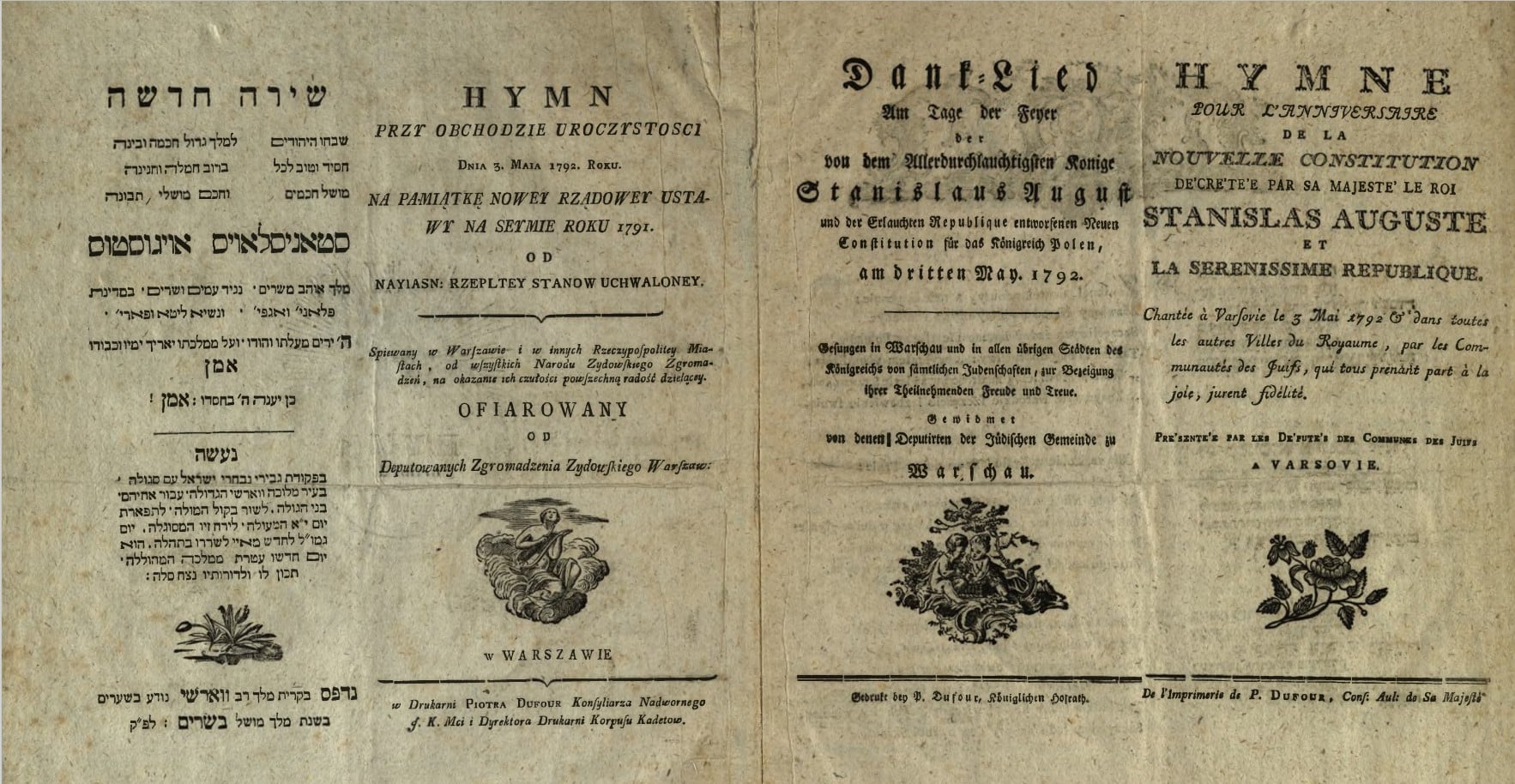
Jewish leaflet with a hymn for the 1st anniversary of the Constitution of 3 May. Warsaw 1792.
The Jewish question at the Great Sejm
The Jewish question, discussed so abundantly in the literature of that time, came to the agenda as a result of an event that took place in Warsaw on May 15, 1790. It was a tumult, i.e. a small pogrom directed against Jewish merchants and craftsmen by Warsaw townspeople, who were eager to "settle the Jewish question as they please". As we know, Warsaw had the old privilege de non tolerandis Judaeis, and only during the sejms and two weeks before and two weeks after the session, Jews were allowed to stay and trade in the capital. Thus, when the "Great Sejm" began to drag on for years, Jews from Praga and other larger and smaller town and neighbouring areas, who were so many times expelled from the capital, settled there "permanently", occupying the Pociejów Palace (then located at today's Teatralny Square), Bielańskie, Kłopockie, Tłomackie up to Leszno. The inhabitants of Warsaw, led by the brave president Jan Dekert, sent numerous petitions to various authorities on this matter, appointed a separate body to oversee them, and allocated 50,000 zlotys to be paid to the state treasury in the event that the Jews were actually removed from the city. In March 1790, the Crown Marshal partially fulfilled Dekert's request and ordered the Jewish factors and craftsmen to be removed from the city, but when they, trusting in the protection of "their" masters, returned to their homes, tailors and furriers attacked them and arranged for them a real pogrom on May 15, 1790. Jewish stalls and workshops were smashed, goods were destroyed or stolen, and the Jews were driven out of the city.
This behaviour of the townspeople outraged the Sejm nobility; cities organizing the so-called "black procession" to the castle and other such events caused anxiety among the deputies, and the news from Paris about the strengthening of the "third estate" added fuel to the fire. So, the day after the tumult, Butrymowicz raised the matter at the plenum of the Sejm and demanded a strict inquisition, punishment of the guilty and compensation for Jewish damages. Butrymowicz was supported by Jacek Jezierski, Zakrzewski, Wawrzecki and others, and then a commission (deputation) was appointed to deal with the Jewish question.
From then on, this "question" moves along two parallel tracks. One track is followed by the townspeople trying to obtain political equality in the state, and at the same time the exclusive right of trade and industry in their cities (to the detriment of the Jews); along the second track moves, albeit too slowly, the aforementioned Deputation working on the reform, i.e. the right of Jews.
The townspeople defeated the Jewish Deputation. The "Law on Cities" of April 18, 1791, incorporated into the Constitution of 3 May, gives the townspeople very extensive rights, their delegates appear in the Sejm already in 1791, and thus sit in the Jewish Deputation, paralyzing the aspirations of its liberal members: Butrymowicz, Kołłątaj, Liniecki and others. According to the Constitution, the merged cities absorb suburbs and neighbouring towns, which also very harmfully affects the situation of the Jews. This is clearly revealed in Krakow, where the newly elected magistracy of Great Krakow extends its power not over the city, but to the "quarter", Kazimierz and immediately removes Jewish merchants from Christian Kazimierz to Jewish Kazimierz, that is, to the ancient, narrow and dirty "Jewish town". The crying Jewish elders rush to Kołłątaj, who turns to the Krakow magistracy with a call to leave the Jews in their positions "since the homeland has yet spoken its word about the Jews". Further correspondence between the Krakow magistracy and its plenipotentiary in Warsaw, Jagielski, and between Kołłątaj and Krakow dignitaries teaches us how difficult was the situation of the Kazimierz Jews.
The Warsaw magistracy also decided to speak out on the Jewish question and handed the king its own screed entitled Zasady dla projektu urządzenia Żydów [Rules for the project of setting up Jews], which the city chancellery sent to all large cities in Poland. On November 28, 1791, the Krakow magistracy received these "Rules" together with Jagielski's letter, but although they were extra black, they seemed too liberal to the townspeople of Krakow, as they allowed wealthy Jews to participate in a heavily limited trade. The inhabitants of Kraków did not want to tolerate the Jews neither in Kraków nor in Kazimierz and, referring to their treaty of 1485 and the judicial judgment of 1776, were of the opinion that Jews, both in Kraków and in other cities of the Republic of Poland, should be satisfied with their own quarter, that is, the Jewish Street.
The response of the Krakow burghers to the call of the Warsaw magistracy was of theoretical importance so far. Despite the opposition from Krakow, and maybe from other cities, the Warsaw magistracy brought its project to the Jewish Deputation, but the commission did not function at all and only at great intervals gave a vague sign of life.
It came to life as late as 1792, and it is difficult to say at whose initiative. Was it brought to life by delegates of Lithuanian kehilas, who held several meetings on the issue of reform, or King Stanislaus II Augustus, who was choking in debt, or his secretary, Father Piattoli, who wanted to help the Jews and cut the king free from creditors. Suffice to say that in the autumn of 1791 we see in Warsaw numerous delegates of Jewish communities, not only from Lithuania, but also from the Crown, headed by the syndic of the Jews of Warsaw (Praga), Pesach Chaimowicz. The king's court bankers are probably active here: Hayman and Simon, the royal factor Abraham Hirszowicz, a delegate of the Kraków kehila Hirsz Stobnicki, and perhaps Szmul Zbytkower, the court and army supplier, although detailed research into his life did not reveal his participation in this work.
After many objections, the Jewish Deputation was reorganized, and it began to reflect on various projects. At a ceremonial encounter the king met Jewish delegates and received from them a gift of 15,000 thalers, after which the delegates were to undertake to pay off all the king's debts, when, like a bolt from the blue sky, an edict of the Grand Marshal of the Crown was announced, expelling all Jews from Warsaw. The delegates also had to leave Warsaw and, for the time being, moved to Praga, from where Pesach Chaimowicz ruefully complained to the king, explaining that he had lived in the capital for 30 years.
Thanks to the intervention of Piattoli, the king summoned Marshal Mniszek and the city president Łukasiewicz and asked them to soften the ordered "exile". Mniszek quickly agreed, Łukasiewicz was very reluctant, but finally he gave in. The Jews returned to Warsaw, and their delegates, headed by banker Simon, on March 13, 1792, gave to the king, as a thank you, a voluntary gift of 40,000 zlotys in good assignations to the bearer, as an advance for larger sums to be provided to the king "in the era of their equality". It seems that this equality was taken very seriously at that time, since even Jagielski, in a letter to the Krakow magistracy, talking about the Jews’ generous contribution to the (king's) state treasury, demanded the magistracy to send him Krakow privileges as soon as possible, while at the same time explaining that "they (Jews) cannot be exiled from the country, nor can they be left without any food”. In another letter, he reports that Jews are to be tolerated in cities, i.e. have equal rights in trade, against which the mayor of Krakow severely remonstrates, warning that "Jews in cities cannot be granted citizenship, or it will cause the ruin of Christian citizens."
Awakening of patriotism
This is how the negotiations between the king and the Jews dragged on, and at the same time the frictions in the Deputation itself, i.e. the Jewish commission, multiplied. Meanwhile, Piattoli prepared his own "project to reform the Jews", based mostly on Chołoniewski's project, and tried as much as he could to push it through the committee, so to be moved to the plenum as soon as possible. However, the wise Italian failed, because the city deputies, by their plots, ensured that the Sejm passed only "a general examination of the debts of Jewish communities" and thus pushed the matter ad calendas graecas. The Jews, however - like Piattoli and the king - expected the reform to be carried out soon, and on May 3, 1792, together with the whole nation rejoiced on the first anniversary of the Constitution. The Praga (Warsaw) community printed in four languages: Polish, German, French and Hebrew: Hymn przy obchodzie uroczystości dnia 3 maja 1792 r. na pamiątkę nowej rządowej ustawy na sejmie od roku 1791 Najjaśniejszej Rzeczypospolitej stanów uchwalony (!). Śpiewany w Warszawie i w innych Rzeczypospolitej miastach od wszystkich narodu żydowskiego zgromadzenia na okazanie ich czułości, powszechną radość dzielącej. Ofiarowany od deputowanych zgromadzenia żydowskiego, warszawskiego. W Warszawie w drukarni Piotra Dufour konsyliarza nadwornego JKMości i dyrektora drukarni korpusu kadetów. [The Hymn at the celebration of the ceremony on May 3, 1792, in memory of the new government act in the Sejm from 1791 by the Brightest Estates of the Commonwealth passed (!). Sung in Warsaw and in other cities of the Polish-Lithuanian Commonwealth from all the Jewish people congregations to show their responsiveness, universal joy that they share. Donated from deputies of the Warsaw Jewish assembly. In Warsaw, at the printing house of Piotr Dufour, the court counsellor of His Majesty and the director of the printing house of the cadet corps].
This hymn in a decorative binding was presented by a separate deputation to Stanislaus II Augustus, and in addition, ceremonial services were held in all Warsaw synagogues.
Similar services were held in Krakow and other Polish cities. In Krzemieniec, the front of the synagogue was decorated with a carpet and tapestries emblazoned with a royal portrait under a silver, gilded crown, worth 1,200 zlotys. The portrait was illuminated with several hundred lamps, among which there was an inscription in Polish and in Hebrew, embroidered on satin: "Best wishes from the kehila and the entire people of Krzemieniec to His Majesty the king, Stanislaus II Augustus", and a prayer. “When a lot of people and Jews gathered around the illumination, music began to play and Jews started to sing. Then the kehila elders, assisted by the Jewish crowds, went with torches to the chairman of the commission, shouting on the way: Vivat the King! The kehila elders congratulated the chairman of the commission, and then invited him, along with the nobility and townspeople, to a ceremony organized by the kehila, where they all, amid songs and happy shouts, revelled until the morning”.
Less magnificent was the celebration in Chełm, where the crowds returning from the cathedral were blocked by the well-known rabbi Herszel Józefowicz with the kehila elders and Sefer Torah, and he delivered an occasional speech. A ceremony was also held in Grodno, during which the rabbi gave an occasional speech, and we have similar reports from many other Polish cities.
At the same time, generous donations began to be made for the auction of the army, as a war with Russia was widely expected. As early as in 1789, an unknown to us Jew from Kazimierz (Krakow), laid two cannons for the emerging national artillery, now wealthy merchants from Berdyczów, Jews and Christians, represented in the Prince Josef camp near Lubar by the Swiss Jenni, German Gerner, Chaim Chmielnicki and Boruch donated for Cossack military music 25 horses, as many uniforms and leather accessories, 12 trumpets, two oboes, two clarinets, four horns, two clash cymbals, etc. “It is impossible to express - tells us Jan Duklan Ochocki who is usually not very kind to Jews - how Prince Józef was happy about it. It was before the hour of the reports, the commander kept them (the merchants) in the tents until the generals came with their reports, and when they left, after they read their declarations, he presented the merchants to the people gathered around. Everyone thanked them; Christians were kept on for breakfast, Israelites were "offered liquors and wine ...".
In the journals of those days we can read about such and similar gifts very often. And so, the Jews together with other citizens gave in Siennica various gifts, the same in Tykocin, in Końska Wola, in Włostowice; the kehila in Leszno gave 300 zlotys, in Sochaczew 300 zlotys in cash, pledging to add another 150 zlotys, Vilnius tailors undertook to sew 200 uniforms for the army free of charge.
The patriotic fervour was immediately subdued by Targowica; Muscovite troops soon entered the country and advanced concentrically towards Warsaw. Not much time had passed and the Muscovite army under the command of Kachowski marched to Warsaw and started appointing Targowica plotters to various offices. Supporters of the collapsed Constitution hide or leave the country, and Catherine, together with Frederick William imposed the second partition of Poland. When the head of Louis XVI falls on the altar of freedom in Paris, the freedom of the Polish-Lithuanian Commonwealth also falls as a result of the discord of its own sons and the most outrageous self-interests.
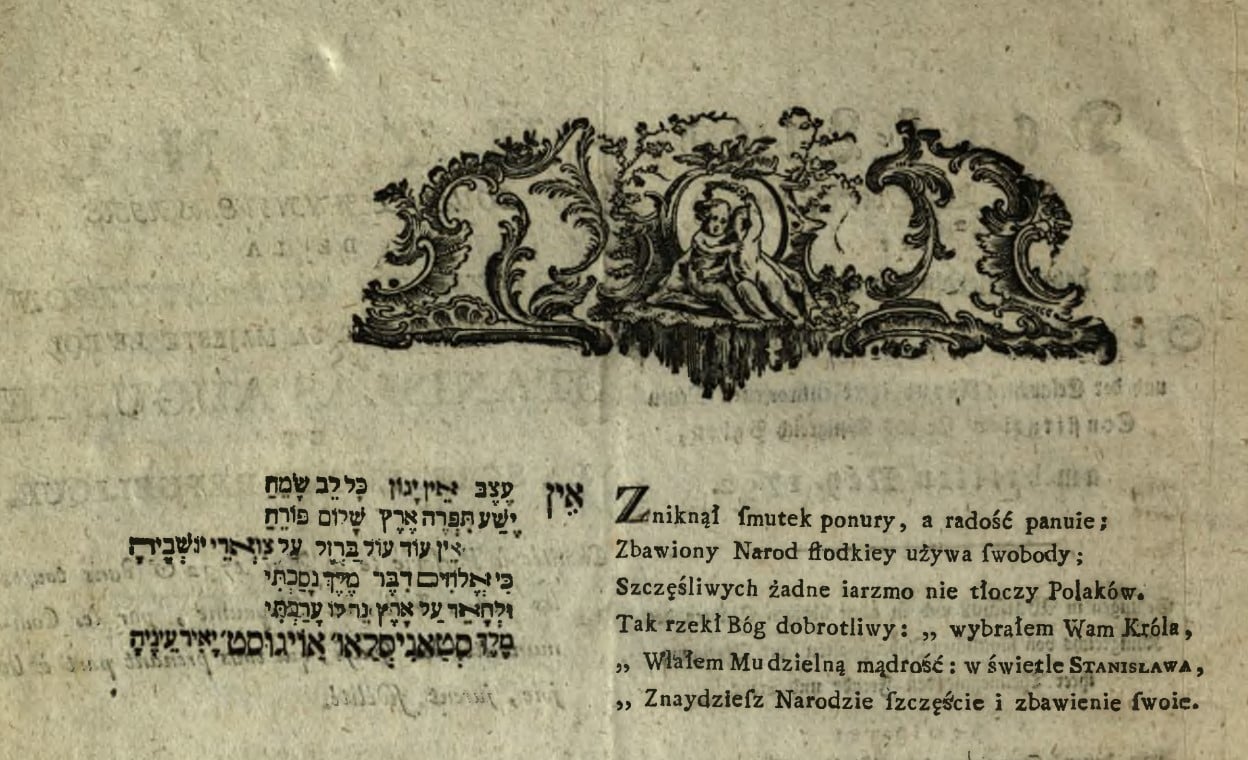
The beginning of the text of hymn for the 1st anniversary of the Constitution of 3 May 1791. Warsaw 1792
During the Insurrection
The Kościuszko Uprising was a response to the second partition and a kind of rehabilitation of patriots after the sad memory of the Grodno Sejm. This is not the place for a detailed description of the uprising, or even for a more extensive summary on the participation of Jews in the Insurrection, but it must be said that for the first time a large number of them took an active part with arms in their hands and responded to the appeal as befits real citizens. Was it influenced by the works - although unfinished - of the Great Sejm, or by the Enlightenment, which was blowing from the west, and already managed to create a layer of the Jewish intelligentsia who understood their duties towards the state? Suffice to notice that all sources and all chroniclers, such as: Karpiński, Wojda, Krzyszkowski, etc., all contemporary diaries and almost all historians of our day, such as Tokarz, Kukiel, etc., conclusively confirm this active participation of Jews in the uprising, contradicting the rumours of indifference or even Jewish betrayal spreading in our earlier historical literature.
Tadeusz Kościuszko's attitude towards Jews was positive from the beginning to the end. The Commander-in-Chief, a liberal by conviction in every way, in his private life in Lithuania often met Jews, and during his stay in America he encountered Jewish officers in Washington's army. Among 37 Jews fighting in that army, the lists of officers include: Washington’s aide-de-camp colonel Isaac Franks, colonel David S. Franks, colonel Solomon Bush as another Washington’s aide-de-camp, colonel Isak, wounded at Cambden, captain Jakub de Lean in the headquarters of general von Kalb and others. One should not ignore the Polish Jew Chaim Salomon (born in Leszno in 1740), who devoted his entire fortune amounting to 658,000 dollars for the idea of freedom and, captured by the British, escaped from captivity and reappeared in Philadelphia at Washington's side.
Already in Krakow, immediately after his wedding at the market square, Kościuszko came into contact with Jews and, according to the most reliable source, he went to Kazimierz and there, in the Old Synagogue, he called them to act for the good of the homeland. "He wants nothing for himself," he argued, "he cares only about the deplorable state of his homeland, and from the bottom of his heart wishes to make happy all its inhabitants, including the Jews!"
In response to this call, the Krakow kehila undertook to provide the appropriate number of Jewish recruits, and, although it was heavily indebted, allocated a considerable sum for the most pressing needs of the army, but this it could only partially meet pledge afterwards. The Prussian invasion prevented the further development of events in the city.
On those days of April (17 and 18), Kosciuszko's call echoed loudly in Warsaw, when the capital was expelling Muscovites. Jews and neophytes (Frankists) - as we can learn from the accounts of Wojda and Laneri, a confectioner, as well as from later police investigations - mixed with the crowd, armed themselves with whatever they could and took part in driving out Igelström's soldiers. And so, we read that during an alarm Josko Ickowicz went armed with his brother to Leszno and suffered an arm injury. BecaIel (Całek) Abrahamowicz, a tar maker from Złota Street, captured from a Cossack a horse, a coat and a weapon, and in Cossack clothes (disguise) he went to his friends to Szulcowizna. At first it was thought that he was an astray Cossack, then that he was a spy, so he was imprisoned and kept in jail until May. Then he was released and his honour was restored. The participation of Jews in the insurrection was so common that dailies, by no means philosemitic, stated it emphatically more than once. Kościuszko himself affirmed this participation in his well-known appeal to the Jews (see below) in the following words: Only in the present year 1794, on April 17 and 18, when Warsaw fought a bloody battle against the Muscovite invaders, the Jews living in this city rushed to the arms, fought valiantly against the enemy and proved to the world that there where mankind could gain they would not spare their life”.
After the Muscovites were driven out, a militia or guard was formed in Warsaw, in which the Jews participated, organized, as it appears from contemporary reports, into separate groups or companies. The kehilas which the Commander-in-Chief approached allocated considerable sums for patriotic purposes. The Warsaw (Praga) kehila undertook to pay 72,450 zlotys in four instalments, moreover, four private Jews undertook to provide uniforms for 40 soldiers, or 241 zlotys for each. The contribution of Krakow kehila is mentioned above, the Vilnius kehila undertook to give 25,000 zlotys, and apart from that, various contributions were made by individual Vilnius Jews, such as Beniamin Joselowicz - 10 Dutch thalers, Landy - 10 red Dutch zlotys (200 zlotys), Szmujłowicz - 100 zlotys, etc.
Lithuanian Jews supported the insurrection movement not only with money, but also by taking part in the armed struggle. In Grodno, on April 26, 1794, the Order Committee declared "that the Jewish population should provide both infantry and cavalry recruits from their denomination", and in Vilnius a Jewish doctor, Dr Salomon Polonus, court physician of Stanislaus II Augustus, author of the reform project during the Great Sejm (see above) issued a proclamation under the title: Głos Salomona, obywatela wileńskiego w dn. 17 maja roku 1794, do ludu izraelskiego miany [The voice of Solomon, a Vilnius citizen, on May 17, 1794, addressed to the people of Israel]. it was probably a speech delivered in the Vilnius synagogue on Saturday, May 17, and it did not miss its target.
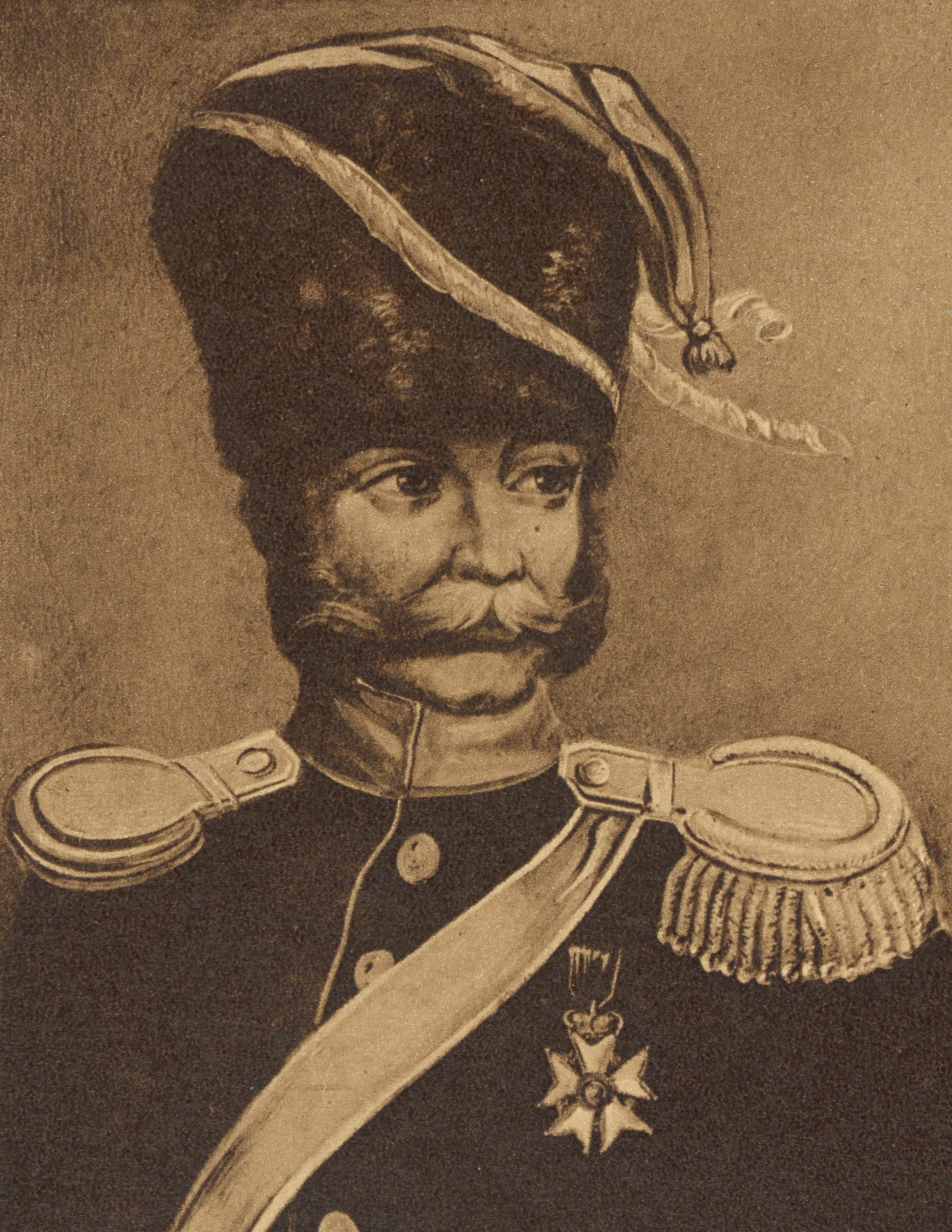
Berek Joselewicz. Portrait from the collection of the National Library.
Among the insurgents, we can see several Lithuanian Jews, such as Józef Kapłan from Lucyna in Witebsk, who served in the Polish army in 1792, and now returned to his place, so as to, after the fall of the Uprising, together with Berek (though less known) go through the whole legionary ordeal and all Napoleonic campaigns, and be taken captive by the Russians in 1813. Meanwhile, the Capital was preparing to defend itself. Soon, Muscovite and Prussian armies encircled the city, so in order to repel the enemy, ramparts were dug all over the city periphery. “2,000 Jews take part in this work. Every day they go to work in an orderly way, with shovels in their hands and with music. Jews are also in the city militia, guarding the gates, ramparts and cannons, and are attentively patrolling even on Sabbaths. However, the medieval harassment hurts the Jewish soldier; he, who fights for his homeland, has to - according to an old custom - pay for the right to stay in Warsaw, the so-called tickets (tax for five days of stay), no wonder then that a group of smarter young men is bringing a memorial to the Supreme National Council for the abolition of this tax, because "it is not fitting, nor should it be ... that a class of inhabitants, equally useful as others, and as others willing to defend the homeland, was to be removed from the government's considerations”. The petition was not considered! It is difficult to explain whether it was because of medieval tradition or whether it was a void in the treasury. It must have hurt the Jews, but it did not diminish their enthusiasm, and when the siege was ended and the Polish army was getting ready for action in the field, the idea was born to take advantage of this enthusiasm and create a separate armed cavalry regiment composed of Jewish youth. This thought was thrown by two members of the militia: Berek Joselewicz and Józef Aronowicz. The first of them became later famous in the history of Poland.
The Commander-in-Chief applauded this idea. In the "Government Gazette" (No. 78, p. 312, September 17, 1794) he announced a proclamation to the Jews, and in it he expressed his adoration for Jewish heroism in the biblical and Maccabean periods, and praised the Jews' conduct on 17 and 18 April. At the end, the Commander-in-Chief speaks about the Berek and Józef’s request and "gives them permission to recruit the said corps, to provide it with all the war weapons and necessities, so that they could come to get solder’s pay as soon as possible and fight the enemy to the utmost of their strength (!)".
On October 1, as a nominated colonel, Berek issued a proclamation to his fellow believers, and on October 3, he received from the state treasury the first and, according to the bills, the only advance payment of 3,000 zlotys in total, in highly depreciated papers, for the most pressing needs of the forming regiment. During the period of formation, this regiment had to support itself from the kehilas’ donations, and perhaps also from donations of individual richer Jews, and this was spent on uniforms, weapons, etc.
The regiment was quickly on its feet and at the worst time, after the defeat at Maciejowice, even though it was neither properly uniformed nor had a complete staff of officers, but only nominees by grace or whim of Berk, it served in the trenches as well as in the city. "The inhabitants of Warsaw - writes Karpiński – found it difficult to go the trenches in Praga, and even at their own places neglected the old military order. The Wawrzecki’s government was weak, it could not manage it, only the Jewish regiment never left the trenches and diligently did its duty. But not only the townspeople degraded so much, the national cavalry was a scandal for others because of its neglect of the fate of the homeland ... Many of them were in the theatres and at pool tables“.
The catastrophe was fast approaching; Muscovite troops marched from Praga towards the city, and in the city itself there were many supporters of Targowica and a lot of spies. After all, from the beginning of the Uprising the highest dignitaries of the state were in the Moscow camp, such as: Crown Marshal Kazimierz Raczyński, Crown Court Treasurer Teofil Załuski, Marshal of the Grodno Sejm Stanisław Bieliński and numerous deputies to that Sejm, former Crown Chancellor Jacek Małachowski and many, many others, among them the richest Jew of Praga and a supplier of Polish and Russian troops, Szmul Jakubowicz Zarówkaer. His fortune worth millions was confiscated for the benefit of the Uprising, and he was summoned with others (October 9, 1794) by the military criminal court for its session on November 1, "to answer about people and property."
No wonder that the nervous population of Warsaw and Praga searched for and sniffed spies everywhere, and the most innocent Jews were under suspicion. The guilt of those arrested was checked in each individual case by a military criminal court and, except for one (banker Hayman), it released all those arrested.
The verdicts of this court were announced in the "Government Gazette", from which we get this information, and from there, for example, we give the verdict of September 29, which is here more important than others, because it also mentions Berk's regiment. And here it goes "Abraham Fiszel, caught during the Warsaw Revolution and abducted by Muscovites, escaping from those, caught when not only not suspected, but also in the glorious desire to enlist in the regiment of light armed Jews, turned out to be, by a court judgment, immediately released from custody and directed to the same regiment ".
Soon after Muscovite troops attacked Praga, regular Polish troops with their commanders quickly retreated to Warsaw, burning down the bridge over the Vistula River behind them. Suvorov took a terrible revenge on the burghers’ militia that remained in Praga and on the civilian population, at his mercy and mercilessness. Contemporary accounts tell about 15,000 killed and several thousand (up to 8,000) who drowned in the Vistula. Cossacks had no pity even for the old people, women and children. They also terribly tormented the Jews, perhaps out of revenge for their participation in the defence of Praga. Berek's regiment survived at its post, though it suffered heavy losses. The commander himself, wounded, managed to escape from the battlefield, and after long tribulations reached Galicia. The massacre of Praga that started on the night of November 4-5, 1794, lasted the entire day of November 5. The corpses of Christians and Jews littered the streets and courtyards of Praga, and a small, but very characteristic description of this massacre is given to us by the Prussian commissar of provisions, Frederick Nufer in an interesting book entitled Schicksale während und nach seiner Gefangenschaft in Warschau unter den Polen und Russen (Poznań 1795).
Wandering through the smouldering ruins of burning Praga, Nufer heard from one courtyard the terrible screams of children. As he approached the gate, he saw a multitude of Jewish children, with whom the Cossacks were playing, "sticking them on picks". Shocked by this sight, Nufer bought 35 living children, paying one zloty per head.
Folk legend says that the above-mentioned supplier Szmul Jakubowicz Zarówka, who returned with the Muscovites to Praga, seeing what was happening, placed two barrels in his yard, one filled with silver and the other with gold coins, and he paid a silver rouble to everyone who brought the dead and then let the corpse be buried, and paid the ducat for each wounded man and sent him to the hospital. It was apparently at his initiative that Buxhoeveden was to influence Suvorov to stop the cannonade.
During the massacre of Praga, Warsaw was helpless, fear overwhelmed everyone; the army was neglecting its duties, and all spoke loudly of surrender; the rich packed their bags to get out of danger as quickly as possible. "The king also ordered his carts to be packed, but the people filled the castle courtyard and watched the king so that he would not leave, but, having become bored they finally left the guard to the Jews”.
Warsaw surrendered, Russian troops seized the streets and barracks, General Buxhoeveden became the master of the situation, so as to - after the third partition - hand over the capital of Poland to the Prussians.
***
The Berek’s Jewish Regiment has gone down in history; all diarists speak proudly of him, and the legend decorated Berek and his regiment with varicoloured and fragrant flowers. Thirty-six years later (1830) a deputy of the French legislative house, Salverte, in opposing the antisemitic attacks of M. de Montigny, referred to the glorious deeds of Berek and his soldiers. “After the fall of Kościuszko - he argued - Polish patriots made their last efforts in Warsaw. The suburb of Praga, protected by Jewish regiment, was stormed, everything perished cut by the sword. The next day the entire regiment was found on the fortifications in an eternal sleep, not a single soldier escaped before the death call. These people deserved to be called French!".
So much for a French politician; the lists of the deceased from the Burial Society in Praga provide many names of Jews - victims of the massacre, and to this day these names are counted during mourning services on Jewish holidays. “Those murdered in Praga in 1794” also entered liturgical literature; they are mentioned in a folk prayer (in Yiddish), the so-called Techina, published in Nowy Dwór near Warsaw in 1813 entitled Neue lange Rosh Cljodesz-Bentschen Tchine, in which pious women ask for the memory of Jewish martyrs in Poland from various places and ages.