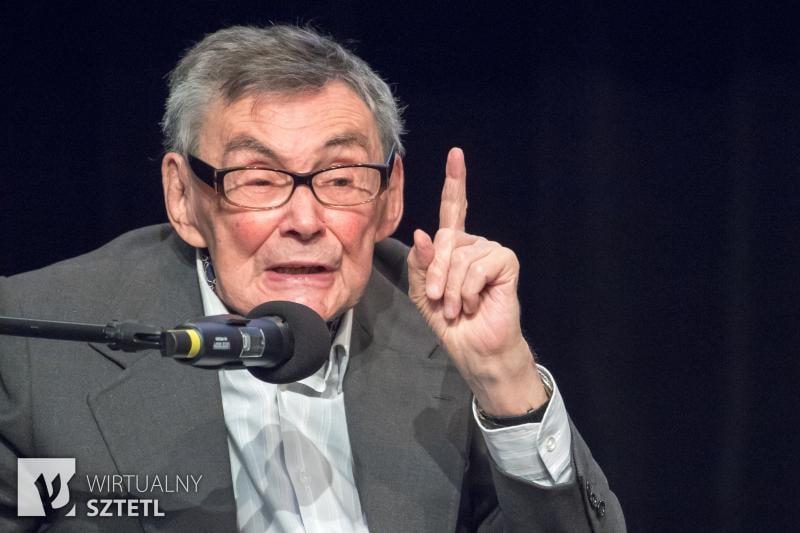
This year marks the 100th anniversary of the birth of Marian Turski. On this occasion, we have gathered articles and materials from Virtual Shtetl about his life and work in one place.
Marian Turski was born on 26 June 1926 as Mosze Turbowicz, most likely in what is now Belarus. He grew up in Łódź in a family strongly connected to Jewish culture. He remembered his father as an educated man, especially knowledgeable about Jewish matters, who tried to pass this knowledge on to his son. His mother spoke several languages fluently: Russian, French, Polish, and Yiddish. This family background became one of the key reference points for his entire life.
Marian Turski: family tree | Virtual Shtetl
As a teenager, Marian Turski watched as reality fell apart step by step: “And so month by month everything dissolved. And the greatest blow was the almost bloodless capture of Paris, because at that time it meant there was no hope,” he said in an interview conducted as part of the oral history project at the POLIN Museum. In 1940, he and his family were sent to the Łódź ghetto. There he continued his education in clandestine classes, was active in the underground organization The Union Left (Pol. Lewica Związkowa), and tried to live under conditions that systematically stripped people of dignity and security.
Marian Turski: biography | Virtual Shtetl
The decisive moment came in 1944. Turski was included in one of the last transports to Auschwitz-Birkenau. As he himself recalled, the journey to the camp and the first months were an extreme experience, not only of physical suffering but also of the collapse of the world of values. His closest relatives – his father and brother, were murdered in Auschwitz. He survived thanks to chance, determination, and, as he stressed, the solidarity of fellow prisoners.
Ghetto Litzmannstadt | Virtual Shtetl
In January 1945, he survived the death marches, first from Auschwitz to Buchenwald and then to Theresienstadt. He survived the war in a state of extreme exhaustion, close to death. This boundary experience became one of the most important reference points for all his later reflections.
German Nazi concentration and extermination camp Auschwitz II Birkenau | Virtual Shtetl
After the war, Turski returned to Poland and gradually built a new life. He joined the Polish Workers’ Party and adopted a new surname. He became involved in journalism and history, working for decades at the weekly Polityka, where he headed the history section. At the same time, he was engaged in social and institutional activities – he was associated, among others, with the Jewish Historical Institute Association, and was one of the founders and later the first chairman of the Council of the POLIN Museum of the History of Polish Jews. His activity, however, was not limited to professional work: he became one of the most important witnesses of the Holocaust in the public sphere.
Over time, this role of witness came to define his place in the world. Turski repeatedly emphasized that his experience is not merely a private memory, but an obligation. From this perspective, his words should be read: “If I had to choose one or two among all the lessons and all the words, I would choose: empathy, compassion. That is what matters most in life.” These are not abstract reflections, but are rooted in the experience of the ghetto, the camps, and the loss of loved ones.
Marian Turski: This is what matters in life | Virtual Shtetl
Therefore, the biography of Marian Turski does not end with a story of survival. It is a story of consistently transforming memory into action: into education, public activity, and speeches that have become a moral appeal to contemporary audiences. His life – from childhood in prewar Poland, through the Holocaust, to postwar activity, forms a story of responsibility.
Marian Turski: oral history | Virtual Shtetl
The materials gathered in Virtual Shtetl make it possible to follow this story in detail: from biographical facts, through testimonies, to texts interpreting his experience. Together, they create a portrait of a person who lived through history and made it a point of reference for others.